CART
NIST AI RMF vs EU AI Act is not a choice between two versions of the same thing. One is a voluntary US framework for managing AI risk, with no enforcement and no certificate; the other is binding EU law with product-style conformity assessment and fines of up to €35 million or 7% of worldwide turnover. Organizations that sell AI into both markets end up using both — the framework to organize the work, the regulation to define what the work must prove.
This guide compares them on scope, legal force, structure, obligations, timing and evidence, shows where the four NIST functions map onto the Act’s articles, and sets out which to lead with depending on where you operate.
Free gap assessment
Which AI Act obligations do you actually owe?
Score what is already in force separately from the high-risk duties that now land in 2027, free.
Run the free EU AI Act gap assessment → or View premium report sample
| NIST AI RMF | EU AI Act | |
|---|---|---|
| What it is | Voluntary risk management framework (NIST AI 100-1), 26 January 2023; being revised under the White House AI Action Plan | Regulation (EU) 2024/1689, in force 1 August 2024; amended by the Digital Omnibus on AI, Regulation (EU) 2026/1744, in force 27 July 2026 |
| Legal force | None. Adoption is a choice, though US federal procurement and sector regulators reference it | Binding on providers, deployers, importers and distributors placing or using AI systems in the EU, wherever they are established |
| Who it targets | Any organization designing, developing, deploying or using AI | Operators by role, with obligations scaled by risk tier: prohibited, high-risk, transparency-bound, general-purpose models, minimal |
| Structure | 4 functions, 19 categories, 72 subcategories; Playbook of suggested actions; profiles | 113 articles and 13 annexes; Annex I and Annex III define high-risk; Chapter III Section 2 sets high-risk requirements |
| Core concept | Trustworthy AI: 7 characteristics, balanced by context | Risk to health, safety and fundamental rights, classified by use case |
| Certification | None | Conformity assessment, EU declaration of conformity, CE marking for high-risk systems; registration in the EU database |
| Penalties | None | Up to €35 m / 7% (prohibited practices), €15 m / 3% (most obligations), €7.5 m / 1% (incorrect information); lower of the two for SMEs |
| Timing | Available now; Playbook updated periodically | Prohibitions and AI literacy since 2 Feb 2025; GPAI since 2 Aug 2025; transparency (Art 50) since 2 Aug 2026; Annex III high-risk from 2 Dec 2027; Annex I high-risk from 2 Aug 2028 |
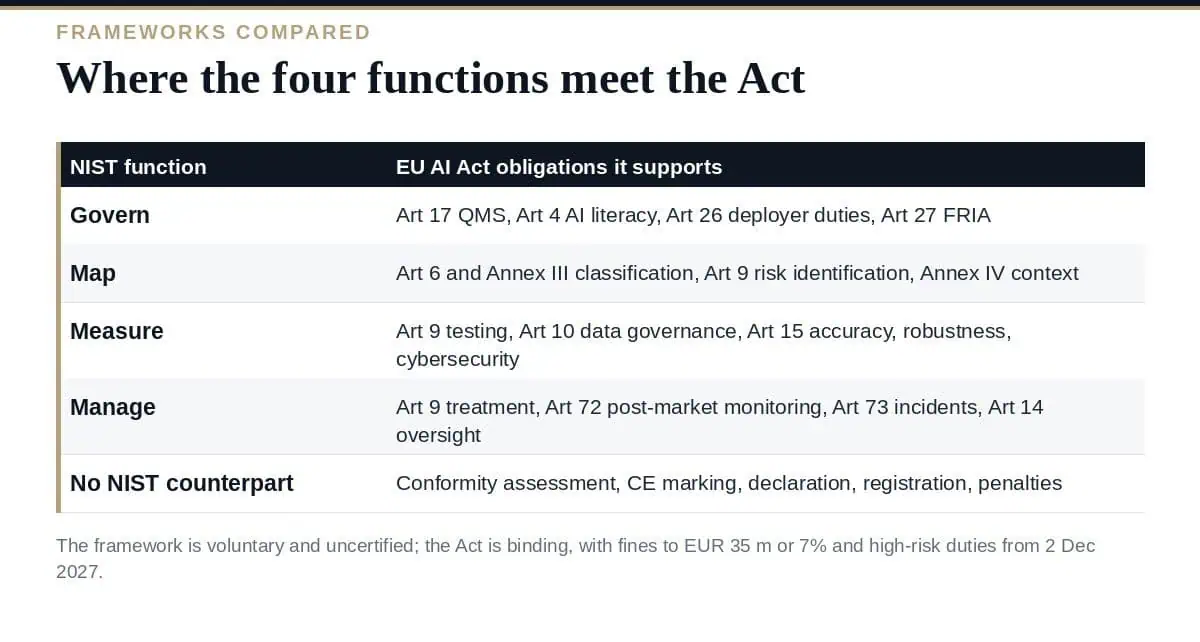
Much of the NIST AI RMF vs EU AI Act comparison comes down to the Act’s high-risk requirements (Articles 9 to 15), which and provider obligations (Articles 16 to 21) read like an outcome list while the four NIST functions cover most of the same ground from the other direction. The mapping below is the practical one — the pairs where evidence built for one serves the other.
| NIST function | EU AI Act obligation it supports | Shared evidence |
|---|---|---|
| Govern | Art 17 quality management system; Art 4 AI literacy; Art 26 deployer duties; Art 27 fundamental rights impact assessment (where required) | AI policy, roles and accountability, training records, inventory of AI systems (GOVERN 1.6), third-party procedures (GOVERN 6) |
| Map | Art 6 and Annex III classification; Art 9 risk identification of known and reasonably foreseeable risks; intended purpose and foreseeable misuse | Context and intended-purpose documentation (MAP 1), system categorization (MAP 2), risk and benefit mapping (MAP 3–5) — much of Annex IV technical documentation |
| Measure | Art 9 testing; Art 10 data governance; Art 15 accuracy, robustness and cybersecurity; Art 13 transparency to deployers | Metrics and test results (MEASURE 2), bias and performance evaluation, measurement of trustworthiness characteristics, documentation of what cannot be measured (MEASURE 1.1) |
| Manage | Art 9 risk treatment; Art 72 post-market monitoring; Art 73 serious incident reporting; Art 12 logging; Art 14 human oversight | Risk response and residual-risk decisions (MANAGE 1–2), incident response and decommissioning plans (MANAGE 4), monitoring records |
Two cautions on any NIST AI RMF vs EU AI Act mapping. First, mapping is not equivalence: the Act has requirements with no NIST counterpart — the conformity assessment procedure itself, CE marking, the EU declaration of conformity, registration, the authorised representative for non-EU providers. Second, the Act’s obligations are role-specific and tier-specific, so a Manage practice that satisfies a provider’s Article 72 does nothing for a deployer’s Article 26 duties. Our guide to who the EU AI Act applies to covers the roles — and role is the first thing to settle in any NIST AI RMF vs EU AI Act exercise.
Free AI risk assessment
Which of your AI systems could harm people, or you?
List your AI systems, models and data, pick from 38 AI risk scenarios, rate them for the people affected and for you, and plan treatment with ISO 42001 Annex A controls. You get a heat map, a process score and the findings an auditor would raise, free.
Run the free AI risk assessment → or View premium report sample
In NIST AI RMF vs EU AI Act terms, NIST frames risk as a composite of the probability of an event and its consequences, to individuals, organizations and society, and asks you to balance seven trustworthiness characteristics against context. The Act classifies by use case: an AI system is high-risk because it is used for recruitment, credit scoring or biometric identification, not because your assessment found it risky. A NIST Map exercise can conclude a system is low-risk; the Act can still list it in Annex III.
GOVERN 1.3 asks the organization to set its risk tolerance. Article 9 of the Act asks providers to reduce residual risk to an acceptable level judged against health, safety and fundamental rights, with testing against defined metrics — and a market surveillance authority is the judge.
The Playbook says organizations “can document” certain things. Annex IV of the Act says what the technical documentation shall contain. Our guide to the EU AI Act documentation requirements lists it.
The Digital Omnibus on AI moved the Annex III high-risk obligations from 2 August 2026 to 2 December 2027 and Annex I to 2 August 2028, but did not move the prohibitions, the AI-literacy duty or the general-purpose model rules already in force. NIST’s revision has no deadline for you at all.
This is where NIST AI RMF vs EU AI Act stops being a comparison of equals. Nobody fines you for a thin NIST profile. Article 99 fines for a breach of the prohibitions can reach €35 million or 7% of worldwide annual turnover, whichever is higher.
| Situation | Lead with | Why |
|---|---|---|
| US-only operations, no EU customers | NIST AI RMF | It is what US federal guidance, procurement and sector regulators reference; the Act does not reach you unless output is used in the EU |
| Selling or deploying AI in the EU, any tier | EU AI Act, organized with NIST functions | Legal obligations set the requirements; the framework gives them a structure and a vocabulary auditors and engineers share |
| Global provider of a high-risk system | Both, with ISO/IEC 42001 as the management system | The Act sets the bar, NIST supplies the practices, 42001 gives them governance and a certificate; harmonised standards under Art 40 create a presumption of conformity |
| Deployer of vendor AI in the EU | EU AI Act deployer duties (Art 26, Art 50), NIST Govern and Manage | Your obligations are narrower and mostly about oversight, monitoring and transparency; Map and Measure are largely the provider’s job |
Organizations that settle the NIST AI RMF vs EU AI Act question by choosing a management system to hold both often land on ISO/IEC 42001, which is certifiable and maps to both — see ISO 42001 vs NIST AI RMF and ISO 42001 vs the EU AI Act.
Does following the NIST AI RMF make us compliant with the EU AI Act?
No. The framework is voluntary and generic; the Act’s obligations are specific, role-based and enforceable. NIST-aligned work supplies much of the evidence, but conformity assessment, CE marking, registration and the Act’s documentation content must be met on their own terms.
Can a US company ignore the EU AI Act?
Only if no AI system it provides or deploys is placed on the EU market or has output used in the EU. The Act applies to providers and deployers outside the EU where the system’s output is used in the Union.
Is the EU AI Act stricter than the NIST AI RMF?
It is binding where the framework is voluntary, and it prescribes documentation and assessment procedures the framework only suggests. On the substance of risk management they ask for similar things; the difference is who decides what is acceptable and what happens if you get it wrong.
Which should a startup adopt first?
If it has EU customers, the Act — start by classifying each system against Article 5 and Annex III. If not, the NIST Govern function, which is cheap to implement and becomes the foundation for either regime later.
Is NIST AI RMF vs EU AI Act a real either-or?
Rarely. Most organizations with any EU exposure run the Act’s obligations inside a NIST-structured programme, often governed by ISO/IEC 42001.
Treat NIST AI RMF vs EU AI Act as a question of order, not choice. If EU law reaches you, its obligations define the target and its dates define the schedule; the framework’s functions give you the working structure and most of the evidence. If it does not, the framework is a sound way to build governance that will survive whichever regulation arrives next — and the Act is the best current preview of what that regulation will ask for.
Templates for the four functions, with a crosswalk to the EU AI Act and ISO 42001, are in the NIST AI RMF Toolkit (36 templates); the Act’s own document set is in the EU AI Act Toolkit (60 templates).

October 11, 2026
October 11, 2026
October 11, 2026
October 11, 2026
October 11, 2026

