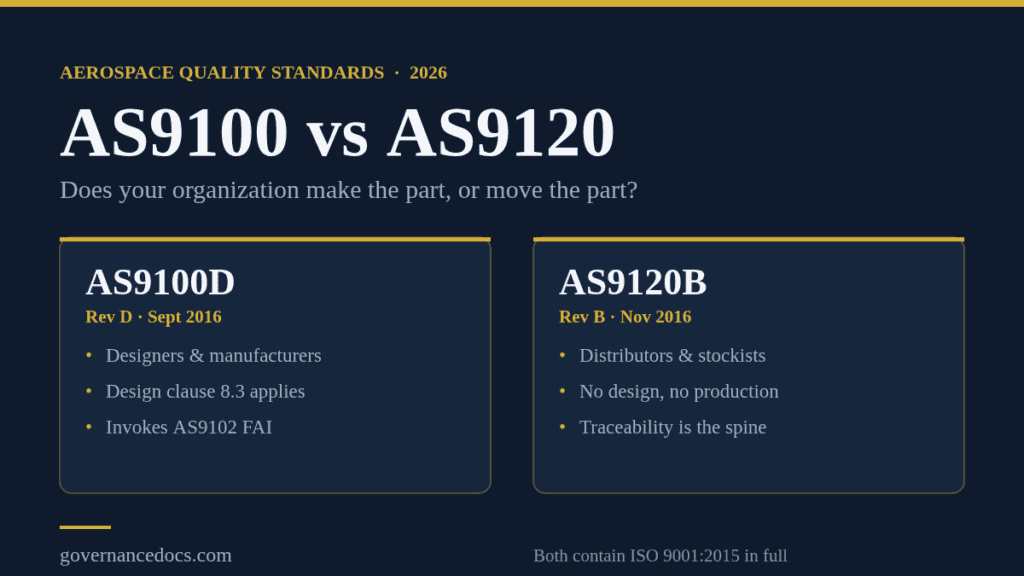
The choice between AS9100 vs AS9120 comes down to one question: does your organization make the part, or does it move the part? Get that answer right and the rest of the decision follows. Get it wrong and you pay for an audit against requirements you can never demonstrate, or you certify to a standard your prime contractor will not accept.
Both standards are published by SAE International and both contain ISO 9001:2015 in full. The difference is the sector-specific layer bolted on top of it — and that layer is built for two very different kinds of business. This AS9100 vs AS9120 guide walks the comparison clause by clause, explains the three-question test that settles almost every case, and covers what the IA-series revision does and does not change.
Free gap assessment
Are you ready for the 2026 edition of ISO 9001?
Score yourself against the new edition, free, including the risk and opportunity split and the clause 10 renumbering that breaks converted checklists.
Here is the AS9100 vs AS9120 comparison in one table. Everything below expands on it.
AS9100D
AS9120B
Full title
Quality Management Systems — Requirements for Aviation, Space, and Defense Organizations
Quality Management Systems — Requirements for Aviation, Space, and Defense Distributors
Current revision
Rev D, revised 20 September 2016
Rev B, revised 1 November 2016
Base standard
ISO 9001:2015, in full
ISO 9001:2015, in full
Who certifies to it
Designers, manufacturers, and service providers
Distributors, stockists, and brokers who resell without altering the product
Design and development (8.3)
Applies unless formally excluded
Does not apply
Production and process controls
Full set: production process verification, FOD, special requirements and critical items
Not included — a distributor that processes product has left the scope
First article inspection
Invokes AS9102
Not invoked
Dominant risk the standard targets
Escapes from a manufacturing process
Loss of traceability and unapproved parts entering the chain
Certification scheme
IAQG ICOP, certificate recorded in OASIS
IAQG ICOP, certificate recorded in OASIS
Typical audit scope
Larger — more processes in scope
Smaller at the same headcount
What AS9100 Actually Covers
AS9100 Rev D, issued by SAE’s G-14 Americas Aerospace Quality Standards Committee, is the quality management standard for organizations that design, develop, produce, or service aviation, space, and defense products. It is ISO 9001:2015 verbatim with roughly a hundred added aerospace requirements threaded through clauses 4 to 10.
The additions all answer the same question: what happens when a part fails at altitude? So AS9100D brings in product safety, configuration management, counterfeit part prevention under clause 8.1.4, human factors in root cause analysis, foreign object debris control, special requirements and critical items, control of work transfers, and on-time delivery as a measured performance indicator. It also invokes AS9102 first article inspection, which is a manufacturing control and has no distributor equivalent.
If your organization machines, assembles, coats, tests, programs, or repairs product, AS9100 is your standard. There is no version of the AS9100 vs AS9120 question that lets a manufacturer out of it.
What AS9120 Actually Covers
AS9120 Rev B, revised in November 2016, applies to organizations that buy aerospace parts, materials, and assemblies and resell them without changing what they are. The original AS9120 was issued in October 2002 under the title “Aerospace Requirements for Stockist Distributors”; Rev B dropped that language and aligned the document with ISO 9001:2015.
A distributor’s quality risk is not a bad weld. It is a good part with a broken paper trail — or a part that was never airworthy in the first place. So AS9120B concentrates on traceability back to the original component manufacturer, chain of custody through every transaction, control and availability of records, controls on splitting and repackaging batches, certificate of conformity handling, storage and shelf-life control, suspected unapproved parts, and control of external providers.
One asymmetry is worth naming before the detail: in the AS9100 vs AS9120 comparison, AS9120B is the shorter document, but its traceability requirements are audited more aggressively than a manufacturer’s. Note what AS9120 is not. It is not an airworthiness approval. A national aviation authority’s release paperwork is a separate matter, and AS9120 certification does not substitute for it.
AS9100 vs AS9120: The Five Differences That Decide It
Most of the AS9100 vs AS9120 comparison is noise. Five differences carry the decision.
1. Design and development. AS9100D includes ISO 9001 clause 8.3. An auditor will expect design inputs, reviews, verification, validation, and change control, or a documented justification for excluding the clause. AS9120B has no design clause at all, because distribution does not create a design.
2. Production controls. This is the widest gap. AS9100D carries production process verification, equipment and tooling control, FOD prevention, and critical-item controls. AS9120B carries none of it. The moment a distributor starts cutting, testing, or reworking product, it is operating outside the AS9120 scope.
3. Where traceability sits. Both standards require traceability. In AS9100 it is one control among many. In AS9120 it is the spine of the system — the reason the standard exists — and audits go deep on it.
4. What a nonconformity looks like. Under AS9100, a major finding usually means a process that can produce a bad part. Under AS9120, it usually means a shipment whose history cannot be proven.
5. Audit effort at the same headcount. Audit duration for the whole 9100 series is set by AS9104/1, driven by the effective number of personnel and the complexity of the scope. A fifteen-person distributor with one warehouse has far fewer processes in scope than a fifteen-person machine shop, so AS9120 audits are generally shorter and cheaper.
Which One Do You Need? A Three-Question Test
Run these in order and stop at the first yes.
Do you change the product in any way beyond splitting, repackaging, or kitting it? If yes — machining, assembly, surface treatment, testing, software loading — you need AS9100.
Do you maintain, repair, or overhaul in-service aircraft or components? If yes, neither of these is right: you need AS9110. Our AS9110 vs AS9120 guide covers that fork.
Do you buy finished parts and resell them as they arrived? If yes, AS9120 is your standard.
Two edge cases come up constantly. A distributor that also designs and sells its own branded product line needs AS9100 for that line — one certificate cannot stretch to cover both models. And a manufacturer with a separate distribution arm can hold both certificates, scoped to different legal entities or sites, which is the cleanest way to run it.
What AS9100 vs AS9120 Means for Certification Cost and Audit Days
Both standards certify through the same machinery: the IAQG Industry Controlled Other Party scheme, an aerospace-authenticated auditor, a Stage 1 readiness review followed by a Stage 2 certification audit, annual surveillance, and recertification in year three. Every valid certificate is recorded in the IAQG OASIS database, which is where a prime contractor will check you rather than taking your PDF at face value.
Treat the following as typical ranges rather than quotes, because audit days are calculated from your own effective headcount and scope:
Registrar fees, initial certification. A small distributor usually lands at the low end of the 9100-series range; a manufacturer of the same size runs higher because more processes are in scope.
Internal effort. This is where the real cost sits for both standards — usually several months of part-time work to build the system, write the documents, and run a full internal audit and management review before Stage 2.
Timeline. Six to twelve months from a standing start is a realistic planning assumption for either standard, and distributors are usually at the faster end.
The IA-Series Revision Changes the Names, Not the Choice
ISO 9001 published its sixth edition, ISO 9001:2026, in September 2026, which withdrew ISO 9001:2015. Because the whole 9100 series embeds ISO 9001 verbatim, the series has to follow — and the IAQG is renumbering it in the process. AS9100 becomes IA9100, AS9110 becomes IA9110, and AS9120 becomes IA9120.
As of late October 2026 the IAQG had not published the IA-series documents or announced a transition deadline, so AS9100D and AS9120B remain the certifiable editions and existing certificates remain valid. Our IA9100 guide tracks that status. For the AS9100 vs AS9120 decision itself, the revision is irrelevant: the manufacturer-versus-distributor split is structural and is not going away.
Frequently Asked Questions
Is AS9120 easier than AS9100?
It has fewer requirements, not lower standards. AS9120B drops design and production clauses, which shortens the system. But its traceability and records requirements are audited harder than a manufacturer’s, because they are the only thing standing between a customer and an unapproved part.
Can one certificate cover both AS9100 and AS9120?
No. They are separate standards with separate scopes and separate certificates. An organization that genuinely does both can hold both, usually scoped by site or entity, and some certification bodies will audit them in one visit to save days.
Does AS9120 certification make me an approved aerospace supplier?
It makes you eligible to be one. Most primes treat a 9100-series certificate as a gate, then run their own supplier approval on top — and many add Nadcap for special processes. The certificate opens the conversation; it does not end it.
What happens if a distributor starts doing light assembly?
Kitting and repackaging stay inside AS9120. Assembly that creates a new part number, or any processing that changes product characteristics, does not. Tell your certification body before you start, because discovering it at a surveillance audit is a scope nonconformity.
Which standard do defense subcontracts usually require?
Whichever matches what you do, which is why the AS9100 vs AS9120 question is answered by your own activities and not by the contract. Flowdown clauses normally say “AS9100 or AS9120 as applicable,” and a prime will reject an AS9120 certificate from a machine shop as fast as it rejects an AS9100 certificate whose scope says nothing about distribution.
Where to Start
Settle the AS9100 vs AS9120 question first, because it determines every document you will write. Then build the system: scope statement, quality manual, the clause-by-clause procedures, and the records that prove traceability. The authoritative text is worth buying — SAE publishes AS9120B through SAE Mobilus — and no toolkit replaces reading the requirements you will be audited against.
If you want the document set rather than a blank page, our Comprehensive AS 9100/9110/9120 Aerospace QMS Toolkit ships 38 editable templates covering all three standards in the series for $99, so the AS9100 vs AS9120 decision does not change what you buy. For the wider family and how the three standards fit together, start with our overview of aerospace quality management standards.