CART
A first article inspection is the aerospace industry’s answer to a simple question: before you make a thousand of these, prove that the first one meets every requirement on the drawing. AS9102 is the standard that says how to document that proof, and the current revision — AS9102C, issued June 2023 — is what your customer’s purchase order will flow down to you.
This guide covers what a first article inspection has to demonstrate, the three AS9102 forms and what belongs on each, when a FAI has to be re-accomplished, and what changed in Revision C.
Free gap assessment
Are you ready for the 2026 edition of ISO 9001?
Score yourself against the new edition, free, including the risk and opportunity split and the clause 10 renumbering that breaks converted checklists.
Run the free ISO 9001 gap assessment → or View premium report sample
The purpose is not to show that one part is good. It is to show that the production process — the tooling, the routing, the operators, the measurement equipment, the special processes and the suppliers — produces parts that meet every design characteristic. The part is the evidence; the process is the subject.
That distinction explains everything else about the discipline. It is why the FAI has to be performed on a part produced by the intended production process rather than a prototype made in the tool room, why every characteristic on the drawing has to be accounted for individually, and why a change to any input can force the whole thing to be done again.
The resulting document is the First Article Inspection Report — the FAIR — and it becomes part of the quality record for the life of the part.
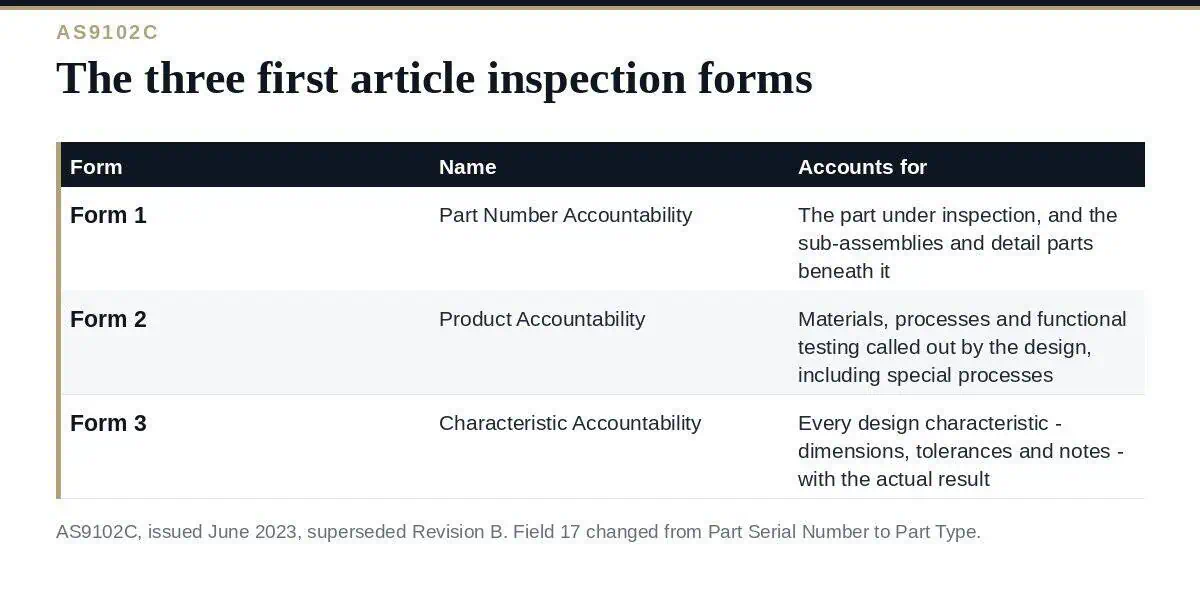
| Form | Name | Accounts for |
|---|---|---|
| Form 1 | Part Number Accountability | Identifies the part under inspection and the sub-assemblies and detail parts beneath it |
| Form 2 | Product Accountability | Materials, processes and functional testing called out by the design — including special processes and their approvals |
| Form 3 | Characteristic Accountability | Every design characteristic — dimensions, tolerances and notes — with the actual result recorded against each |
Form 3 is where the work is. Every characteristic on the drawing gets a unique number, a requirement, a result and the means of inspection. Bubble the drawing first, number the characteristics once, and keep that numbering stable — a renumbered balloon drawing between revisions is the single most common cause of a rejected FAIR.
Two habits separate a FAIR that gets accepted from one that comes back:
AS9102 requires re-accomplishment when something that could affect conformity changes. In practice the triggers your customer will flow down are:
A re-accomplished FAI can be partial. Where only some characteristics are affected, a partial FAI covers those characteristics and references the previous full FAIR for the rest. That is the mechanism that keeps the requirement proportionate, and it is where most of the cost saving in a mature FAI process comes from. Get the referencing right, though: a partial FAIR that does not point cleanly at the baseline report is an incomplete record.
Revision C, issued in June 2023, replaced Revision B. The changes are practical rather than philosophical:
If your FAI templates predate 2023, the field-17 change alone means they are producing reports against the wrong form.
Suppliers who serve both aerospace and automotive customers frequently try to reuse one process for both, and it does not quite work. The automotive equivalent — the production part approval process, PPAP — is a submission package built around approving a supplier’s part for series production, with submission levels defining how much of the package the customer actually receives. The AS9102 FAI is narrower and more prescriptive about form: three defined forms, every characteristic accounted for, and no concept of submission levels.
The underlying discipline is shared, which is why the same measurement data can often feed both. The paperwork is not, and a PPAP package sent to an aerospace customer will be returned. Our guide to the IATF 16949 core tools covers the automotive side.
What is the current AS9102 revision?
AS9102C, issued June 2023, which superseded Revision B. Check the purchase order — some customers still flow down Rev B contractually.
Who performs the first article inspection?
The organization producing the part, using its own qualified inspection personnel and calibrated equipment. It is not a customer inspection, though customers may witness or review it.
Does every part need a FAI?
Every part number your customer requires one for — typically new parts and parts affected by a qualifying change. Standard catalogue items and COTS are accounted for on the forms rather than fully inspected.
Can a FAIR be electronic?
Yes, provided it contains the required fields and is controlled. Most organizations produce them from an inspection data system rather than by hand, which also solves the balloon-numbering problem.
How does a first article inspection relate to AS9100?
AS9100 requires verification that the production process produces conforming product; AS9102 is the standardized way of documenting that verification. One is the requirement, the other is the method.
A first article inspection is a process verification wearing a document’s clothes. Bubble the drawing once and keep the numbering, account for every characteristic including the notes, record measured values rather than requirements, and be honest about what triggers a re-accomplishment — because the FAIR that matters is the one that is still true about how you make the part today. Check which AS9102 revision your customer flows down, and if your forms predate June 2023, rebuild them against Revision C.
FAI forms, inspection records and the supporting procedures are in the AS 9100/9110/9120 Aerospace QMS Toolkit, or start with the free ISO templates.

October 14, 2026

October 13, 2026

October 12, 2026

October 12, 2026

October 12, 2026

