The ISO 21502 vs PMBOK question gets sharper in 2026 than it has been for years, because PMI released the eighth edition of the PMBOK Guide in early 2026 and ISO 21502:2020 entered systematic review with a close date of 5 March 2026. If you are choosing which one your project management framework should be built on, you are choosing between a standard that describes what good project management looks like and a body of knowledge that describes how practitioners do it.
They are not interchangeable, and the difference matters most when an auditor, a client or a regulator asks you to show your method.
ISO 21502 vs PMBOK at a glance
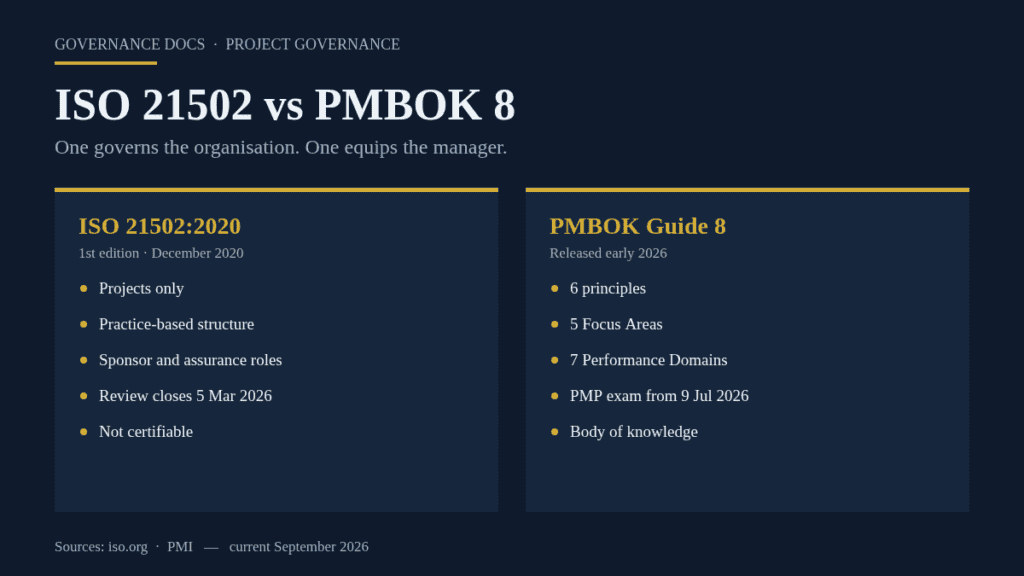
ISO 21502:2020
PMBOK Guide, 8th edition
Published by
ISO
Project Management Institute
Current version
First edition, December 2020
Eighth edition, released early 2026
Title
Project, programme and portfolio management — Guidance on project management
A Guide to the Project Management Body of Knowledge
Nature
International standard, guidance type
Professional body of knowledge
Structure
Practices grouped around governance and the project life cycle
Six principles, five Focus Areas, seven Performance Domains
Certifiable?
No — organizations cannot certify to it
No — but it underpins the PMP credential
Covers programmes and portfolios?
No — projects only
Adjacent PMI standards cover those
Best used for
Defining an organization’s project governance
Equipping individual practitioners
What ISO 21502 actually is
ISO 21502:2020 is the first edition, published in December 2020, and it replaced ISO 21500 as the project management guidance document. It is currently under systematic review, with the review closing on 5 March 2026 — so expect movement, but nothing has superseded it yet.
Its scope is narrower than people assume. It covers project management and explicitly excludes guidance on programmes and portfolios, even though those words appear in the title of the family. And like most ISO guidance documents, it is a Type B standard: it describes practices rather than stating auditable requirements, so no organization can be certified to ISO 21502. Anyone offering you certification against it is selling something that does not exist.
What it is genuinely good at is giving an organization a defensible, vendor-neutral definition of how projects should be governed — sponsorship, business case, assurance, decision gates, benefits — in language a regulator or an ISO 9001 auditor already recognises.
What the PMBOK Guide actually is
The PMBOK Guide has always been a body of knowledge rather than a standard, and the eighth edition leans into that. Released in early 2026, with the PMP exam updating to match on 9 July 2026, it reorganises around six streamlined principles, five Focus Areas and seven Performance Domains.
The headline change is a correction. The seventh edition moved sharply towards principles and away from prescriptive process, and a lot of practitioners found it too abstract to use day to day. The eighth edition keeps that flexibility across delivery approaches but brings back concrete “how-to” guidance — the Focus Areas function much like the Process Groups that older editions used.
That makes the ISO 21502 vs PMBOK comparison less lopsided than it was under the seventh edition. PMBOK 8 is again a practical manual, which is precisely where ISO 21502 does not compete.
ISO 21502 vs PMBOK: the four differences that matter
1. One defines the organization, the other equips the person. ISO 21502 answers “how does this company run projects?” PMBOK answers “how does this project manager work?” Most organizations need both answers, from different documents.
2. Recognition travels differently. An ISO reference is understood by auditors, procurement teams and regulators worldwide without explanation. A PMP is understood by hiring managers. In a tender document, the ISO reference usually carries more weight; in a CV, the PMP does.
3. Stability. ISO 21502 has been unchanged since 2020. PMBOK has moved twice in five years, and the exam moves with it. If your internal method is written against PMBOK, you inherit that revision cycle.
4. What you can show an auditor. This is the practical core of the ISO 21502 vs PMBOK choice. Neither is certifiable, but ISO 21502 is structured as practices you can evidence one by one — which is exactly what an assessor wants to walk through.
Where the two diverge in day-to-day delivery
On paper the overlap looks near total — both cover scope, schedule, cost, risk, quality, stakeholders and benefits. The divergence shows up in three places once real work starts.
Tailoring. PMBOK 8 treats tailoring as a first-class activity: you are expected to select and adapt your approach per project, and the Focus Areas are written to support that. ISO 21502 assumes tailoring happens but says comparatively little about how. If your portfolio mixes predictive, agile and hybrid delivery, PMBOK gives you more to work with.
Assurance and sponsorship. ISO 21502 is noticeably stronger here. It treats the sponsor, the governing body and independent assurance as named, accountable roles rather than stakeholders to be managed. For organizations that have to demonstrate oversight to a regulator or an audit committee, this is the single biggest reason to build on ISO 21502 rather than PMBOK.
Benefits after handover. Both mention benefits. ISO 21502 is more explicit that benefit realisation usually lands outside the project’s own life cycle, which is the part organizations most often fail to document — the project closes, the benefit owner is never named, and nobody checks whether the case held.
Put plainly: PMBOK 8 is better at helping a project manager decide what to do this week, and ISO 21502 is better at helping an organization prove it governed the work. Teams that only read one usually end up weak on whichever side they skipped, which is why the ISO 21502 vs PMBOK framing as a contest does more harm than good.
Which one your organization should build on
You need a project governance framework that survives audit. Build on ISO 21502. Its practice structure maps cleanly onto evidence.
You need to raise individual capability. Use PMBOK 8 and the PMP pathway. Note the 9 July 2026 exam change if anyone is mid-study.
You already run ISO 9001 or ISO 27001. ISO 21502 will feel familiar and will slot into your existing management system documentation without translation.
You deliver to US federal or large enterprise clients. PMBOK vocabulary is often expected in the room, whatever your internal framework says. Using ISO 21502 internally and PMBOK terms externally is a normal and workable compromise.
The mistake to avoid is picking one and treating the other as forbidden. They answer different questions, and the ISO 21502 vs PMBOK argument only becomes costly when an organization rewrites a working method for the sake of a label.
Our guide to structured project management covers how the governance layer and the delivery layer fit together, and the PMO charter guide covers the document that usually has to exist before either framework can be enforced.
What the ISO 21502 vs PMBOK decision means for your documents
Whichever you build on, the evidence is the same shape: a project management policy, a governance and decision-gate model, role descriptions including sponsor and assurance, a business case template, planning and schedule artefacts, risk and issue logs, change control, benefits tracking, and a closure and lessons-learned record.
The difference is the vocabulary and the ordering, not the existence of the documents. An organization that has these and maintains them will satisfy either framework; one that has none will fail both, regardless of which cover page it chooses.
If you want to know where you stand before committing, our free project management gap assessment scores you across governance, life cycle, planning, scope and benefits, risk and quality, and returns a prioritized list of what is missing. Where the gaps are documentation, the Project Management Toolkit supplies the charter, business case, plans, registers and closure templates already structured to ISO 21502’s practice order.
Frequently asked questions
Is ISO 21502 vs PMBOK really an either/or choice?
No. Most mature organizations use ISO 21502 to define governance and PMBOK to develop practitioners. The two operate at different levels and do not conflict.
Can my company be certified to ISO 21502?
No. It is guidance, not a requirements standard, so there is nothing for a certification body to audit against. Individuals can take training; organizations cannot be certified.
Is ISO 21502 still current?
Yes. ISO 21502:2020 is the current first edition. It is under systematic review with a close-of-review date of 5 March 2026, which may lead to confirmation, revision or withdrawal, but it remains in force until ISO says otherwise.
What changed in PMBOK 8?
It restructures around six principles, five Focus Areas and seven Performance Domains, restoring practical process guidance that the seventh edition had stripped back while keeping its flexibility across predictive, agile and hybrid delivery. The PMP exam reflects the eighth edition from 9 July 2026.
Does ISO 21502 cover programmes and portfolios?
No. Despite the family title, ISO 21502 addresses project management only and explicitly excludes programme and portfolio guidance. Other standards in the 21500 family cover those.