CART
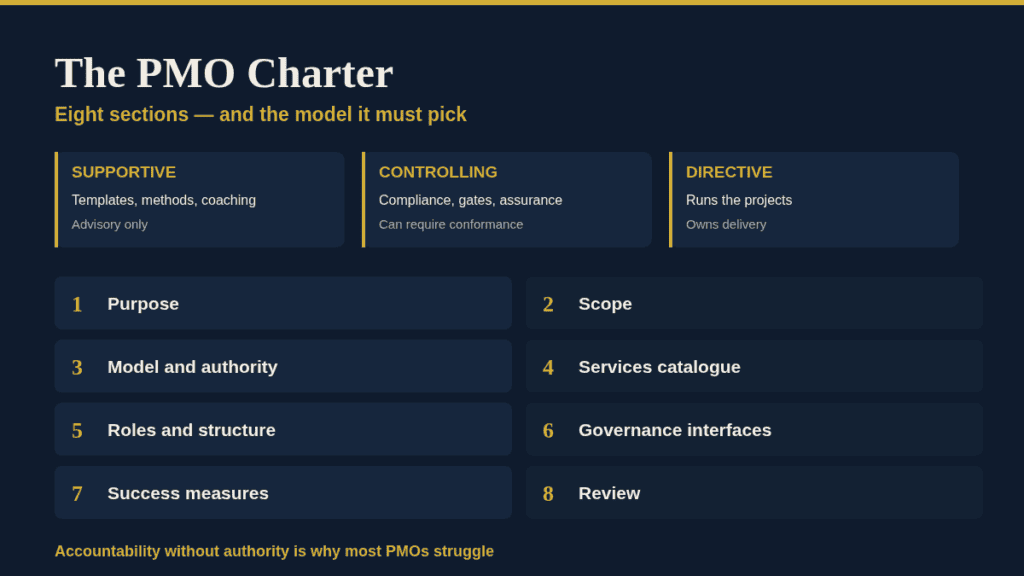
A PMO charter is the document that says what your project management office is for,
what it decides, and what it does not do. Without one, a PMO becomes whatever the loudest stakeholder
last asked for — a reporting function one quarter, a delivery team the next — and then
gets closed in a cost review because nobody could say what it was achieving.
Free gap assessment
How consistently are projects actually run?
A vendor-neutral maturity assessment against ISO 21502, free, so predictive, agile and hybrid teams are scored on the same basis.
Run the free project management maturity assessment → or View premium report sample
It is a mandate, not a job description. The charter is agreed with the executive sponsor and it
settles four things that otherwise get relitigated every month: what the PMO exists to achieve, what
authority it holds, what services it provides, and how its own performance is judged.
The authority question is the one that decides whether a PMO works. There is an enormous
difference between a PMO that reports that a project is off-track and one that can
stop it, and both are legitimate models — but only if the choice is explicit. Most
struggling PMOs are struggling because they were given the accountability of the second with the
authority of the first.
PMI’s PMBOK Guide
moved to its Eighth Edition in November 2025 and notably expanded its coverage of PMOs alongside AI
and procurement — a signal that the function is being taken more seriously as a discipline
rather than as an administrative layer.
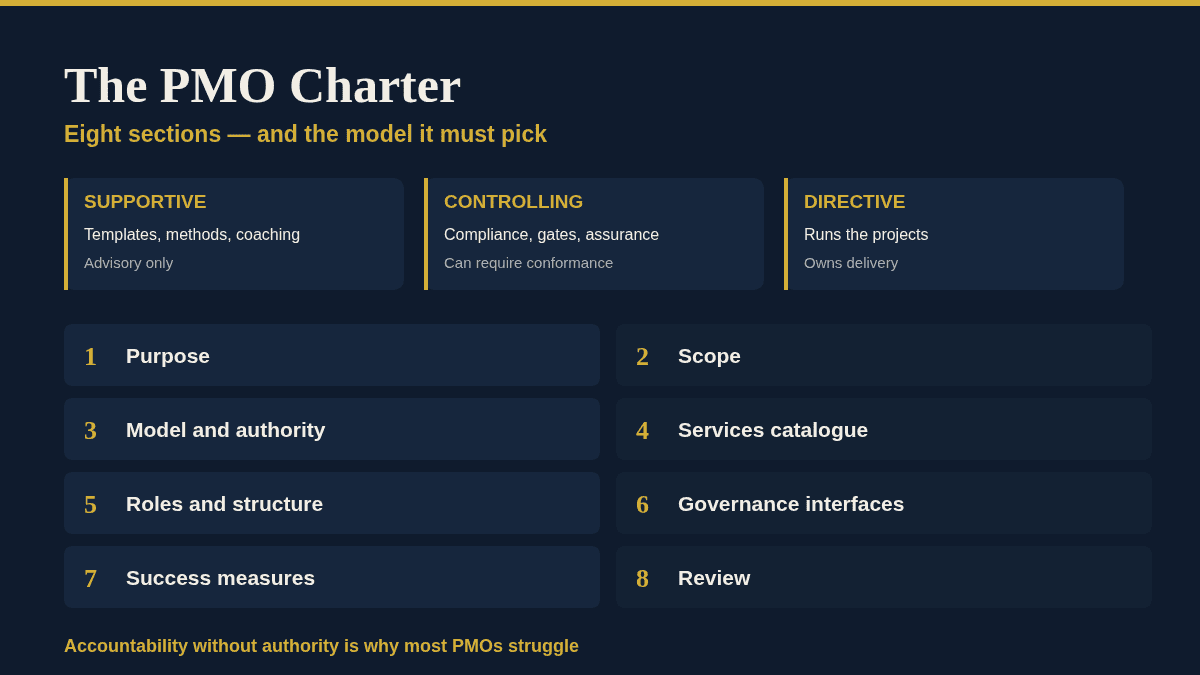
| Model | What it does | Authority |
|---|---|---|
| Supportive | Templates, methods, training, a repository, coaching | Low — advisory only |
| Controlling | Compliance with method, gate reviews, assurance | Moderate — can require conformance |
| Directive | Runs the projects; project managers report into it | High — owns delivery |
None is better. What breaks organisations is ambiguity between them, or drift from one to another
without anybody re-agreeing the mandate. Write the model into the PMO charter in a sentence, and write
what it means in practice in a paragraph.
Section seven is where most charters go soft, because measuring a PMO is genuinely hard. The trap
is measuring activity — reports issued, templates published, gates held — which rewards
producing more process regardless of whether it helps.
Better measures attach to the outcomes a PMO can actually influence: forecast accuracy against
actuals, the proportion of projects passing gate review first time, time from idea to authorisation,
the rate at which benefits in business cases are subsequently tracked, and how many projects reach
closure with a completed post-implementation
review. Each of those says something about whether delivery is improving.
Whatever you choose, put targets against them in the PMO charter. A measure without a target
cannot fail, and a function that cannot fail cannot demonstrate success either.
A PMO with no published catalogue absorbs work by default: someone needs a deck built, a
spreadsheet maintained, a meeting minuted. Six months later the team is fully occupied with
administration and the assurance work it was created for is not happening.
Write the catalogue as a list of named services with an owner and a standard, publish it, and route
requests that fall outside it back through the sponsor. That single artefact does more to protect a
PMO’s mandate than any amount of restructuring.
Thirty-three PMO and portfolio templates, charter included.
The Project Management Toolkit ships 390+ editable MS Office templates. The PMO set covers the PMO charter in Word and deck form, a service catalogue, PMO roles, implementation plan and roadmap, KPI dashboards, a comms plan and kick-off deck, plus portfolio prioritisation, project scoring, pipeline trackers and multi-project dashboards.
The charter is the first deliverable, not a document produced once the PMO is running. Draft it
with the sponsor before hiring anyone, because the model you pick determines who you need — a
supportive PMO wants method and tooling skills, a directive one wants delivery managers.
Then sequence the first ninety days against it. Publish the services catalogue, agree the reporting
cycle with the boards named in the governance section, baseline the current portfolio so you have a
starting position to improve on, and set the measures running from day one. A PMO that cannot show
movement against its own measures by the end of the first year is difficult to defend in a budget
round.
One warning worth stating plainly: do not let the PMO charter be written by the PMO alone. A
mandate an executive has not argued with is a mandate they have not agreed to, and it will not hold
the first time a project manager escalates around it.
Four failure patterns account for most of the PMOs that get quietly disbanded, and all four are
visible in the charter before they show up in the organisation.
Accountability without authority. The charter makes the PMO responsible for
delivery performance but gives it no power to stop, gate or reprioritise anything. It becomes a
reporting function that is blamed for outcomes it cannot influence. If the mandate says the PMO is
accountable for portfolio delivery, it must also say what the PMO can decide.
A scope with no boundary. “All change activity” sounds
comprehensive and means the PMO is on the hook for every piece of work anybody labels a project. A
threshold — by value, duration or risk — is what makes the scope real.
No sponsor, or a sponsor who has moved on. A PMO whose executive sponsor has left
and not been replaced has no route to escalate and no defender in a budget round. The charter should
name the sponsoring role, not the individual, and require reconfirmation when it changes hands.
Measures that reward process. Counting reports issued and gates held produces more
reports and more gates. Measure the delivery outcomes instead, accept that they are noisier, and be
honest that some of the movement will not be attributable to the PMO.
Writing a PMO charter is uncomfortable precisely because it forces decisions the organisation has
been avoiding: whether project managers report to delivery or to the PMO, whether a failing project
can be stopped and by whom, whether the method is mandatory or advisory, and what happens when a
senior stakeholder simply ignores the gate process.
None of those questions is easier six months in with a team hired and expectations set. That is
the argument for drafting the charter early and having the disagreement on paper, where it costs a
few meetings, rather than in the middle of a troubled programme, where it costs considerably more.
What is a PMO charter?
The agreed mandate for a project management office — its purpose, scope, authority, services,
structure, governance interfaces and success measures, authorised by an executive sponsor.
How is it different from a project charter?
A project charter authorises one project. A PMO charter establishes a permanent function that
supports, controls or runs many projects.
Who approves the PMO charter?
The executive sponsor, and normally the board or committee the PMO will serve. Approval by the PMO’s
own management is not enough to give it standing.
How long should it be?
Short enough that executives read it — typically a handful of pages. The services catalogue and
measures can be annexes.
How often should it be reviewed?
Annually, and whenever the operating model changes. A charter describing a supportive PMO in an
organisation that now expects it to stop projects is worse than none.
A PMO charter is a short document that does one hard thing: it makes the organisation decide what
it actually wants from the function before the function exists. Pick a model and name it. State the
decisions the PMO can make on its own. Publish a services catalogue and hold the line on it. Attach
measures with targets to outcomes rather than to activity. And get an executive to argue with the
draft, because a mandate nobody contested is a mandate nobody has agreed to.
All of these are covered by the Project Management Toolkit, or start with the free ISO templates.

October 11, 2026
October 11, 2026
October 11, 2026
October 11, 2026
October 11, 2026

