CART
An asset register is the record of what an organisation owns or is responsible for, in enough detail to make decisions about it, and under ISO 55001:2024 it is the practical form of two clauses: 7.5, documented information, and 7.6, data and information, which expects the organisation to determine the data it needs, its quality, and how it is collected and kept. The standard does not prescribe fields. It prescribes decisions — life-cycle management under 8.1, decision-making under 4.5, risk and opportunity under 6.1 — and the register has to hold whatever those decisions need. That is why most registers fail as asset management tools while succeeding as inventories: a list of tag numbers and locations answers the auditor’s “what do you have” and none of the standard’s “what should you do about it”. This guide sets out the twelve fields a register needs to support ISO 55001 decisions, the difference between a financial and a non-financial asset register and why ISO/TS 55010 wants them aligned, how to build one from a poor inventory, and the five register failures auditors find.
Three clauses set the register’s job. Clause 7.6 requires the organisation to determine its information requirements — what data, at what quality, collected how, kept where — to support the asset management system and the decisions it makes. Clause 8.1 requires operational planning and control “including life cycle management”, which means the register must know where each asset is in its life. And clause 4.5, new in the 2024 edition, requires a documented decision-making approach with criteria, which the register must feed. The 2024 foreword also names a new subclause on knowledge (7.7): the tacit understanding of an asset held by the engineer who has maintained it for twenty years is a register field waiting to be written down. ISO 55013:2024 gives guidance on managing data assets in their own right. Our guide to ISO 55001:2024 covers the clause structure.
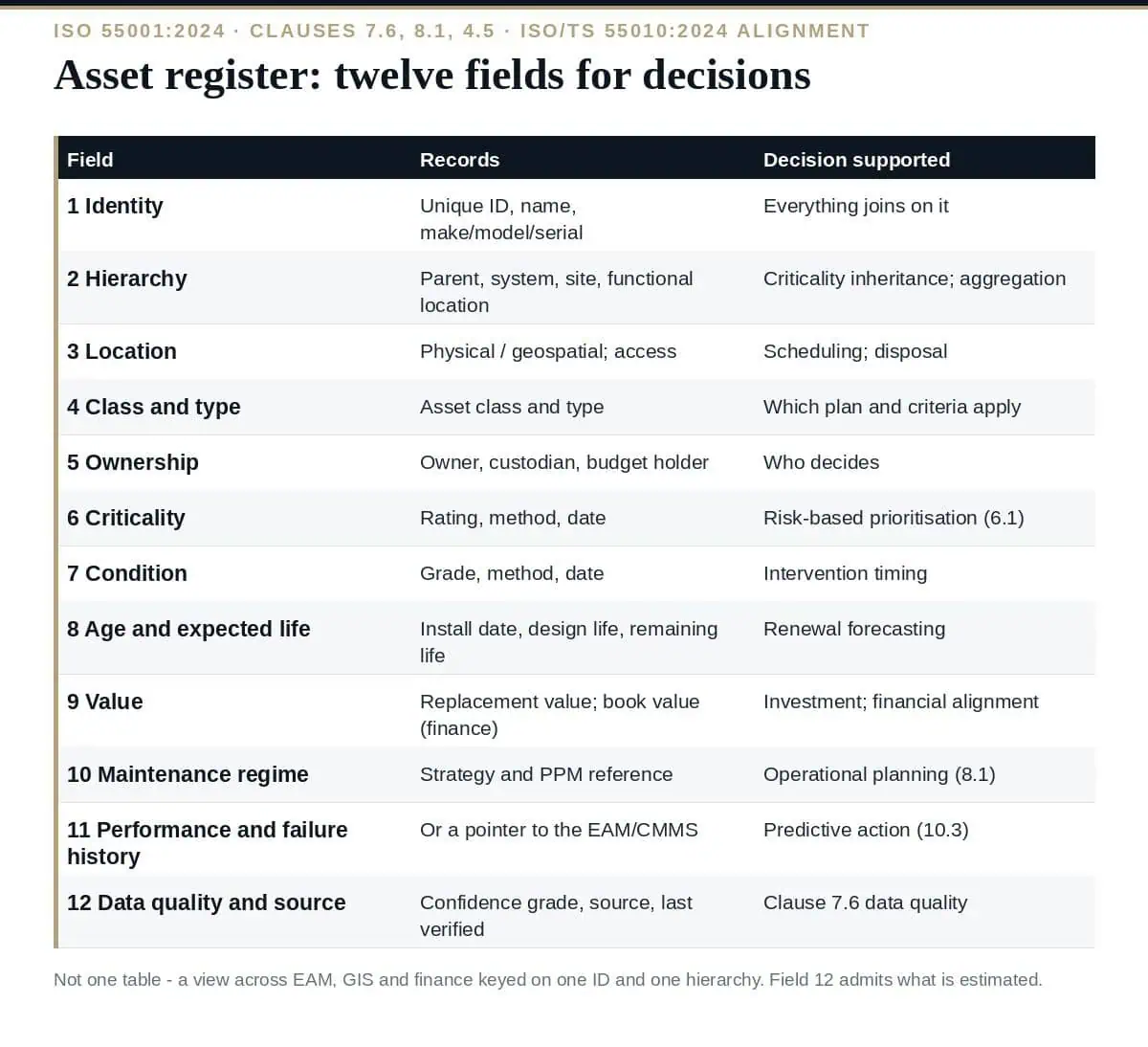
| Field | What it records | Decision it supports |
|---|---|---|
| 1. Identity | Unique asset ID, tag or UDI-style identifier; name; manufacturer, model and serial where relevant | Everything — without a stable ID nothing else can be joined |
| 2. Hierarchy | Parent asset, system and site; the functional location in the plant or network | Criticality inheritance; aggregation for plans and budgets |
| 3. Location | Physical and, where relevant, geospatial position; access constraints | Maintenance scheduling; disposal logistics |
| 4. Class and type | Asset class (e.g. rotating equipment, linear network, building, fleet, IT) and type within it | Which asset management plan governs it; which decision criteria apply |
| 5. Ownership and accountability | Legal owner, operational custodian, budget holder | Who decides; who signs the plan |
| 6. Criticality | The criticality rating and the date and method behind it | Risk-based prioritisation under 6.1; maintenance strategy selection |
| 7. Condition | Condition grade or index, the assessment date and method | Intervention timing; remaining life estimates |
| 8. Age and expected life | Install or commission date; design life; remaining useful life estimate | Renewal forecasting; whole-life cost horizon |
| 9. Value | Replacement cost and, aligned with finance, book value and depreciation basis | Investment decisions; the financial–non-financial alignment ISO/TS 55010 describes |
| 10. Maintenance regime | The applicable strategy (run-to-failure, time-based, condition-based) and the PPM schedule reference | Operational planning under 8.1 |
| 11. Performance and failure history | Availability, failures, downtime, costs, incidents — or a pointer to the system that holds them | Predictive action under 10.3; reliability decisions |
| 12. Data quality and source | Confidence grade per key field, source system, last verified date | Clause 7.6 data quality; where to spend data effort |
Twelve fields is the decision minimum, not the design maximum; a linear-asset utility adds segment attributes, a fleet adds odometer and emissions, a building portfolio adds compliance certificates. The register need not be one table — most are a view across an EAM system, a GIS and a finance ledger — but the twelve fields must be answerable for every asset in scope, and field 12 has to be honest about which answers are guesses.
Finance keeps a fixed-asset register for accounting: acquisition cost, capitalisation, depreciation, book value, disposal. Engineering keeps an asset register for operations: condition, criticality, maintenance, performance. In most organisations the two disagree on what exists, and ISO/TS 55010:2024 — the guidance on alignment of financial and non-financial functions — devotes a clause to asset-register alignment for that reason: without it, whole-life cost decisions rest on values finance does not recognise, and finance capitalises assets engineering has scrapped. The practical fix is a shared identifier (field 1) and an agreed hierarchy (field 2) that both registers key on, with field 9 carrying both the replacement value engineering needs and the book value finance reports. Our guide to whole life cost covers what the aligned register feeds.
What is an asset register under ISO 55001?
The organisation’s record of the assets in scope of its asset management system, holding the data clause 7.6 requires to support life-cycle management (8.1), decision-making (4.5) and risk-based planning (6.1). ISO 55001 prescribes no fields; it prescribes the decisions the register must support.
Which fields does it need?
A decision minimum of twelve: identity, hierarchy, location, class and type, ownership, criticality, condition, age and expected life, value (replacement and book), maintenance regime, performance and failure history, and data quality and source.
Is the fixed-asset register enough?
No. It serves accounting — cost, depreciation, book value — and typically lacks condition, criticality and maintenance data. ISO/TS 55010:2024 recommends aligning the financial and non-financial registers on a shared identifier and hierarchy.
Does it have to be one system?
No. Most registers are a view across an EAM or CMMS, a GIS and the finance ledger; what matters is that the twelve fields are answerable for every asset and the data quality is stated.
How often should it be reviewed?
Continuously for transactions — additions, disposals, condition updates — and at least annually for reconciliation with finance and for the data-quality grades.
Build the asset register as the data layer under ISO 55001’s decisions: twelve fields answerable for every asset in scope, criticality and condition dated and methoded, values aligned with finance on a shared identifier, history linked rather than copied, and a data-quality grade that admits what is estimated. An inventory tells an auditor what you own; a register tells you what to do about it.
The Asset Register, the Criticality Register, the Condition Index Register, the Asset Information and EAMS procedure and the Knowledge Management procedure are in the ISO 55001 Asset Management Toolkit, or start with the free templates.

September 20, 2026
September 19, 2026

September 19, 2026

September 19, 2026

September 19, 2026

