CART

Asset criticality is the ranking of assets by the consequence of their failure — to service, safety, the environment, cost and reputation — and it is the single input that turns an ISO 55001 system from a list of assets into a set of priorities. ISO 55001:2024 never uses the phrase, but clause 6.1’s actions to address risks and opportunities, clause 4.5’s documented decision-making and clause 8.1’s life-cycle management all presuppose that the organisation knows which assets matter most; the standard’s principle of value, from ISO 55000:2024, is meaningless without a way of saying which failures destroy the most of it.
The assessment is also the input the maintenance strategy, the condition survey programme, the data-quality effort and the whole-life cost models all consume. This guide sets out a five-step asset criticality assessment, the consequence categories and scales that make it consistent, how probability is kept separate from consequence, where the result feeds the rest of the system, and the five mistakes that make criticality rankings useless.
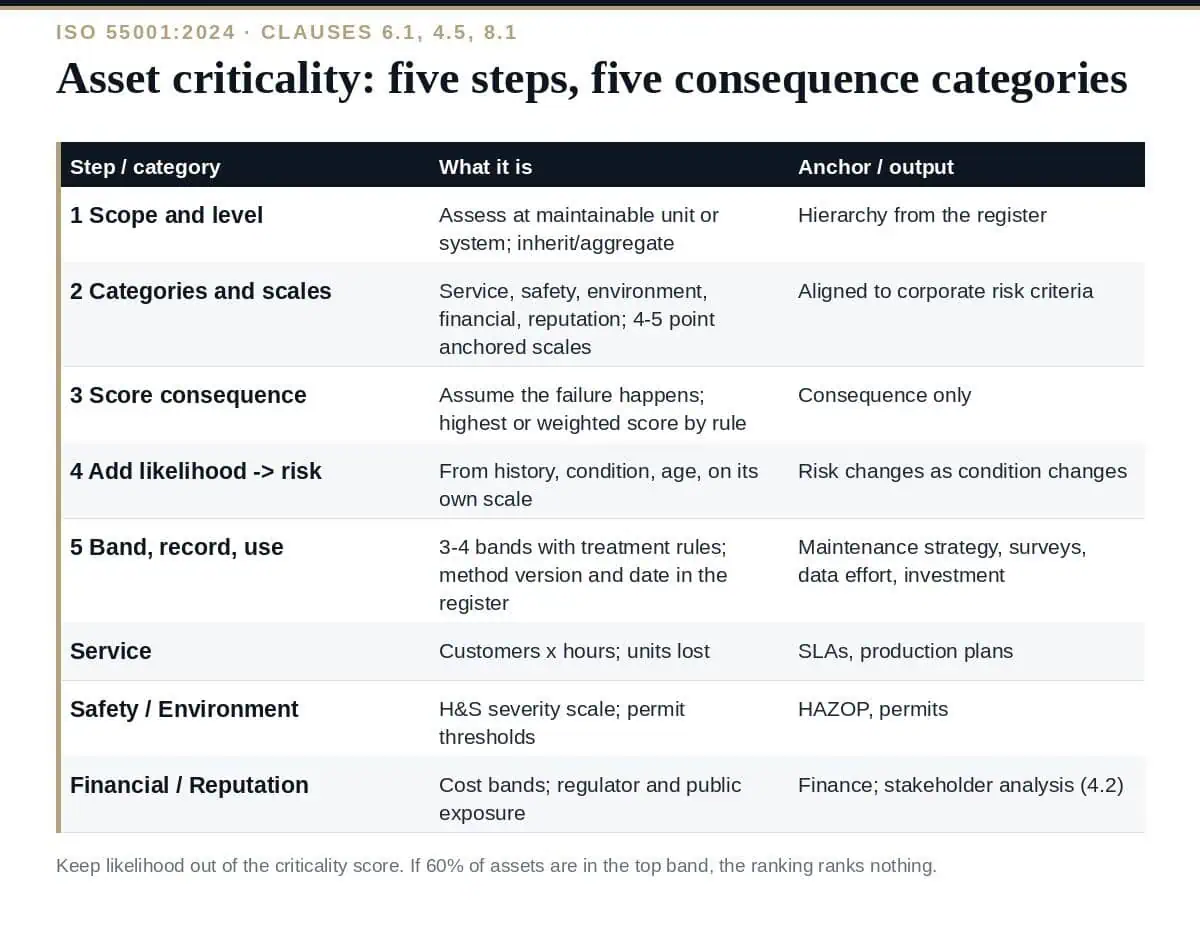
Clause 6.1 requires the organisation to determine the risks and opportunities that need to be addressed and to plan actions proportionate to them; the 2024 edition’s foreword adds a “clear distinction between how an organization shall address ‘risk’ and how it shall address ‘opportunities'”.
Proportionate action needs a scale, and criticality is that scale for assets: it says which assets’ risks are worth a condition-based maintenance regime, a spare in stock, an annual inspection and a whole-life cost model, and which are worth run-to-failure and a reorder point. Clause 4.5’s decision-making criteria and clause 8.1’s life-cycle management then apply different rules to different criticality bands. Our guide to ISO 55001:2024 covers the clauses; the register that holds the result is covered in our guide to the asset register.
| Category | What a high score means | Anchor the scale in | Typical source |
|---|---|---|---|
| Service or production | Loss of service to many customers, or full production stoppage, for a long period | Customers affected × hours; units lost | Service level agreements; production plans |
| Safety | Potential for fatality or multiple serious injuries on failure | The organisation’s H&S risk matrix severity scale | HAZOP, safety cases, incident history |
| Environment | Permit breach, reportable release, lasting damage | Regulatory reporting thresholds | Environmental permits, aspects register |
| Financial | Repair, consequential loss and penalties above a defined band | Cost bands agreed with finance | Whole-life cost models, contracts |
| Reputation and compliance | Regulator intervention, public attention, contractual breach | Stakeholder and regulatory exposure | Stakeholder analysis under clause 4.2 |
Redundancy is the factor most often applied wrongly. A duty-standby pair has lower service consequence per pump than a single pump, because failure of one does not stop service — but the standby’s criticality rises the moment the duty pump is out. Handle it by assessing the system’s consequence and the units’ contribution, and by flagging assets whose criticality is conditional on redundancy being available.
| System element | How asset criticality is used | ISO 55001 clause |
|---|---|---|
| Maintenance strategy | Band A: condition-based or predictive; Band B: time-based; Band C: run-to-failure with spares | 8.1 operational planning |
| Condition assessment programme | Survey frequency and method by band | 7.6 data; 9.1 monitoring |
| Data-quality effort | Complete and verify register fields for high-criticality assets first | 7.6 data and information |
| Whole-life cost and investment decisions | Consequence pricing for element 6; investment priority | 4.5 decision-making |
| Risk and opportunity actions | Proportionate treatment; opportunity to reduce criticality by redundancy or redesign | 6.1 |
| Spares and contingency | Stocking policy and emergency plans by band | 8.1; 8.3 externally provided |
| Predictive action | Where to look for potential nonconformities before they occur | 10.3 |
What is asset criticality?
A ranking of assets by the consequence of their functional failure across service, safety, environmental, financial and reputational categories, scored on anchored scales and banded so that maintenance strategy, condition assessment, data effort and investment priority can be set proportionately. It is consequence-based; risk adds likelihood.
Does ISO 55001 require it?
Not by name. Clause 6.1’s proportionate actions on risks and opportunities, clause 4.5’s decision-making criteria and clause 8.1’s life-cycle management all presuppose a way of ranking assets by what their failure would cost, and criticality is the established method.
Criticality or risk — which goes in the register?
Both, separately: criticality as a property of the asset’s role, risk as criticality combined with a likelihood that changes with condition. Recording only a combined risk score hides catastrophic-but-reliable assets.
How many bands?
Three or four is usual — enough to give each band a distinct treatment rule, few enough that the rules are actually different.
How often should it be reviewed?
Annually, and on any change of role, redundancy, service obligation or regulatory requirement; the register should carry the assessment date and method version.
Run asset criticality as a five-step assessment on anchored scales, keep consequence separate from likelihood, band the result with treatment rules that actually differ, record method and date in the register, and wire the bands into the maintenance strategy, the survey programme and the investment criteria. If the assessment changes nothing downstream, it has not been done yet.
The Risk-Based Decision-Making and Criticality procedure, the Criticality Register, the Risk Register, the Condition Assessment procedure and the PPM Schedule are in the ISO 55001 Asset Management Toolkit, or start with the free templates.

October 12, 2026
October 12, 2026

October 12, 2026

October 12, 2026
October 12, 2026

