
CART
No products in the cart.
ISO Compliance Insights & Best Practices
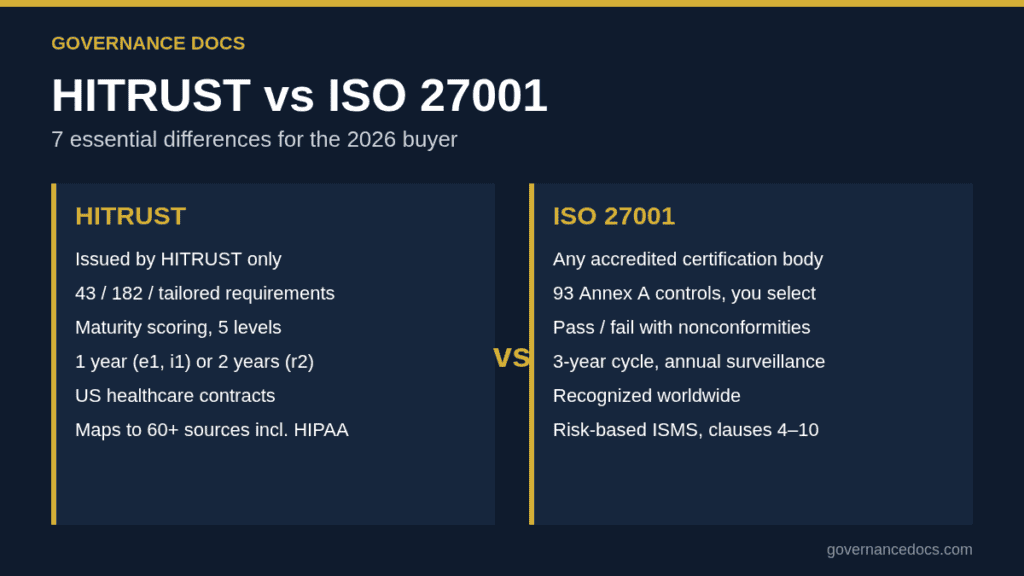
HITRUST vs ISO 27001 is rarely a free choice. In most cases a customer contract, a security questionnaire, or a target market has already decided it for you, and the real job is to work out which one you are being asked for, what it will cost, and whether one can carry you toward the other. This guide sets the two side by side: who issues the certificate, what gets tested, how long it lasts, what it costs, and the five situations where the answer is clear.
The short version: ISO 27001 certifies a management system built around your own risk assessment, is recognized worldwide, and is issued by any accredited certification body on a three-year cycle. HITRUST certifies you against a prescribed set of requirement statements (43, 182, or a tailored several hundred), is issued only by HITRUST after an External Assessor validates the evidence, and is what US healthcare payers and providers most often write into vendor contracts.
Free gap assessment
Where do you actually stand against ISO 27001?
Score every management system clause and all 93 Annex A controls, free, and get a prioritised gap list back.
Run the free ISO 27001 gap assessment → or View premium report sample
| Dimension | HITRUST | ISO 27001 |
|---|---|---|
| What it is | A control framework (the HITRUST CSF) plus an assessment and certification program run by HITRUST | An international management system standard (ISO/IEC 27001:2022) for an information security management system (ISMS) |
| Who issues the certificate | HITRUST itself, after an authorized External Assessor validates the assessment and HITRUST completes quality assurance | Any accredited certification body (for example, one accredited by ANAB or UKAS); ISO does not certify anyone |
| What is tested | A prescribed set of requirement statements: 43 (e1), 182 (i1), or a tailored set commonly running to several hundred (r2) | Clauses 4–10 of the standard plus the Annex A controls you selected in your Statement of Applicability (93 controls in four themes) |
| How controls are chosen | Selected by HITRUST for e1 and i1; selected by HITRUST’s scoping questionnaire for r2 | Selected by you, justified by your own risk assessment and documented under clause 6.1.3 |
| How results are scored | Each requirement is scored on maturity levels (policy, procedure, implemented, and for r2, measured and managed); certification needs a passing score | Pass or fail against the standard, with major and minor nonconformities to close |
| Validity | e1 and i1: one year. r2: two years with an interim assessment after year one | Three years, with surveillance audits in years one and two and a recertification audit in year three |
| Typical first-year cost (labelled ranges) | e1 roughly $35,000–$130,000; i1 $100,000–$365,000; r2 $235,000–$860,000+ including internal time | Roughly $20,000–$150,000 for a small to mid-sized company including internal time; certification body fees are a minority of that |
| Where it carries weight | US healthcare payers, providers, and their vendors | Worldwide, across every sector |
| Regulatory mapping | HITRUST states the CSF maps to 60+ authoritative sources including HIPAA, NIST, ISO, PCI, and GDPR | None built in; you map regulations into your own risk assessment and control set |
The cost figures are planning ranges, not quotes. Neither HITRUST nor certification bodies publish a tariff, and the biggest line in both budgets is your own staff time. Our HITRUST certification cost and ISO 27001 certification cost guides break each line down.
This is the HITRUST vs ISO 27001 difference that explains every other row in the table. ISO 27001 certifies that you run an information security management system: you defined a scope, assessed risk, chose controls to treat that risk, wrote them into a Statement of Applicability, and can show the system operating and improving.
HITRUST certifies that you meet a set of requirement statements HITRUST chose. There is no argument to be had about whether a requirement applies once it is in your assessment object; you either evidence it to the required maturity level or you lose points. That is why HITRUST is popular with buyers who want comparable results across hundreds of vendors, and why ISO 27001 is popular with organizations whose risk profile does not fit a template.
An ISO 27001 certificate can be issued by any certification body that holds accreditation for the standard. You choose the body, negotiate the fee, and can change bodies at recertification.
HITRUST is a closed system. Your assessment is performed by an authorized External Assessor organization, but the certificate is issued by HITRUST after its own quality assurance review of the assessor’s work. Every certified organization has been through the same scoring engine, which is the consistency buyers pay for.
ISO 27001:2022 has 93 Annex A controls in four themes: 37 organizational, 8 people, 14 physical, and 34 technological. All 93 are considered, but only those your risk treatment requires are implemented, and the Statement of Applicability records the reasoning for every inclusion and exclusion.
Free ISO 27001 risk assessment
Which of your risks sit above your appetite line?
Set your own risk criteria, pick from 61 information security risk scenarios, rate likelihood and impact, and decide how to treat each one. You get a heat map, a process score and the findings an auditor would raise, free.
Run the free risk assessment → or View premium report sample
HITRUST publishes three assessment levels, each with its own control count. The e1 has 43 requirement statements and is pitched at start-ups and lower-risk organizations. The i1 has 182 and suits organizations with an established program. The r2 is tailored from a scoping questionnaire about your size, systems, and regulatory exposure and commonly runs to several hundred requirement statements. HITRUST requires new e1 and i1 assessments created after 7 May 2026 to use CSF v11.8.0. Our guide to HITRUST assessments covers choosing between the three.
On scoring, HITRUST vs ISO 27001 is a difference in kind. An ISO 27001 audit produces findings: major nonconformities that block the certificate until corrected, minor ones that need a corrective action plan, and observations. A control can be present but immature and still pass if it meets the requirement.
HITRUST scores every requirement statement on maturity levels: whether a policy exists, whether a procedure exists, whether the control is implemented, and for the r2, whether it is measured and managed. A control you run well but never measure loses points. Organizations that arrive at an r2 with solid implementation and no metrics find their remediation budget goes into measurement.
ISO 27001 runs a three-year cycle. After the initial Stage 1 and Stage 2 audits, the certification body performs a surveillance audit in each of the next two years and a full recertification audit in year three. Our guide on how to get ISO 27001 certified walks through each stage.
HITRUST validity depends on the level. The e1 and i1 are valid for one year and are renewed with a fresh validated assessment (the i1 offers a lighter rapid recertification in year two). The r2 is valid for two years with an interim assessment after the first year.
The HITRUST vs ISO 27001 cost gap comes from what each budget is made of. The ISO 27001 budget is dominated by implementation: building the ISMS, running the risk assessment, writing the documentation, and closing gaps. Certification body fees are typically a minority of the total, and a documentation toolkit can replace a large share of consultant time.
The HITRUST budget has three invoices at every level: HITRUST’s own fees for MyCSF and the assessment, the External Assessor’s fees, and the internal cost of evidencing every requirement statement. The counts drive the cost, which is why an r2 can run several times the price of an e1. The one mechanism that cuts every line is inheritance: HITRUST allows a vendor on a certified cloud provider to inherit a large share of applicable controls rather than evidencing them from scratch.
ISO 27001 is the global default. It is the certificate enterprise procurement teams outside the US ask for first, it is accepted across every sector, and it is the base other standards build on: ISO 27701 for privacy, ISO 27017 for cloud, and ISO 42001 for AI all follow the same management system structure.
HITRUST is a US healthcare specialty that has spread outward. Payers and large provider systems write HITRUST certification into vendor contracts, and a growing number of US financial services buyers accept it. Outside the US, and outside healthcare, it is rarely requested by name. Our ISO 27001 vs SOC 2 guide covers the other comparison US buyers most often face.
Five situations settle the HITRUST vs ISO 27001 question for most organizations.
Not formally. HITRUST vs ISO 27001 is not an either/or at the certificate level: a HITRUST certification does not grant an ISO 27001 certificate, and an ISO 27001 certificate does not grant a HITRUST one. What does transfer is the work. Both programs want documented policies, documented procedures, evidence that controls operate, and a defined scope. An organization that has done that work for one will find the other is largely an exercise in re-mapping and filling gaps, not starting over.
The gaps run in a predictable direction. From ISO 27001 to HITRUST, you add prescribed controls you may have excluded on risk grounds, the measurement evidence the r2 scores, and the requirements your scoping factors pull in. From HITRUST to ISO 27001, you add the management system itself: a risk assessment and treatment plan, a Statement of Applicability, internal audit, and management review.
Whichever way you go, the first evidence any assessor asks for is written policy and procedure: the first two maturity levels of every HITRUST requirement statement, and mandatory documented information under ISO 27001. Buying that layer as a template set and tailoring it is the cheapest line in either budget.
The ISO 27001 Toolkit (165 templates, $99) covers the ISMS documentation from scope statement and risk assessment through the Statement of Applicability and every Annex A policy. The HITRUST CSF Toolkit (45 templates, $99) covers the policy and procedure layer for the HITRUST control domains. Both are editable Microsoft Office files.
An r2 is usually more work than an ISO 27001 certification because it tests several hundred prescribed requirements at five maturity levels rather than a control set you chose. An e1 is usually less work than ISO 27001. The i1 lands somewhere between, depending on how mature your program already is.
HITRUST states that the CSF maps to more than 60 authoritative sources, including ISO. That means HITRUST requirement statements draw on ISO 27001 controls, not that a HITRUST certificate counts as ISO 27001 certification. Only an accredited certification body can issue an ISO 27001 certificate.
ISO 27001 is usually cheaper, and the gap widens with the HITRUST level. A first-year ISO 27001 certification for a small to mid-sized company typically lands between $20,000 and $150,000 all in; a HITRUST e1 is a comparable range, while an r2 commonly runs from $235,000 upward once internal time is counted. Treat both as planning ranges.
ISO 27001 typically takes six to twelve months from a standing start to certificate. HITRUST reports e1 assessments completing in around 30 days on average, an i1 typically in six to twelve months, and an r2 is set by scoping and readiness and is usually the longest.
Read the contract or questionnaire that prompted the question and find the exact wording: if it names HITRUST, note the level and the deadline. Then price the route from the official sources: the HITRUST assessment descriptions at hitrustalliance.net and the standard itself at iso.org. The choice between HITRUST vs ISO 27001 is a commercial one; the documentation underneath is the same work either way, so start it now and let the contract decide which certificate it feeds first.

October 11, 2026
October 11, 2026
October 11, 2026
October 11, 2026
October 11, 2026
