
CART
No products in the cart.
ISO Compliance Insights & Best Practices
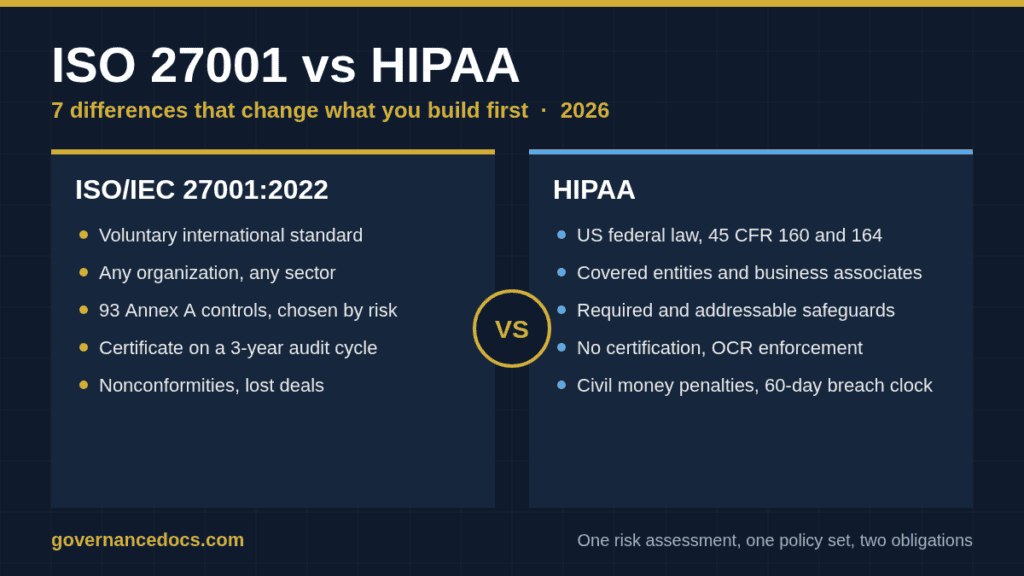
ISO 27001 vs HIPAA is the comparison every health-tech vendor runs into the first time a hospital procurement team asks for “your certification” and a legal team asks for “your HIPAA program” in the same week. They are not the same thing, one cannot substitute for the other, and the mistake that costs the most money is treating them as two separate projects. This guide sets out the seven differences that actually change your decisions, shows how the two map onto each other, and tells you which to pursue first.
Free gap assessment
Where do you actually stand against ISO 27001?
Score every management system clause and all 93 Annex A controls, free, and get a prioritised gap list back.
Run the free ISO 27001 gap assessment → or View premium report sample
| Dimension | ISO/IEC 27001:2022 | HIPAA |
|---|---|---|
| What it is | International standard for an information security management system (ISMS) | US federal law and its implementing rules (45 CFR Parts 160 and 164) |
| Who must comply | Nobody by law; adopted voluntarily or under contract | Covered entities and their business associates |
| What it protects | Any information you put in scope | Protected health information (PHI), with the Security Rule limited to electronic PHI |
| Control set | 93 Annex A controls in 4 themes, selected by risk assessment | Administrative, physical and technical safeguards, each with required or addressable implementation specifications |
| Proof of compliance | Accredited certificate on a 3-year cycle with annual surveillance | No certification exists; compliance is enforced by HHS OCR through complaints, breach reports and investigations |
| Breach rules | Incident management controls; no statutory notification clock | Breach Notification Rule: individuals within 60 days, HHS and media for 500+ affected |
| Consequences | Nonconformities, certificate suspension, lost deals | Tiered civil money penalties, corrective action plans, monitoring, and potential criminal referral |
| Typical first-year cost (small org) | $8,000–$30,000 including audit | $3,000–$35,000 depending on size and outsourcing |
ISO/IEC 27001 is a management system standard published by ISO and IEC. No regulator requires it. You adopt it because a customer contract asks for it, because a tender scores it, or because you want a defensible, repeatable security program. Its full text costs money and its clauses read as requirements for a system, not for a technology.
HIPAA is the Health Insurance Portability and Accountability Act of 1996, brought into force through the Privacy Rule, the Security Rule and the Breach Notification Rule in 45 CFR Parts 160 and 164. If you fall inside its scope, compliance is not a choice. The rules are free to read on the HHS Security Rule page and in the eCFR, and they are written as legal obligations with an enforcement regime behind them.
That single distinction drives most of the ISO 27001 vs HIPAA debate: one framework is something you can choose to be audited against, the other is something you can be investigated under.
HIPAA applies to covered entities (health plans, health care clearinghouses, and providers who transmit health information electronically for standard transactions) and to their business associates, meaning any vendor that creates, receives, maintains or transmits PHI on their behalf. A SaaS platform hosting patient records, a billing company, a cloud backup provider and a law firm reviewing claims are all business associates, and since the 2013 Omnibus Rule they are directly liable for Security Rule compliance.
ISO 27001 vs HIPAA on applicability is simpler: ISO 27001 has no jurisdiction and no sector. A ten-person fintech in Singapore and a 40,000-person manufacturer in Germany can both certify. If your customers are not in US health care, HIPAA is irrelevant to you and ISO 27001 may be the credential you actually need. If they are, HIPAA applies whether or not you also certify.
On scope, ISO 27001 vs HIPAA is a contrast between a boundary you draw and a boundary the law draws. HIPAA protects PHI, and the Security Rule narrows further to electronic PHI. Your source code, your HR files and your customer list for non-health clients are outside it. That makes a HIPAA program precise but narrow.
An ISMS under ISO 27001 covers whatever you define in the scope statement under clause 4.3: usually a business unit, a product or the whole company, and all the information those processes handle. Many vendors scope the ISMS around the same platform that processes ePHI, which is why the two programs share so much evidence in practice.
This is the ISO 27001 vs HIPAA difference auditors care about most. ISO 27001 does not hand you a fixed list of things to do. Clause 6.1.2 requires a risk assessment, clause 6.1.3 requires you to select controls to treat those risks and to record the decision in a Statement of Applicability against the 93 controls in Annex A (37 organizational, 8 people, 14 physical and 34 technological). A control you exclude must be justified; a control you include must be implemented and shown to work.
Free ISO 27001 risk assessment
Which of your risks sit above your appetite line?
Set your own risk criteria, pick from 61 information security risk scenarios, rate likelihood and impact, and decide how to treat each one. You get a heat map, a process score and the findings an auditor would raise, free.
Run the free risk assessment → or View premium report sample
The HIPAA Security Rule works the other way round. Section 164.308 lists administrative safeguards (security management process, assigned security responsibility, workforce security, information access management, awareness and training, incident procedures, contingency plan, evaluation, and business associate contracts), 164.310 the physical safeguards, and 164.312 the technical ones. Each standard carries implementation specifications marked Required or Addressable. Under 164.306(d), an addressable specification is not optional: you implement it, or you document why it is not reasonable and appropriate and implement an equivalent alternative.
The overlap is deliberate. The Security Rule’s first required specification, risk analysis at 164.308(a)(1)(ii)(A), is functionally the same exercise as an ISO 27001 clause 6.1.2 risk assessment. One risk register, written to the stricter of the two formats, serves both. Our guide to HIPAA safeguards explains why “addressable does not mean optional” in detail.
On proof, ISO 27001 vs HIPAA could not be more different. ISO 27001 ends in a certificate. An accredited certification body runs a Stage 1 documentation review and a Stage 2 implementation audit, issues a certificate valid for three years, and returns for surveillance audits in years one and two and a recertification audit in year three. The certificate is portable evidence that a customer in any country understands.
HIPAA has no certificate. HHS does not recognize any “HIPAA certified” status, and a vendor badge saying so is a marketing claim, not a legal one. Compliance is demonstrated on demand: to a customer during due diligence, to the Office for Civil Rights during a complaint investigation or breach inquiry, and to your own auditors. That is why HIPAA-regulated vendors so often reach for a SOC 2 report, HITRUST assessment or ISO 27001 certificate as the independent proof their customers want. The SOC 2 vs HIPAA comparison covers the attestation route; this one covers the certification route.
ISO 27001 requires you to plan for incidents (Annex A 5.24), assess and decide on events (5.25), respond (5.26), learn from them (5.27) and collect evidence (5.28). It imposes no notification deadline of its own; those come from whatever law applies to the data.
HIPAA’s Breach Notification Rule is that law for PHI. After a breach of unsecured PHI is discovered, affected individuals must be notified without unreasonable delay and no later than 60 calendar days (164.404). Breaches affecting 500 or more individuals must be reported to HHS at the same time and to prominent media in the affected state (164.406 and 164.408); smaller breaches are logged and reported to HHS within 60 days after the end of the calendar year. Business associates notify the covered entity, which then carries the individual notice obligation. An ISMS incident procedure that ignores these clocks is not HIPAA-ready, however well it scores at a Stage 2.
The last ISO 27001 vs HIPAA difference is what happens when you get it wrong. Failing an ISO 27001 audit produces nonconformities. Major ones block or suspend the certificate; minor ones need a corrective action plan before the next visit. The financial damage is commercial: a lost tender, a delayed contract, a repeat audit fee.
Failing HIPAA is a legal matter. OCR can impose tiered civil money penalties under 45 CFR 160.404, with the dollar amounts adjusted for inflation each year, and settlements routinely add a multi-year corrective action plan with external monitoring. Knowing misuse of PHI can be referred to the Department of Justice for criminal prosecution. State attorneys general can also bring HIPAA actions. Nobody suspends your license to operate for a failed ISO audit; a HIPAA resolution agreement, by contrast, becomes public record.
On the spending side, the numbers are closer than most people expect. For a small US company, the ISO 27001 certification cost typically lands at $8,000–$30,000 in year one including the audit. A HIPAA compliance program for a 10–50 person business associate typically runs $6,000–$35,000 in year one, with no audit fee but with the risk analysis, policies, training and BAA work you cannot skip. Treat both as labelled planning ranges, not quotes.
Settle ISO 27001 vs HIPAA in three steps.
A useful reference for that second route is NIST SP 800-66 Rev. 2, the HIPAA Security Rule cybersecurity resource guide, which walks each safeguard through the same risk-based logic ISO 27001 uses.
Every ISO 27001 vs HIPAA comparison ends with the same practical question: which control satisfies which safeguard? The table below shows where each Security Rule standard lands in ISO 27001:2022. It is a working crosswalk, not an official one; the Annex A controls named are the primary matches, and most standards touch two or three more.
| HIPAA Security Rule standard | ISO 27001:2022 clause or Annex A control |
|---|---|
| Security management process, risk analysis and risk management (164.308(a)(1)) | Clauses 6.1.2 and 6.1.3, 8.2 and 8.3; A.5.1 policies; A.6.4 disciplinary process |
| Assigned security responsibility (164.308(a)(2)) | Clause 5.3 roles; A.5.2 information security roles and responsibilities |
| Workforce security and information access management (164.308(a)(3)–(4)) | A.6.1 screening, A.6.5 responsibilities after termination; A.5.15 access control, A.5.18 access rights |
| Security awareness and training (164.308(a)(5)) | Clause 7.2 and 7.3; A.6.3 awareness, education and training |
| Security incident procedures (164.308(a)(6)) | A.5.24–A.5.28 incident management |
| Contingency plan (164.308(a)(7)) | A.5.29 security during disruption, A.5.30 ICT readiness, A.8.13 backup |
| Evaluation (164.308(a)(8)) | Clauses 9.1, 9.2 internal audit and 9.3 management review |
| Business associate contracts (164.308(b), 164.314) | A.5.19–A.5.21 supplier relationships |
| Facility access, workstation and device/media controls (164.310) | A.7.1–A.7.4 physical perimeters and entry, A.7.7 clear desk, A.7.10 storage media, A.7.14 secure disposal |
| Access control and authentication (164.312(a), (d)) | A.5.17 authentication information, A.8.2 privileged access, A.8.3 access restriction, A.8.5 secure authentication |
| Audit controls and integrity (164.312(b), (c)) | A.8.15 logging, A.8.16 monitoring, A.8.9 configuration management |
| Transmission security (164.312(e)) | A.8.20 networks security, A.8.24 use of cryptography |
| Policies, procedures and documentation, 6-year retention (164.316) | Clause 7.5 documented information |
Two gaps run in each direction. HIPAA says nothing about secure development, threat intelligence or cloud service agreements, which ISO 27001 covers in A.8.25–A.8.29, A.5.7 and A.5.23. ISO 27001 says nothing about the 6-year documentation retention rule in 164.316(b)(2), the specific content of a business associate agreement, or the Privacy Rule’s individual rights, which the ISMS has to absorb as legal requirements.
Whichever side of ISO 27001 vs HIPAA you start on, the same core documents do double duty: an information security policy, a risk assessment method and register, an access control policy, an incident response procedure, a business continuity and backup plan, supplier and business associate agreements, a training record, and an internal audit program. Write them once to the stricter standard and cross-reference the HIPAA section numbers in the margin, and your Stage 2 auditor and an OCR investigator will be reading the same file.
If you want the ISO side handled, the ISO 27001 Toolkit gives you 165 editable templates for $99 (policies, procedures, the Statement of Applicability, risk register and internal audit checklist) aligned to the 2022 edition. For the HIPAA-specific layer, the HIPAA Toolkit adds 160+ templates covering the Privacy, Security and Breach Notification Rules, including BAA forms and the risk analysis workbook.
No. An ISO 27001 certificate proves your ISMS meets the standard for the scope you declared. It does not prove you have signed business associate agreements, met the 60-day breach notification clock, or given individuals their Privacy Rule rights. It does, however, produce most of the Security Rule evidence, so a certified vendor is usually a short step from a defensible HIPAA program.
In the ISO 27001 vs HIPAA effort comparison, different rather than harder. ISO 27001 is harder to pass because an external auditor tests every clause and every selected control; HIPAA is harder to live with because the obligations never end and the consequences of a breach are legal. Most teams find the HIPAA documentation lighter and the ISO 27001 audit heavier.
Yes, and many do precisely because HIPAA offers no certificate. Scope the ISMS around the systems that store or process ePHI, feed the Security Rule safeguards into the Statement of Applicability, and the certificate becomes your independent evidence for covered-entity customers.
If you already hold PHI, HIPAA first, because you are already liable. If you are pre-revenue and choosing which credential to build toward, build the ISMS to ISO 27001 with HIPAA as a legal requirement inside it; you will reach both faster than running them as two projects.
Settle the ISO 27001 vs HIPAA question by asking who your customers are, not which framework sounds more rigorous. US health care customers make HIPAA non-negotiable; everyone else is better served by the certificate. If the answer to ISO 27001 vs HIPAA is both, one risk assessment, one policy set and one audit program written to the stricter requirement will carry you through a Stage 2 audit and an OCR inquiry alike. Our step-by-step guide to how to get ISO 27001 certified covers the certification route from scoping to certificate, and the standard itself is at iso.org/standard/27001.

October 11, 2026
October 11, 2026

October 11, 2026
October 11, 2026
October 11, 2026
