CART
Complementary user entity controls are the part of a SOC 2 report that creates work for the reader. Most organisations file the report as evidence that a supplier is secure, without noticing that a section of it is a list of things they must do.
If you do not do them, the criteria the report covers are not met for your use of the service — regardless of how clean the opinion is.
Free gap assessment
How much of your SOC 2 report can you already evidence?
Score yourself against the Trust Services Criteria, free, before an auditor charges you to find out.
Run the free SOC 2 gap assessment → or View premium report sample
A SOC 2 report describes a service organisation’s system and the controls it operates. But many controls only work as a pair. The provider can enforce multi-factor authentication; it cannot decide who in your organisation should have an account. It can log administrative actions; it cannot review those logs on your behalf.
Where meeting a trust services criterion depends on something the customer does, the service organisation states it as a complementary user entity control — a control it assumes you operate.
Three consequences follow, and they are the whole reason this matters:
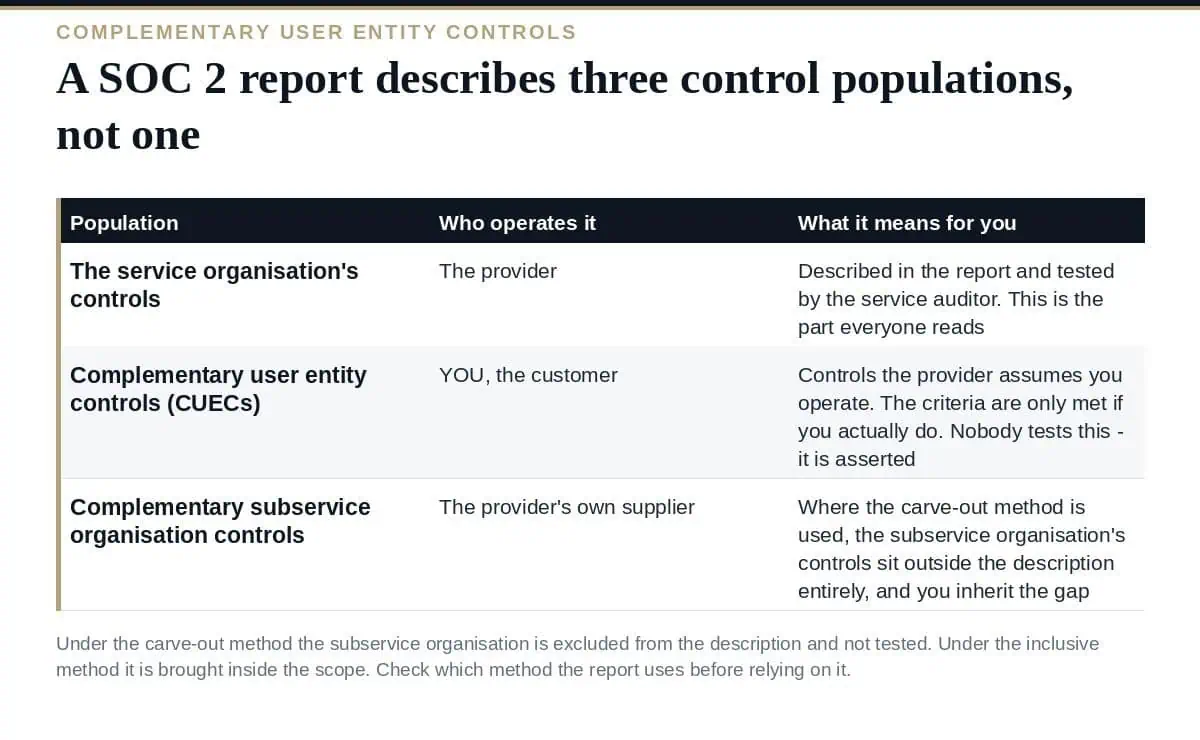
Reading a SOC 2 report properly means separating three populations, only one of which the report actually tests.
There is the service organisation’s own controls, described and tested. There are the complementary user entity controls, described and assumed. And there are the controls of the provider’s own suppliers — where a subservice organisation is involved.
That last one is where reports differ most, and it is worth checking before you rely on anything.
Under the carve-out method, the subservice organisation’s controls are excluded from the description and are not tested. The report will typically list complementary subservice organisation controls — controls the provider assumes its own supplier operates. Under the inclusive method, the subservice organisation is brought inside the scope and examined.
A carved-out report covering a service that runs entirely on a third-party platform can therefore say very little about the platform. That is not a defect — it is a scoping choice you need to notice.
Treat the complementary user entity controls list as an inbound requirements document, because that is what it is.
The common failure mode is quiet: a supplier’s report lists twelve CUECs, the customer performs eight, and both parties believe the arrangement is covered. The gap only becomes visible after an incident.
In a SOC 1 report the same mechanism carries a sharper edge: the service auditor’s report states that the control objectives can be achieved only if the complementary user entity controls are suitably designed and operating effectively, so a user entity that cannot show its own control for each CUEC has a gap in its own internal control over financial reporting, not in the vendor’s report. Our SOC 1 control objectives guide explains how CUECs attach to objectives, and the SOC 1 audit checklist covers the CUEC register and drafting guide for service organisations and a CUEC mapping workbook for user entities.
If you issue a SOC 2 report, your complementary user entity controls list is a design decision with commercial consequences.
A long list moves responsibility to customers, which weakens the report’s value as a sales asset and invites questions during diligence. A short list means you have taken more into your own control boundary, which is a stronger position to sell but a more expensive one to operate.
The unhelpful middle is a list written defensively by advisors — long, generic, and impossible for a customer to operationalise. It protects nobody, because a CUEC that no customer implements is not a control, it is a disclaimer.
| Area | Connection |
|---|---|
| SOC 2 compliance | The wider programme, and what the report covers on the provider side |
| Third-party risk management | CUECs are inbound obligations from suppliers. They belong in the supplier record, with an owner |
| ISO 27001 | Most CUECs map to access control, change management and operations controls you already run — the work is confirming, not building |
| CSA STAR | The Cloud Controls Matrix states which actor implements each control, which is the same shared-responsibility question in a clearer format |
This guide describes SOC 2 reporting practice as at 16 August 2026. Report structure and terminology follow the AICPA’s attestation framework; your service auditor is the authority on how a specific report is scoped.
The SOC2 Toolkit provides the documentation pack behind a SOC 2 programme, including the control descriptions, the system description and the evidence records a service auditor works from.

October 15, 2026
October 15, 2026
October 14, 2026
October 14, 2026
October 14, 2026

