CART
ISO 21001 is the management system standard written specifically for educational organizations — and as of July 2025 there is a second edition, which means most of the guidance published about it online now describes a withdrawn document.
That is the first thing to check before anything else.
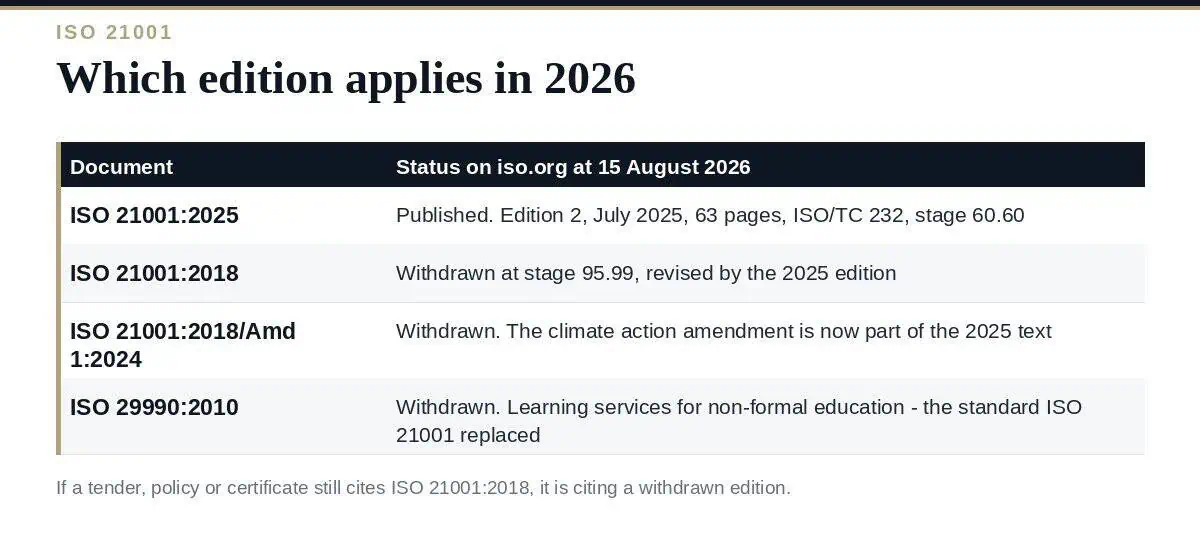
ISO 21001:2025 — Educational organizations — Management systems for educational organizations — Requirements with guidance for use — is the current text. Second edition, published July 2025, 63 pages, maintained by ISO/TC 232, at stage 60.60.
The 2018 first edition is withdrawn, and so is its separate climate action amendment, ISO 21001:2018/Amd 1:2024 — that content sits inside the 2025 edition now. Further back, ISO 21001 itself replaced ISO 29990:2010, which covered learning services for non-formal education and is also withdrawn.
This is the question every school, university and training provider asks, and the answer is not “nothing”.
Both are management system standards with the same structural backbone. The difference is who the system is for. A quality management system is built around the customer. An educational organization management system is built around learners and other beneficiaries — and those are not the same party.
The learner receives the education. The person paying may be a parent, an employer or a government. Regulators, awarding bodies, employers hiring graduates and the wider community all have a stake in the outcome. ISO 21001 requires you to identify those groups separately and address their differing needs, rather than collapsing them all into “the customer”.
That distinction produces requirements a generic quality standard does not reach:
Its scope is wider than formal education, and this catches people out in both directions.
It applies to any organization that uses a curriculum to support the development of competence through teaching, learning or research — schools, universities and colleges, but equally corporate training functions, professional bodies running qualifications, vocational and online providers, and coaching organisations.
It does not apply to organisations that only produce educational products without delivering learning. A publisher selling textbooks is out of scope; the same publisher running assessed courses is in.
| Standard | Relationship |
|---|---|
| ISO 9001 | Shares the structure. A certified education provider can integrate the two, but ISO 9001 alone does not reach learner-specific requirements — which is exactly why ISO 21001 was written |
| ISO 27001 | Education providers hold minors’ data, assessment records and safeguarding information. The privacy expectations in ISO 21001 land more comfortably on top of a real ISMS |
| ISO 31000 | One risk method underneath, rather than a separate educational risk scale nobody outside the institution recognises |
| ISO 45001 | Relevant wherever there are workshops, laboratories, sports facilities or placements |
Worth stating plainly: ISO 21001 is not an accreditation of educational quality. It certifies that a management system meeting the requirements is in place. It does not say your teaching is good, and it does not replace whatever national regulator or awarding body governs your provision.
This guide reflects the ISO 21001 record on iso.org at 15 August 2026.
The ISO 21001 Educational Management Toolkit provides 43 editable templates covering the EOMS policy and scope, the beneficiary and learner needs analysis, the educational design records, educator competence, and the audit and management review artefacts.

October 15, 2026
October 15, 2026
October 14, 2026
October 14, 2026
October 14, 2026

