CART

CSA STAR is the cloud industry’s answer to the security questionnaire — a public registry where a provider publishes its security posture once, in a format buyers already trust, instead of answering the same 200 questions in a different spreadsheet every quarter.
It is also the assurance programme that has moved fastest in the last two years, because the Cloud Security Alliance extended it to cover AI.
Free gap assessment
Where do you actually stand against ISO 27001?
Score every management system clause and all 93 Annex A controls, free, and get a prioritised gap list back.
Run the free ISO 27001 gap assessment → or View premium report sample
The CSA STAR name stands for Security, Trust, Assurance and Risk. The STAR Registry is publicly accessible: anyone can look up a cloud service and read what its provider says about its controls, and at higher levels what an auditor has confirmed.
Underneath sits the Cloud Controls Matrix — 207 control objectives across 17 domains (CCM v4.1, released January 2026), aligned to CSA’s cloud security guidance and treated across the industry as the de facto cloud control framework. The CCM’s companion is the Consensus Assessments Initiative Questionnaire, the CAIQ, which turns those objectives into questions a provider answers. As of v4.1 the two are published combined.
The CCM does something most control frameworks do not: it says which actor in the cloud supply chain should implement each control. That single feature is why it resolves shared-responsibility arguments better than a generic checklist.
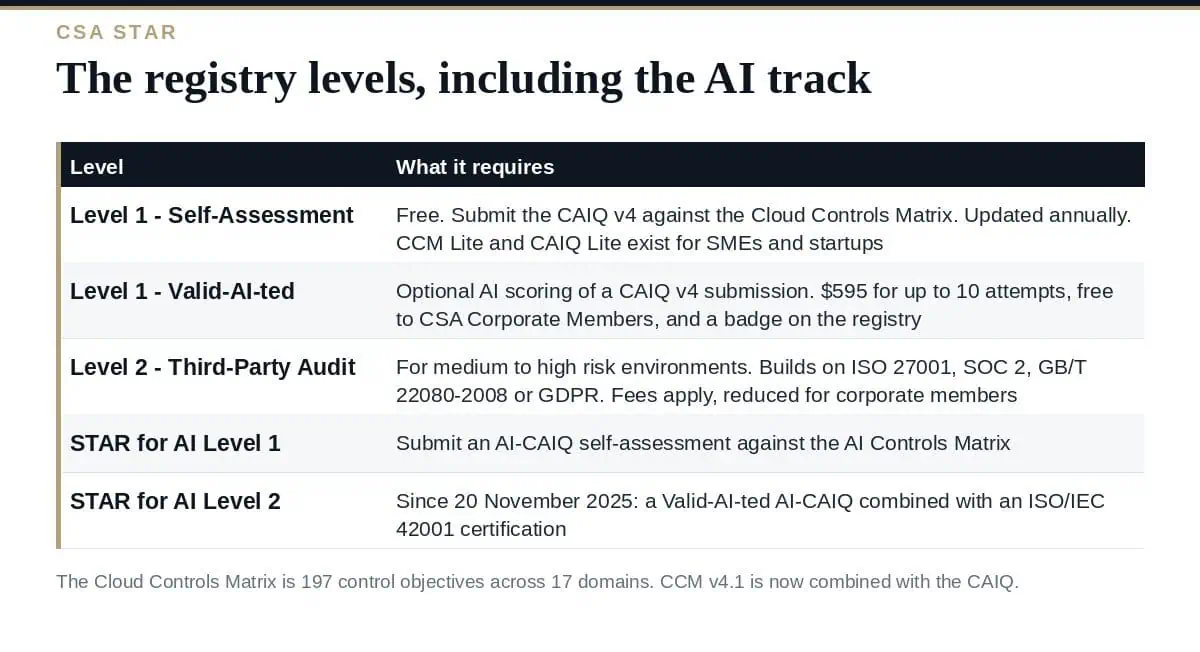
Level 1 is a self-assessment and it is free. You complete the CAIQ v4.1 and submit it; it becomes public and is updated annually. For a startup or SME the CCM Lite and CAIQ Lite variants trim it to something achievable without a compliance team.
Self-assessed does not mean worthless. It is published, attributable and comparable — which is more than most vendor security pages offer.
Level 2 is a third-party audit, and its design is the clever part: it builds on certifications you may already hold rather than duplicating them. If you have ISO 27001, SOC 2, GB/T 22080-2008 or a GDPR-based position, Level 2 makes it cloud-specific instead of starting again. It is aimed at medium-to-high risk environments, and it carries fees, reduced for CSA corporate members.
Valid-AI-ted is an optional enhancement to Level 1 in which CSA’s own AI scores your CAIQ v4.1 submission against a standardised model derived from the CCM.
The ten attempts matter more than the price, and they make CSA STAR unusual among assurance schemes. This is a scoring loop, not an exam — you are meant to submit, read the feedback, fix the answers and resubmit.
CSA has extended the programme to AI systems, built on three things: the AI Controls Matrix (AICM), the AI-CAIQ, and ISO/IEC 42001.
STAR for AI Level 1 works like the cloud equivalent — submit an AI-CAIQ self-assessment against the AICM.
STAR for AI Level 2 is the interesting one. Since 20 November 2025, an organisation can combine a Valid-AI-ted AI-CAIQ with an ISO/IEC 42001 certification to earn it.
That combination is worth understanding before you plan an AI assurance roadmap. ISO 42001 gives you a certifiable management system; the AI-CAIQ gives you public, control-level transparency. Level 2 requires both, which means an organisation already pursuing ISO 42001 is most of the way to a STAR for AI designation it may not know exists.
| Standard | Relationship |
|---|---|
| ISO 27001 | The management system underneath. Level 2 explicitly builds on it, so the sequence is ISO 27001 first, then STAR — not in parallel |
| ISO 27017 | Cloud-specific security controls. Substantial conceptual overlap with the CCM, but ISO 27017 is guidance attached to an ISO certificate while the CCM drives a public registry entry |
| SOC 2 | Another accepted Level 2 basis. Useful where your buyers are North American and already ask for SOC 2 reports |
| ISO 42001 | Required for STAR for AI Level 2 alongside a Valid-AI-ted AI-CAIQ |
The pattern across all four: CSA STAR is not a replacement for a certification, it is a way of publishing one in cloud terms where buyers can find it.
This guide reflects cloudsecurityalliance.org at 15 August 2026. The AI track is moving quickly; check the submission guides before committing to a route.
The CSA STAR Cloud Security Toolkit provides 30 editable templates covering the control mapping, the shared responsibility documentation, the self-assessment evidence and the registry submission records — the working papers behind a CAIQ that stands up to a customer reading it.

October 15, 2026
October 15, 2026
October 14, 2026
October 14, 2026
October 14, 2026

