CART
The CIS Controls are the most practical answer to a question every security programme eventually asks: out of everything we could do, what should we do first?
They are not a certification. Nobody audits you against them and there is no certificate at the end. That is exactly why they are useful — this is a prioritised list of things that demonstrably reduce risk, published by the Center for Internet Security and maintained from real attack data.
Free gap assessment
Have you cleared Implementation Group 1?
Score all 18 Controls, free, with IG1 treated as the floor rather than the starting point, so you find out whether the basics are actually covered.
Run the free CIS Controls gap assessment → or View premium report sample
The current release is v8.1: 18 Critical Security Controls, containing 153 Safeguards between them.
The distinction between the two levels is the one people get wrong. A Control is a theme — “Inventory and Control of Enterprise Assets”. A Safeguard is the individual, testable action inside it. You do not implement a Control; you implement its Safeguards, and each one is something you can assign, evidence and check.
Version 8.1 of the CIS Controls was an alignment release rather than a restructure. CIS describes it as updated alignment to evolving industry standards and frameworks, revised asset classes and Safeguard descriptions, and one genuinely new element: the addition of a Governance security function. That addition tracks the direction every serious framework has moved in — technical controls without accountability do not survive contact with an organisation.
Two design decisions make the set unusual, and both are worth understanding before you adopt it:
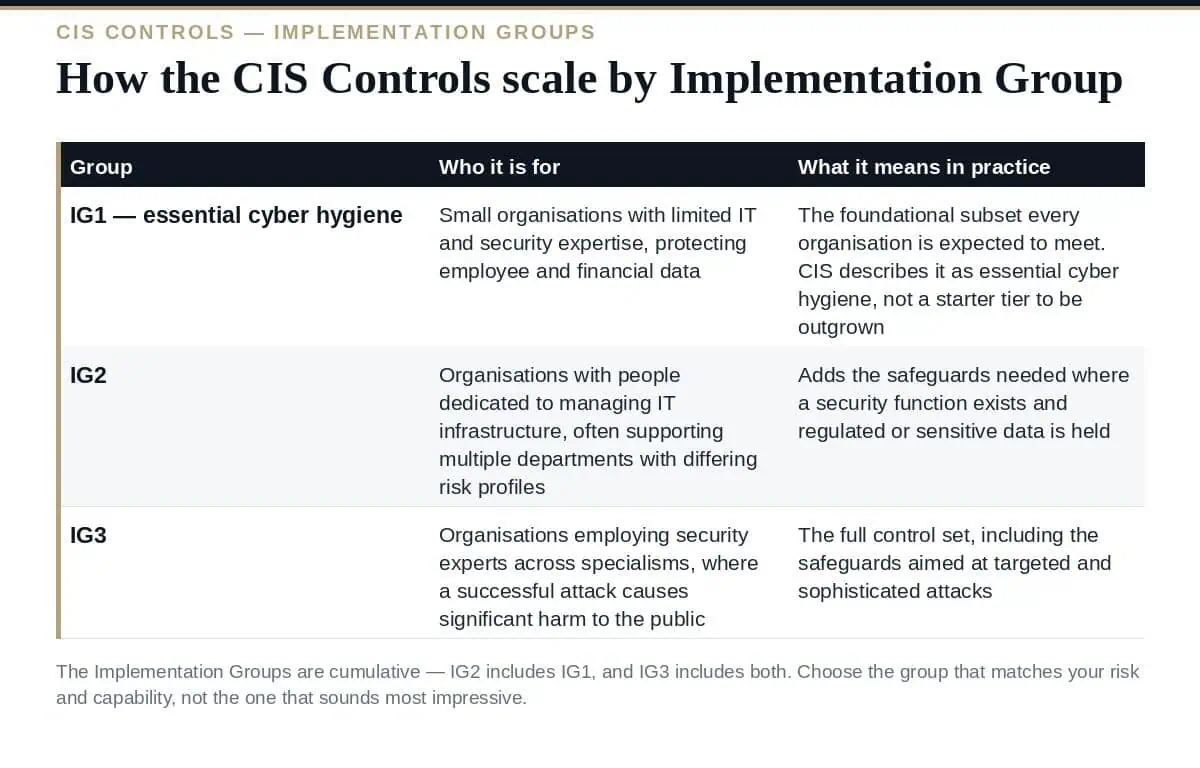
Implementation Groups are based on an organisation’s risk profile and the resources it has available. Each group identifies the subset of the 153 Safeguards that applies to it.
| Group | Who it is for |
|---|---|
| IG1 | Small organisations with limited IT and security expertise. CIS defines this as essential cyber hygiene — the foundational defences that guard against the most common attacks, and where every enterprise should start |
| IG2 | Organisations with staff dedicated to managing IT infrastructure, often supporting multiple departments with differing risk profiles |
| IG3 | Organisations with security specialists, where a successful attack would cause significant harm to the public. IG3 comprises every Control and every Safeguard |
The groups are cumulative: IG2 builds on IG1, and IG3 contains both. The honest way to choose is to match your actual capability and risk, not the tier that sounds most impressive to a customer. An organisation claiming IG3 while failing IG1 asset inventory is worse off than one doing IG1 properly.
Most control frameworks present their requirements as a flat set and leave prioritisation to you. That is defensible for an auditable standard and useless when you have three months and one security hire.
Inventory comes first — enterprise assets, then software assets — because every other control silently assumes it. Vulnerability management covers the systems you know about. Access control governs the accounts you have listed. Malware defences run on the endpoints you can see. A gap in Control 1 quietly becomes a gap in everything after it.
The second cluster is equally deliberate: data protection, secure configuration, account management and access control management — Controls 3 through 6. These are what stop a foothold becoming a breach, and they are mostly configuration and process rather than procurement. The expensive capabilities sit further down the list on purpose.
Nothing in the CIS Controls requires a purchase order. What it asks for is a small number of things maintained properly:
That last point is where self-directed frameworks quietly fail. No external auditor forces the annual re-examination, so it has to be scheduled deliberately or it does not happen.
| Framework | Relationship |
|---|---|
| ISO 27001 | A management system you can certify against, where this is a prioritised control set you cannot. They pair well — one tells you what to do first, the other gives you the governance to keep doing it |
| NIST CSF | CSF organises outcomes into functions; the Safeguards are far more prescriptive about the actions. Many organisations use CSF to talk to the board and CIS to talk to engineers |
| Cyber Essentials | A UK certification covering five technical controls, with substantial overlap with IG1 — but Cyber Essentials is independently assessed and this is not |
| SOC 2 | An attestation against trust services criteria. Working the Safeguards is a strong way to build the underlying practice a SOC 2 auditor will then test |
The useful framing: the CIS Controls answer “what should we do”, and certifiable standards answer “how do we prove we did it”. Organisations that adopt only the second end up with well-documented programmes that still miss basics.
Most of IG1 needs no tooling budget at all, which is the quiet advantage the CIS Controls have over every framework that starts with a platform. What it needs is someone to own the inventory, and the discipline to work down an ordered list rather than across a comfortable one.
This guide reflects v8.1 as published by the Center for Internet Security at 15 August 2026. CIS revises the set periodically and keeps v8 and v7.1 resources available separately — confirm the current version before building a programme around specific Safeguard numbering.
The CIS Controls v8.1 Toolkit provides 40 editable documents covering the asset and software inventories, the Safeguard implementation records, the Implementation Group determination and the review artefacts — the parts that turn an ordered list into something a team can actually run.

October 15, 2026
October 15, 2026
October 14, 2026
October 14, 2026
October 14, 2026

