CART
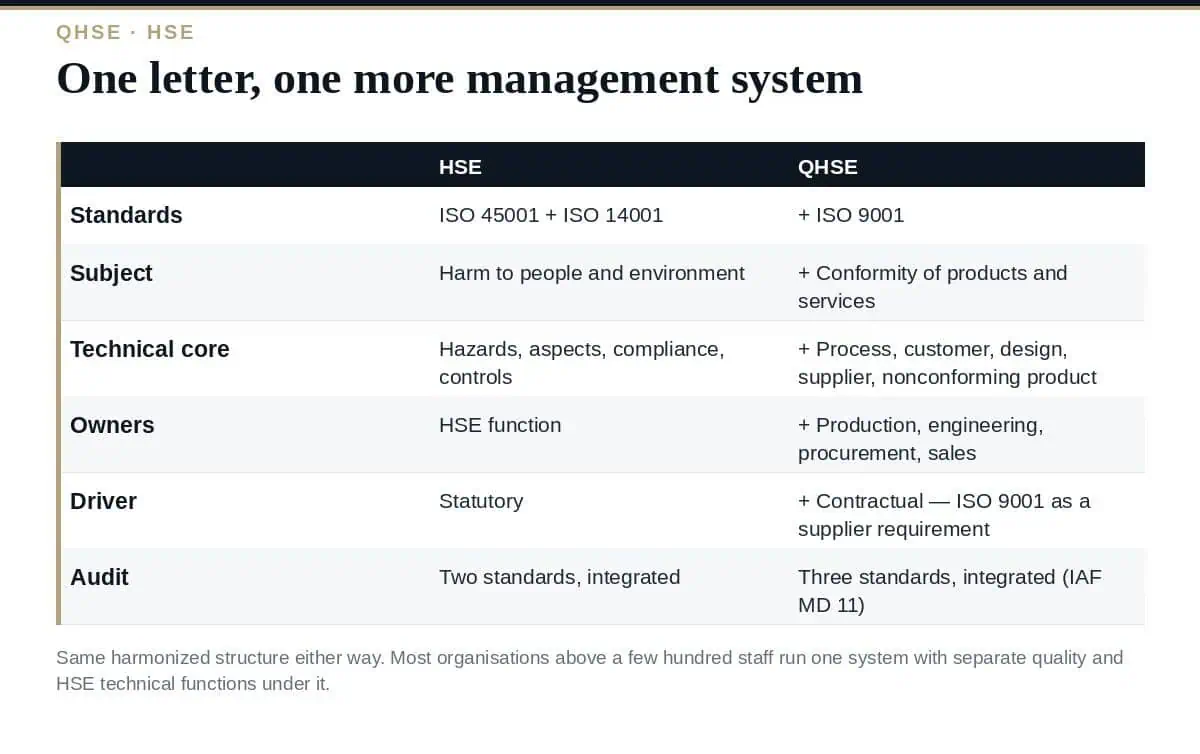
QHSE vs HSE is a difference of one letter and one management system, and the letter matters more than it looks. HSE — health, safety and environment — is the pairing of ISO 45001 and ISO 14001 (or their regulatory equivalents) into one function that manages harm to people and harm to the environment, two disciplines with a shared logic of hazards, aspects, controls and compliance obligations. QHSE adds quality, ISO 9001, whose subject is not harm but conformity — products and services that meet requirements — and whose owners are production, engineering and customer-facing functions rather than the safety office.
Whether the Q belongs with the HSE is a question about how the organisation is run, not about the standards, which share a structure that makes either arrangement auditable. This guide sets the two side by side, explains what quality adds and what it changes, gives the six questions that decide which structure fits, shows how the document set and audit programme differ, and describes the hybrid most organisations above a certain size end up with.
Free gap assessment
Are you ready for the 2026 edition of ISO 9001?
Score yourself against the new edition, free, including the risk and opportunity split and the clause 10 renumbering that breaks converted checklists.
Run the free ISO 9001 gap assessment → or View premium report sample
| HSE | QHSE | |
|---|---|---|
| Standards | ISO 45001:2018 and ISO 14001:2026 | ISO 9001:2026, ISO 14001:2026 and ISO 45001:2018 |
| Subject | Preventing harm: injury and ill health to workers; adverse impact on the environment | Preventing harm, plus conformity: products and services that meet customer and applicable requirements |
| Core logic | Hazard identification and risk assessment; aspects and impacts; compliance obligations; hierarchy of controls | Adds the process approach, customer focus, risk-based and opportunity-based thinking, supplier control, design and production control |
| Typical owner | HSE manager or advisor; reports to operations or the board | QHSE manager; reports to operations or the managing director; quality engineers in the line |
| Regulatory driver | Strong — OH&S and environmental law bind every employer and operator | Quality is contractual, not statutory, except in regulated sectors (medical devices, aerospace, automotive, food) |
| Customer driver | Contractor pre-qualification, supply-chain questionnaires, tender requirements | The same, plus ISO 9001 as a near-universal supplier requirement |
| Common structure | Harmonized structure clauses 4–10 shared by both | The same clauses, shared by all three |
| Certification | Two certificates, one integrated audit possible | Three certificates, one integrated audit under IAF MD 11 |
Quality adds a management system whose technical core is different in kind. ISO 45001 and ISO 14001 ask what can go wrong and how badly; ISO 9001 asks whether what was promised was delivered. Its distinctive requirements have no HSE counterpart: requirements for products and services (8.2), design and development (8.3), control of externally provided processes, products and services (8.4), production and service provision including identification, traceability and preservation (8.5), release (8.6) and control of nonconforming outputs (8.7), plus customer satisfaction (9.1.2) and the process approach throughout.
The people who own those requirements are not the people who own permits to work and waste transfer notes. What quality changes, therefore, is who is in the room: a QHSE system is run with production, engineering, procurement and sales at the table, or it is an HSE system with a quality manual attached. The 2026 edition of ISO 9001 sharpens the point by naming quality culture and ethical behaviour among top management’s commitments — culture is a whole-organisation property, and the Q is where the standards say so. Our guide to the QHSE management system covers the integration; ISO 9001:2026 changes covers the edition.
| Question | Points to HSE | Points to QHSE |
|---|---|---|
| 1. Does a customer or market require ISO 9001? | No — quality is managed informally or contractually | Yes — most manufacturing, construction and service supply chains |
| 2. Are the quality owners the same people as the HSE owners? | No — separate functions with separate reporting lines that work | Yes, or they could be — one operations director, one site management team |
| 3. Is the organisation’s risk mainly harm or mainly conformity? | High-hazard, low-complexity product: HSE is the system that matters | Complex products or services where defects cost more than incidents |
| 4. How many audit days can the organisation absorb? | Two systems’ worth, integrated | Three systems’ worth, integrated — IAF MD 11 allows a reduction of up to 20% of the combined time |
| 5. Is there one document owner? | Separate quality and HSE document sets already work | A single hierarchy is achievable and the duplication is visible |
| 6. What does the board want to see? | Harm and compliance metrics | Harm, compliance and customer and process metrics on one page |
| Element | HSE | QHSE |
|---|---|---|
| Policy | One HSE policy carrying ISO 45001 5.2 and ISO 14001 5.2 commitments | One QHSE policy carrying all three sets — see our guide to the QHSE policy |
| Manual and shared procedures | Context, leadership, risk and opportunity, competence, documents, audit, review, corrective action — written once for two systems | The same, written once for three |
| Technical procedures | Hazard identification, aspects register, legal register, permits, emergency, incident investigation | Adds process control, design, supplier evaluation, inspection and test, calibration, nonconforming product, customer feedback |
| Registers | Hazards and risks, aspects and impacts, compliance obligations | Adds quality risks and opportunities, approved suppliers, calibration, complaints |
| KPIs | Injury rates, near misses, environmental incidents, compliance status | Adds first-pass yield, cost of poor quality, on-time-in-full, complaints |
| Internal audit | One programme across two standards; auditors competent in both | One programme across three; auditors competent in all three, or a team |
| Management review | Two standards’ 9.3 inputs on one agenda | Three standards’ inputs — the agenda gets longer, not different |
Our guides to QHSE documentation and combined internal audit cover the two elements that change most.
Above a few hundred staff, or where the product is technically demanding, the answer to QHSE vs HSE is usually both: an integrated management system at the level of clauses 4 to 10 — one policy, one document hierarchy, one audit programme, one management review — with separate technical functions underneath it. Quality engineering owns process control, inspection, supplier quality and nonconforming product; HSE owns hazards, aspects, permits and incidents; a QHSE manager or head of QHSE owns the system that both operate within.
That is not a failure of integration; it is what integration means in the standards, which share their management clauses and keep their technical cores distinct. The failure mode is the opposite — a quality engineer asked to run safety by checklist, or a safety advisor asked to run quality by template — and it shows up at the technical clauses of whichever standard the person did not come from. Our guide to the QHSE manager covers the role that holds the hybrid together.
What is the difference in QHSE vs HSE?
HSE integrates health and safety (ISO 45001) with environment (ISO 14001): two systems about preventing harm. QHSE adds quality (ISO 9001), a system about conformity of products and services with different technical requirements and different owners. All three share the harmonized structure, so either arrangement can be run as one management system.
Which is better?
Neither in the abstract. QHSE fits where ISO 9001 is required by the market, where quality and HSE report to the same management, and where a single document hierarchy removes real duplication. HSE fits where quality is managed separately and the organisation’s dominant risk is harm rather than conformity.
Can an HSE system become a QHSE system later?
Yes — the shared clauses 4 to 10 are already in place, so adding ISO 9001 means adding its technical requirements (8.2–8.7, 9.1.2) and the people who own them, not rebuilding the system. Certification bodies audit the addition as a scope extension.
Does QHSE mean one person runs everything?
It means one management system. Most organisations of any size keep separate quality and HSE technical functions under one system owner, which is what the standards’ shared structure and distinct cores imply.
Is QHSE the same as an integrated management system?
It is one kind. An IMS is any combination of management-system standards run as one; QHSE is the quality-environment-safety combination, and IMS may also include ISO 27001, ISO 50001, ISO 22000 or others.
Decide QHSE vs HSE on the six questions, not on the acronym: if ISO 9001 is required, the owners overlap and a single hierarchy removes duplication, integrate the Q; if quality lives elsewhere and harm is the dominant risk, run HSE and let quality be its own system. Either way, share the management clauses, keep the technical cores with the people who understand them, and give the whole thing one owner.
The complete ISO 9001, ISO 14001 and ISO 45001 documentation sets, the integrated manual and policy, the shared procedures and the separate technical procedure sets that let an organisation run HSE now and add the Q later are in the QHSE Documentation Bundles, or start with the free templates.

October 12, 2026
October 12, 2026

October 12, 2026

October 12, 2026
October 12, 2026

