CART
An integrated management review is one meeting, one agenda and one set of minutes that satisfies clause 9.3 of ISO 9001, ISO 14001 and ISO 45001 at the same time. It is the point at which an integrated management system either proves it is integrated or reveals that it is three systems sharing a manual: if the quality, environmental and OH&S reviews still happen separately, with separate inputs and separate decisions, the integration is on paper only, and an IMS auditor working under IAF MD 11 will say so. This guide sets out what clause 9.3 requires in each of the three standards, builds one agenda that covers every input without repetition, explains the outputs the minutes must record, and covers the three places integrated reviews most often fail an audit.
Free gap assessment
Are you ready for the 2026 edition of ISO 9001?
Score yourself against the new edition, free, including the risk and opportunity split and the clause 10 renumbering that breaks converted checklists.
Run the free ISO 9001 gap assessment → or View premium report sample
All three standards follow the harmonized structure, so clause 9.3 has the same skeleton: top management reviews the management system at planned intervals to ensure its continuing suitability, adequacy and effectiveness, considers a defined list of inputs, and produces a defined list of outputs, retained as documented information. The lists overlap heavily. The differences are the standard-specific inputs each adds, and they are the reason a review that only covers the common items fails one or more of the standards.
| Input | ISO 9001:2026 | ISO 14001:2026 | ISO 45001:2018 |
|---|---|---|---|
| Status of actions from previous reviews | Yes | Yes | Yes |
| Changes in external and internal issues | Yes | Yes, including compliance obligations and risks/opportunities | Yes, including needs and expectations of interested parties, legal and other requirements, risks and opportunities |
| Performance and effectiveness: objectives, monitoring results, audit results | Yes | Yes | Yes |
| Nonconformities and corrective actions | Yes | Yes | Yes, with incidents |
| Adequacy of resources | Yes | Yes | Yes |
| Opportunities for improvement | Yes | Yes | Yes |
| Customer satisfaction and interested-party feedback; external providers | Yes — customer satisfaction; performance of external providers | Communications from interested parties, including complaints | Communication with interested parties |
| Effectiveness of actions on risks and opportunities | Yes (9.3.2 g), risks and opportunities separately | Yes | Yes |
| Standard-specific | Process performance and product/service conformity | Environmental performance; fulfilment of compliance obligations; significant aspects; changing environmental conditions | OH&S performance: incidents, evaluation of compliance results, worker consultation and participation, hazards and risks; changing legal requirements |
ISO 9001:2026 sharpened its own list — risk effectiveness and opportunity effectiveness are separate items under 9.3.2, and the outputs are now described as “results” — which is a reason to rebuild the agenda rather than carry a 2015-era one forward. Our guide to the integrated management system manual covers how the manual references the review.
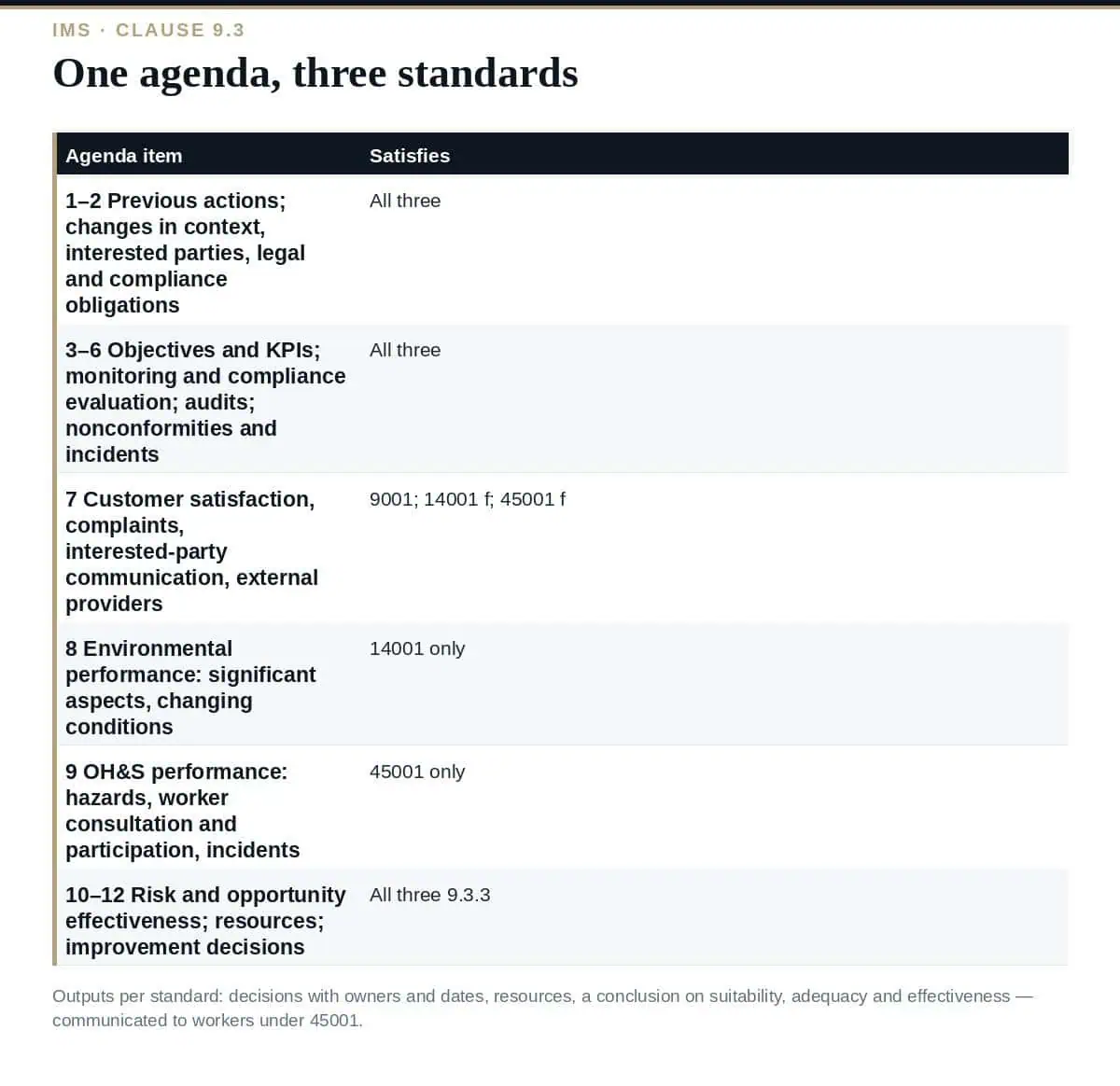
The design principle is simple: common inputs once, standard-specific inputs as separate items, every item tagged with the clauses it satisfies so the minutes are traceable per standard — which IAF MD 11 requires of findings and which auditors extend to review records.
| # | Agenda item | Satisfies | Presented by |
|---|---|---|---|
| 1 | Actions from the previous review: status and closure | 9001/14001/45001 9.3.2 a | IMS manager |
| 2 | Changes in context: external and internal issues, interested parties, legal and other requirements, compliance obligations | 9001 9.3.2 b; 14001 9.3 b; 45001 9.3 b | IMS manager; legal register owner |
| 3 | Objectives and KPIs: quality, environmental and OH&S objectives against targets | 9001 9.3.2 c; 14001 9.3 c; 45001 9.3 d | Objective owners |
| 4 | Monitoring and measurement results; evaluation of compliance results | 9001 9.3.2 c; 14001 9.3 d; 45001 9.3 d | Compliance owner |
| 5 | Internal and external audit results | All three | Audit programme manager |
| 6 | Nonconformities, corrective actions, incidents and investigations | 9001 9.3.2 c; 14001 9.3 d; 45001 9.3 d | Quality; HSE |
| 7 | Customer satisfaction, complaints and interested-party communication; external provider performance | 9001 9.3.2 c; 14001 9.3 f; 45001 9.3 f | Sales/customer service; procurement |
| 8 | Environmental performance: significant aspects, changing conditions | 14001 9.3 | Environmental lead |
| 9 | OH&S performance: hazards and risks, worker consultation and participation, incident trends | 45001 9.3 | HSE lead; worker representative |
| 10 | Effectiveness of actions on risks and on opportunities | 9001 9.3.2 g/h; 14001 9.3 b; 45001 9.3 d | IMS manager |
| 11 | Adequacy of resources | 9001 9.3.2; 14001 9.3 e; 45001 9.3 e | Top management |
| 12 | Opportunities for improvement and decisions | All three 9.3.3 | Top management |
Two integrated management review design points. Item 9 is not optional and cannot be delegated to a separate safety meeting: ISO 45001’s requirement that the review consider “relevant communication with interested parties” and, through clause 5.4, worker consultation and participation, means a worker representative belongs in the room. And the standard-specific items (8 and 9) should be separate agenda lines, not folded into “performance”, because that is how an auditor tests whether the environmental and OH&S reviews actually happened.
Clause 9.3.3 in each standard requires the integrated management review outputs to include decisions and actions on: opportunities for improvement; any need for changes to the management system; resource needs; and, for ISO 14001 and ISO 45001, conclusions on the continuing suitability, adequacy and effectiveness of the system and any implications for strategic direction. ISO 45001 adds that outputs be communicated to workers and their representatives. The minutes therefore need a decisions table — decision, owner, date — a resources table, a stated conclusion on suitability, adequacy and effectiveness for each standard, and a record of communication to workers. Minutes that record discussion without decisions do not meet 9.3.3 in any of the three.
“Planned intervals” is not defined; annual is the minimum most certification bodies accept, and a growing number of integrated systems run a quarterly cycle with a lighter agenda and a full annual review, which suits the Annex SL expectation that management review is a process rather than an event. Format is the organization’s choice; what the auditor tests is that top management — not the IMS manager on their behalf — reviewed the inputs and made the decisions, so attendance and sign-off matter more than the length of the minutes.
Our guide to the combined internal audit covers the audit results that feed item 5, and IMS implementation in seven steps shows where the review sits in the build.
Can one management review cover ISO 9001, ISO 14001 and ISO 45001?
Yes. All three use the harmonized structure and clause 9.3 shares most inputs and outputs. The review must include each standard’s specific inputs — customer satisfaction and external providers, environmental performance and compliance obligations, OH&S incidents and worker consultation — as identifiable items.
How often must an integrated management review be held?
At planned intervals; annually is the minimum certification bodies expect. Quarterly reviews with a full annual review are common in integrated systems.
Who must attend?
Top management, because the review is theirs; the IMS manager and the owners of the inputs; and, for ISO 45001, a worker representative, since consultation and participation are inputs and the outputs must be communicated to workers.
What must the minutes contain?
Evidence that each input was considered, and the outputs of 9.3.3: decisions and actions on improvement, system changes and resources, with owners and dates; a conclusion on suitability, adequacy and effectiveness for each standard; and, for ISO 45001, communication to workers.
Does an integrated review reduce audit time?
It is one of the integration markers IAF MD 11 uses to justify a reduction in audit duration, capped at 20% of the sum of the single-standard durations. A review that is integrated in name only is confirmed as such at stage 1 and the reduction is withdrawn.
Run the integrated management review on one twelve-item agenda with the common inputs once and the environmental and OH&S inputs as their own lines, tag every item with the clauses it satisfies, put a worker representative in the room, and write minutes that record decisions with owners and a conclusion on suitability, adequacy and effectiveness per standard. That is a review that passes three audits and the MD 11 integration test in one sitting.
The Management Review Agenda and Minutes template, the Register of QEHS Objectives and KPIs, the Internal Audit Report and the 26 integrated procedures they draw on are in the IMS Toolkit, or start with the free templates.

October 11, 2026
October 11, 2026
October 11, 2026
October 11, 2026
October 11, 2026

