CART

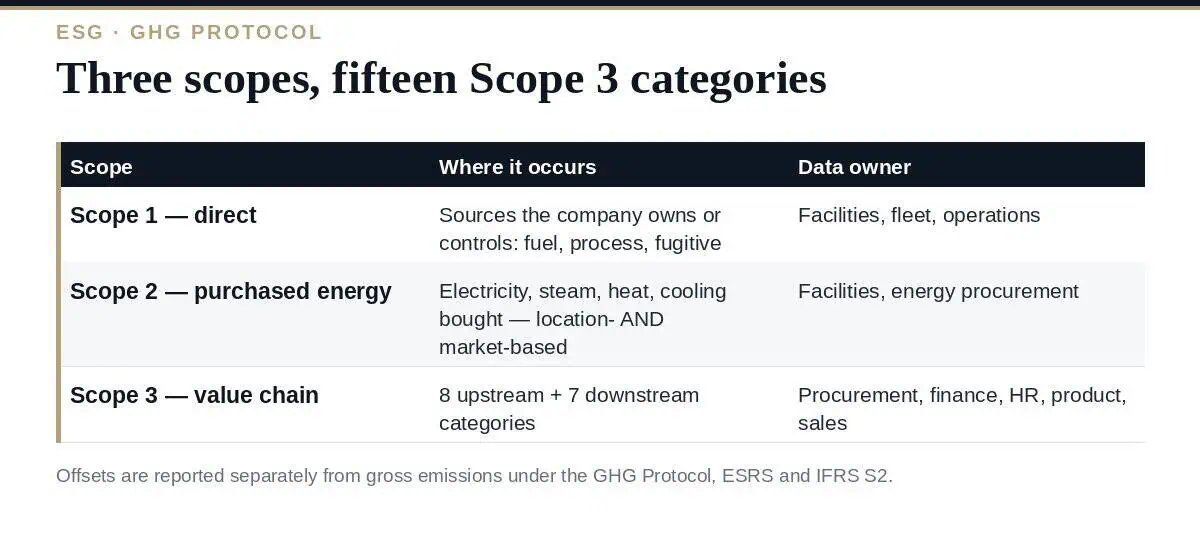
Scope 1, 2 and 3 emissions are the three categories the GHG Protocol uses to divide a company’s greenhouse gas footprint by where the emissions physically occur: Scope 1 from sources the company owns or controls, Scope 2 from the electricity, heat, steam and cooling it buys, and Scope 3 from everything else in its value chain, upstream and downstream.
Every ESG framework that matters — the ESRS under the CSRD, the ISSB’s IFRS S2, GRI 305, the SBTi’s target-setting rules — reports emissions in these three scopes, and for most companies Scope 3 is the largest and least measured of them. This guide explains what each scope contains, the fifteen Scope 3 categories, the two ways Scope 2 must be calculated, how an inventory is built and where the numbers come from, and the errors that make a footprint unassurable.
Free gap assessment
Are you ready for the 2026 edition of ISO 14001?
Score every clause of the new edition, free, including the aspects, life cycle and compliance evaluation work that carries most of the findings.
Run the free ISO 14001 gap assessment → or View premium report sample
| Scope | Definition (GHG Protocol Corporate Standard) | Typical sources | Data owner |
|---|---|---|---|
| Scope 1 — direct | Emissions from sources owned or controlled by the company | Fuel burned in boilers, furnaces and company vehicles; process emissions; fugitive emissions such as refrigerant leaks | Facilities, fleet, operations |
| Scope 2 — indirect, purchased energy | Emissions from the generation of purchased electricity, steam, heat and cooling consumed by the company | Grid electricity; district heating; purchased steam | Facilities, energy procurement |
| Scope 3 — other indirect | All other indirect emissions occurring in the company’s value chain, upstream and downstream | Purchased goods, business travel, employee commuting, transport, use of sold products, investments | Procurement, finance, HR, product, sales |
The boundary rule that decides what is Scope 1 rather than Scope 3 is the consolidation approach: operational control, financial control or equity share, chosen once and applied consistently. A leased vehicle is Scope 1 under operational control and Scope 3 (category 8, upstream leased assets) if the company does not control it. The choice has to be stated in the inventory, because it changes the numbers.
The GHG Protocol Scope 2 Guidance of 2015 requires companies with any operations in markets that offer contractual instruments — renewable energy certificates, guarantees of origin, power purchase agreements — to report Scope 2 two ways. The location-based method applies the average emission factor of the grid where the electricity is consumed; it reflects the physical reality of the local grid.
The market-based method applies the emission factor of the electricity the company has contractually chosen — a supplier-specific factor, a certificate, a PPA, or the residual mix where nothing has been chosen; it reflects purchasing decisions. Both figures are reported; a company that publishes only the market-based number, which its renewable purchases make lower, is not following the standard. The ESRS and IFRS S2 both require the dual disclosure.
The GHG Protocol’s Corporate Value Chain (Scope 3) Standard of 2011 divides value-chain emissions into fifteen categories, eight upstream and seven downstream.
| # | Category | Upstream / downstream | What it covers | Typical share of Scope 3 |
|---|---|---|---|---|
| 1 | Purchased goods and services | Upstream | Cradle-to-gate emissions of everything bought | Usually the largest for service and retail companies |
| 2 | Capital goods | Upstream | Embodied emissions of equipment, buildings, vehicles bought | Lumpy; large in build years |
| 3 | Fuel- and energy-related activities | Upstream | Extraction, production and transmission losses of fuels and electricity not in Scope 1 or 2 | Small but always present |
| 4 | Upstream transportation and distribution | Upstream | Inbound logistics paid for by the company | Material for physical goods |
| 5 | Waste generated in operations | Upstream | Treatment and disposal of operational waste | Small |
| 6 | Business travel | Upstream | Flights, rail, hotels, hire cars | Often the first category measured; rarely the largest |
| 7 | Employee commuting | Upstream | Travel between home and work; remote-working energy where included | Moderate |
| 8 | Upstream leased assets | Upstream | Assets leased by the company not counted in Scope 1 or 2 | Depends on the consolidation approach |
| 9 | Downstream transportation and distribution | Downstream | Outbound logistics not paid for by the company | Material for physical goods |
| 10 | Processing of sold products | Downstream | Emissions from processing intermediate products by customers | Material for materials and components |
| 11 | Use of sold products | Downstream | Energy or fuel used by products in operation | Usually the largest for energy-using products and fuels |
| 12 | End-of-life treatment of sold products | Downstream | Disposal and treatment of products at end of life | Moderate for physical goods |
| 13 | Downstream leased assets | Downstream | Assets owned and leased to others | Real estate lessors |
| 14 | Franchises | Downstream | Operations of franchisees | Franchise businesses |
| 15 | Investments | Downstream | Financed and insured emissions | Usually the largest for banks, insurers and investors |
Not every category applies to every company, but the standard expects each to be assessed and either measured or excluded with a stated reason. “Not measured” is not an exclusion. The categories that dominate depend on the business model: purchased goods for services and retail, use of sold products for manufacturers of energy-using equipment, investments for financial institutions.
Scope 1, 2 and 3 emissions are the first metric in every ESG framework and the basis of every climate target. The SBTi requires a Scope 3 target where Scope 3 is at least 40% of total emissions; IFRS S2 requires Scope 3 disclosure by category with the measurement approach; the ESRS E1 standard requires all three scopes with the dual Scope 2 methods. They also feed the transition plan, the climate risk assessment and, for suppliers to large companies, the customer’s own category 1. A supplier that cannot report its Scope 1 and 2 is increasingly a supplier that cannot be scored. Our guide to ESG KPIs shows where the emissions figures sit among the metrics boards ask for.
What is the difference between Scope 1, 2 and 3 emissions?
Scope 1 is direct emissions from sources the company owns or controls; Scope 2 is indirect emissions from purchased electricity, heat, steam and cooling; Scope 3 is all other indirect emissions in the value chain, in fifteen categories upstream and downstream, as defined by the GHG Protocol.
Is Scope 3 reporting mandatory?
Under the ESRS for companies in CSRD scope and under IFRS S2 where adopted, yes, by category with the measurement approach stated. The GHG Protocol itself expects each category to be assessed and either measured or excluded with a reason.
Why are there two Scope 2 figures?
The GHG Protocol Scope 2 Guidance requires both a location-based figure (grid average factor) and a market-based figure (contractual instruments such as certificates and PPAs) wherever such instruments exist. Reporting only the lower one does not follow the standard.
Which Scope 3 category is usually the largest?
It depends on the business: purchased goods and services for service and retail companies, use of sold products for makers of energy-using products and fuels, investments for financial institutions.
Can carbon offsets reduce reported emissions?
No. Offsets and credits are disclosed separately from gross Scope 1, 2 and 3 emissions under the GHG Protocol, ESRS and IFRS S2, and claims of neutrality based on offsetting outside the value chain are prohibited in the EU from 27 September 2026.
Build the Scope 1, 2 and 3 emissions inventory the way it will be assured: boundary stated, refrigerants in Scope 1, both Scope 2 methods, every Scope 3 category screened and the material ones measured, every factor sourced, the base year policy written, and offsets reported separately. That inventory is the foundation of the targets, the transition plan and the disclosures everything else in ESG rests on.
The environmental policy, the environmental aspects and impacts register and the aspects, impacts, risk and opportunity register that an emissions inventory is documented alongside are in the ESG Toolkit, or start with the free templates.

October 11, 2026
October 11, 2026

October 11, 2026
October 11, 2026

October 11, 2026

