
CART
No products in the cart.
ISO Compliance Insights & Best Practices
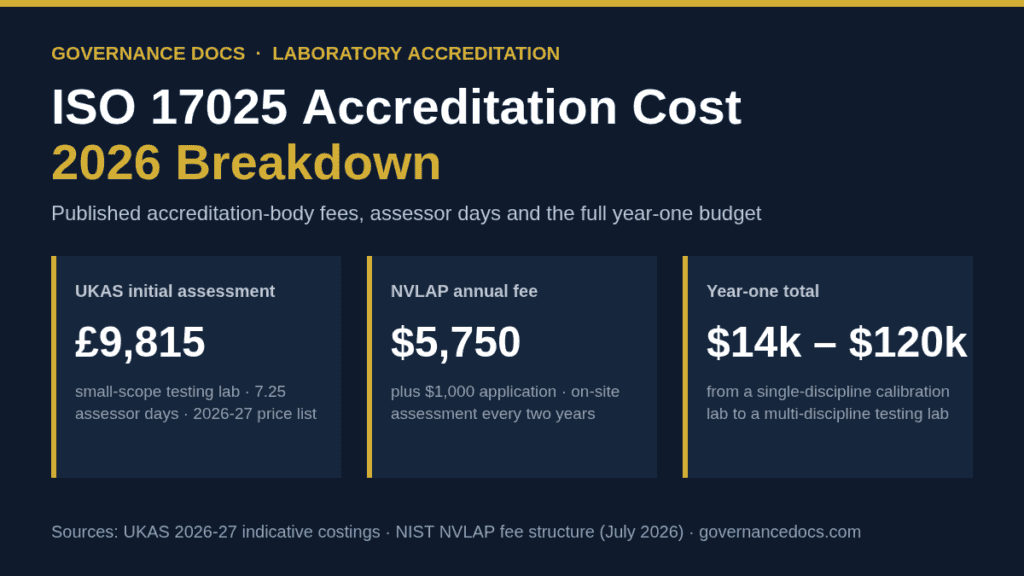
ISO 17025 accreditation cost is the figure every laboratory manager wants before the budget meeting, and the one figure most accreditation bodies will only give you after an application form. That is less mysterious than it looks. Accreditation fees are assessor days multiplied by a day rate, plus expenses, plus a fixed application or annual fee, and two accreditation bodies now publish enough of their pricing to reconstruct the arithmetic. This guide walks through UKAS’s own 2026-27 worked costings, NVLAP’s published fee structure, what the US commercial bodies will and will not say, and the consultant, proficiency-testing and internal costs that sit around the accreditation invoice.
Free gap assessment
Are you ready for the 2026 edition of ISO 9001?
Score yourself against the new edition, free, including the risk and opportunity split and the clause 10 renumbering that breaks converted checklists.
Run the free ISO 9001 gap assessment → or View premium report sample
The first thing to fix is the vocabulary. Laboratories are accredited to ISO/IEC 17025, not certified. Certification bodies audit management systems against ISO 9001 or ISO 27001; accreditation bodies operating under ISO/IEC 17011 assess a laboratory’s technical competence to perform specific tests or calibrations, and the scope of accreditation lists those activities one by one. The distinction matters for cost because the price is driven by the scope, not the headcount. A ten-person lab with forty test methods across chemistry and microbiology needs more technical assessor days than a thirty-person lab that calibrates one class of thermometer.
That is why A2LA, ANAB and PJLA give quotes rather than price lists. A2LA’s own FAQ says the cost “will vary significantly depending on the size of the organization seeking accreditation, the size of the scope(s) of accreditation, and the organization’s readiness for assessment,” and offers a free estimate on request. PJLA’s applicant guide reduces every quote to three elements: a daily rate, overhead, and travel. So the useful question is not “what is the price” but “how many assessor days will my scope take, and at what rate.”
| Cost component | Who invoices it | Typical range (2026) | What drives it |
|---|---|---|---|
| Application fee | Accreditation body | $0 to $1,800 (PJLA charges none; NVLAP $1,000; UKAS £1,796) | Fixed per body |
| Initial assessment (document review + on-site + close-out) | Accreditation body | $8,000 to $22,000 | Assessor days, set by scope breadth and number of technical disciplines |
| Annual fees and surveillance | Accreditation body | $4,000 to $12,000 per year | Cycle length (2 or 4 years), partial vs full visit, NVLAP’s $5,750 flat annual fee |
| Proficiency testing and interlaboratory comparisons | PT providers | $300 to $1,000 per scheme round, several rounds per year | Number of sub-disciplines on scope (clause 7.7 requires coverage, not one scheme) |
| Consultant or gap analysis | Consultancy | $10,000 to $50,000 | Whether they write the system for you or review yours |
| Documentation templates | Template vendor | $99 to $2,000 | Buying a pack versus drafting from scratch |
| Equipment calibration to traceable standards | Calibration labs | $2,000 to $15,000+ | Clause 6.5 traceability; often the largest hidden line for a new lab |
| Internal staff time | Your payroll | $15,000 to $40,000 equivalent | Method validation, uncertainty budgets, records, internal audit |
| ISO/IEC 17025:2017 standard | ISO Store | CHF 179 (about $220) | Fixed |
The accreditation-body rows are anchored to the two published fee sets discussed next, converted loosely to US dollars. The consultant, calibration and internal rows are labelled typical ranges drawn from published consultancy estimates and our own project experience; they are not quotes. Anyone who gives you a single figure without asking how many methods are on your scope is guessing.
UKAS, the UK national accreditation body, is unusually transparent. It publishes indicative case studies on its own site built from its 2026-27 price list, and they are the best public evidence of how ISO 17025 accreditation cost is constructed. All figures below are exclusive of VAT and are UKAS’s estimates for a single UK site with a normal level of compliance.
| UKAS case study (2026-27 price list) | Small-scope testing lab (soil analysis, 5–8 techniques) | Larger-scope testing lab (full food chemistry + microbiology) | Small calibration lab (temperature, −60 °C to 250 °C) |
|---|---|---|---|
| Application fee | £1,796 | £1,796 | £1,796 |
| Optional pre-assessment | £4,694.50 (3.5 days) | £7,331.50 (5.5 days) | £4,694.50 (3.5 days) |
| Initial assessment | £9,815.25 (7.25 days: 2 office, 4.5 site, 0.75 close-out) | £15,790.50 (11.5 days: 2.5 office, 8 site, 1 close-out) | £6,743 (5 days) |
| Surveillance, each of years 1–3 | £6,758.25 (5.25 days) | £8,837.50 (7.25 days) | £4,220.25 (3.25 days) |
| Reassessment, year 4 | £9,464.75 | £15,740 | £6,473 |
| Four-year total, no pre-assessment | about £41,350 | about £59,840 | about £27,670 |
Three things in those tables are worth more than the totals. First, the day rate: the line items imply roughly £1,140 to £1,195 per assessment day in 2026-27, and expenses are a flat £256 per assessor per site day rather than actual travel. Second, office effort is billed. Document review before the visit and report writing after it are two to three assessment days on every initial assessment, which is why a body quoting only “on-site days” is quoting you low. Third, the site days are split across a lead assessor and one or two technical assessors, so a 4.5-day site effort is three people for a day and a half, not one person for a week. Adding a technical discipline usually adds a technical assessor, and that is the single biggest lever on ISO 17025 accreditation cost.
UKAS also caveats that niche activities may require external expertise “at a rate higher than £650/day,” and that a laboratory with more findings than normal will pay for extra close-out effort. Both are real: a first assessment that raises twenty findings across three submissions costs more than one that raises six across one.
The US market is split between one government program and several commercial bodies, and their pricing models differ.
NVLAP (the NIST National Voluntary Laboratory Accreditation Program) publishes its fee structure outright, updated July 2026. The initial application fee is $1,000, one-time and non-refundable. The annual administrative and technical support fee is $5,750, due every year regardless of accreditation status. On-site assessment fees are fixed for a handful of programs (for example $5,040 for bulk asbestos fiber analysis and $8,000 to $11,500 for cryptographic security testing) and quoted case by case for everything else, including calibration. On-site assessments happen at initial accreditation, at the first renewal, and every two years after that, with the annual fee due every year in between. A NVLAP lab should therefore budget roughly $6,750 in year one before the assessment, then $5,750 a year plus an assessment fee in alternate years.
A2LA does not publish rates but states that it charges no hidden or document fees and provides a free written estimate. Its cycle is two years, with a surveillance assessment between renewals, and it reports that a well-prepared applicant completes the process in three to six months, five on average. PJLA charges no application fee, bills travel at cost with no mark-up, and conducts a surveillance assessment twelve months after the initial assessment; after a full cycle with a clean history, that surveillance may be done by document review rather than a site visit, which is a genuine saving. ANAB quotes on application. For all three, the working assumption is a day rate somewhere below the UKAS figure plus assessor travel, and the assessor-day count is what you should compare between quotes.
Clause 7.7 of ISO/IEC 17025:2017 requires the laboratory to monitor the validity of its results, and every accreditation body turns that into a proficiency-testing participation plan covering each sub-discipline on the scope. A lab with chemistry, microbiology and physical testing on scope cannot satisfy that with one scheme. At a few hundred to a thousand dollars per round, PT is a recurring line that scales with scope breadth, and a lab that skips it will be found at surveillance. Our guide to proficiency testing coverage and scores explains how assessors read the plan.
Clause 6.5 requires metrological traceability for every measurement that affects results. For a new laboratory this is often the largest surprise: balances, thermometers, reference materials, pipettes and chambers all need calibration from an accredited provider, on a schedule, before the first assessment. Calibration labs pay it the other way round, in reference standards. Budget it explicitly rather than discovering it in the document review.
Assessors spend more time on clause 7.6 uncertainty budgets and clause 7.2 method validation than on any policy document, and A2LA names “measurement uncertainty budget issues” as one of its three most common causes of delay. That time is internal, expensive, and easy to underestimate. If your technical staff have never built a budget, either pay for training or read our walkthrough of how to build a measurement uncertainty budget that holds up before you apply, not after the findings arrive.
A consultant who writes the whole management system, trains staff and sits in on the assessment typically runs $10,000 to $50,000 depending on scope. A lab that already has competent technical staff usually needs far less: a gap analysis, a documentation framework, and review of the uncertainty and validation files. The pillar guide to ISO 17025 accreditation, scope and where laboratories lose findings is the place to work out which of those you actually need.
| Scenario | Accreditation body, year one | Consultant + templates + training | Calibration, PT, internal time | Year-one total (typical range) | Ongoing, per year |
|---|---|---|---|---|---|
| Small calibration lab, one discipline, 5 staff, in-house build with a template pack | $6,000 to $10,000 | $100 to $3,000 | $8,000 to $18,000 | $14,000 to $31,000 | $5,000 to $9,000 |
| Small testing lab, one sector, 6–8 methods, part-time consultant | $10,000 to $15,000 | $8,000 to $20,000 | $12,000 to $25,000 | $30,000 to $60,000 | $7,000 to $12,000 |
| Larger testing lab, chemistry + microbiology, 30+ methods, full consultant | $18,000 to $25,000 | $25,000 to $50,000 | $25,000 to $45,000 | $68,000 to $120,000 | $10,000 to $18,000 |
These are planning ranges, not quotes. The accreditation-body column is scaled from the UKAS and NVLAP figures above; the rest are typical ranges. The pattern to notice is that the accreditation body is rarely more than a third of year-one ISO 17025 accreditation cost. The money goes into becoming competent enough to pass, which is also why a lab that is technically strong but badly documented gets accredited for far less than one that is neat on paper and weak in the uncertainty files.
PJLA’s guide puts preparation at six months to a year for a typical laboratory, and the assessment itself, from closure of nonconformities to certificate, at 60 to 90 days including committee review. A2LA reports five months on average from application to accreditation for a prepared applicant. UKAS schedules the first surveillance six months after the grant of accreditation, then annually. Put together, a realistic plan is nine to fifteen months from decision to certificate, with the accreditation-body invoice arriving in the last third of that window. Every month of slippage is a month of staff time the schedule did not budget for, and a month of contracts that require an accredited report still going elsewhere.
Narrow the initial scope. Accredit the methods customers actually ask for, then extend. Scope extensions can often be done at a routine visit or by document review, and every method you leave off the first application removes assessor time and PT rounds.
Skip the optional pre-assessment if you are ready. UKAS prices it at £4,694.50 for a small lab. It is worth paying when the technical staff have never been assessed; it is wasted money when a competent internal audit under clause 8.8 would find the same gaps.
Clear findings in one submission. Close-out effort is billed per submission of evidence. A well-organised corrective-action pack with root cause and objective evidence for every finding costs a fraction of two rounds of “please clarify.”
Do not buy the consultant’s documentation twice. If you retain a consultant for the technical work, supply the management-system documents yourself. The ISO 17025 Toolkit ($99) contains 70 editable templates aligned to ISO/IEC 17025:2017 under either Option A or Option B: impartiality and confidentiality policies, personnel competence and authorisation records, equipment and traceability registers, method validation and uncertainty templates, proficiency-testing plans, decision-rule and reporting templates, and the internal audit and management review records the assessor asks for on day one. That is the documentation line of the table above at the bottom of its range, leaving the consultant budget for the uncertainty budgets and validation work that actually need an expert.
Plan on $14,000 to $31,000 in year one for a single-discipline calibration lab built in-house, and $30,000 to $60,000 for a small testing lab using a consultant, with $5,000 to $12,000 a year after that. The accreditation body’s own share of that is typically $6,000 to $15,000 in year one: UKAS’s published small-scope estimate is £9,815 for the initial assessment plus a £1,796 application fee, and NVLAP charges $1,000 to apply plus $5,750 a year.
Annual. Every body runs a surveillance cycle: UKAS assesses every year on a four-year cycle with reassessment in year four, A2LA renews every two years with a surveillance between, NVLAP charges a $5,750 annual fee with on-site assessment every two years after the first renewal, and PJLA surveils at twelve months. On UKAS’s published figures each surveillance year runs roughly 55 to 70 percent of the initial assessment fee, plus proficiency testing and calibration.
No. ISO 9001 certification attests that a quality management system meets the standard; ISO 17025 accreditation attests that a laboratory is technically competent to perform the specific tests or calibrations on its scope, and is granted by an accreditation body under ISO/IEC 17011, not a certification body. ISO 17025 clause 8 gives you Option B, which lets a lab already certified to ISO 9001 use that system, but the technical assessment is not reduced. Medical laboratories are accredited to ISO 15189 instead; see our guide to ISO 15189 for medical laboratories.
More technical disciplines cost more, because each usually needs its own technical assessor and its own proficiency-testing scheme. More methods within one discipline cost less than you would expect, since the same assessor samples across them. UKAS’s larger-scope food lab, with four full technique families, costs about 60 percent more to assess than its single-sector soil lab, not four times more.
Yes, and many calibration labs do. The prerequisites are technical staff who can build uncertainty budgets and validate methods, a documentation framework you do not have to invent, and an internal audit before you apply. A2LA’s own FAQ attributes most delays to incomplete applications, uncertainty budget problems and slow responses to findings, none of which a consultant fixes better than a competent quality manager with time allocated.

October 11, 2026
October 11, 2026
October 11, 2026
October 11, 2026
October 11, 2026
