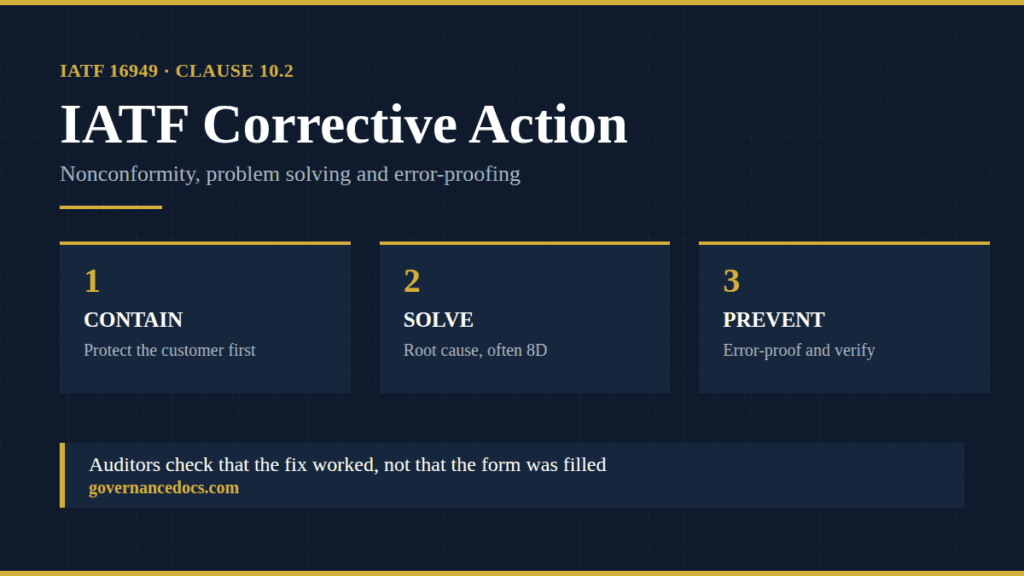
IATF 16949 corrective action is the part of an automotive quality system that shows whether a problem stays fixed. Auditors and customers read your corrective action records to judge the whole QMS, so weak ones cost you more than a single finding.
This guide walks through IATF 16949:2016 clause 10.2, nonconformity and corrective action. It covers the ISO 9001 base, the four automotive additions, the evidence an auditor asks for and a worked 8D outline you can copy.
A quick edition note. IATF 16949:2016 still sits on top of ISO 9001:2015. The IATF plans a second edition for mid-2027, and its Stakeholder Communiqué SC-2026-005 aligns the transition end with the end of the ISO 9001 transition. Our IATF 16949 second edition timeline tracks what may change.
Free gap assessment
Where do you stand on the automotive supplemental requirements?
Score only what IATF adds to ISO 9001, free, including customer-specific requirements, product safety and the core tools.
The ISO 9001 base under IATF 16949 corrective action
IATF 16949 is not a standalone standard. It adds automotive requirements to ISO 9001, so every IATF 16949 corrective action starts with ISO 9001 clause 10.2.
ISO 9001 clause 10.2.1 says that when a nonconformity occurs, including one from a complaint, you must:
react to it: control and correct it, and deal with the consequences;
evaluate the need to remove its causes, by reviewing it, finding its causes and checking whether similar nonconformities exist or could occur;
implement any action needed;
review the effectiveness of the corrective action taken;
update risks and opportunities from planning, if necessary;
change the QMS, if necessary.
Clause 10.2.2 then requires documented information as evidence of the nature of each nonconformity, the actions taken and the results. That is the minimum. The automotive layer is where most findings come from.
IATF 16949 clause 10.2 additions: four automotive requirements
IATF 16949 clause 10.2 keeps the ISO text and adds four supplemental clauses. Each one closes a gap that a generic QMS tends to leave open.
10.2.3 Problem solving
Clause 10.2.3 requires a documented problem-solving process. The IATF revised it through Sanctioned Interpretation 20, issued December 2020 and effective January 2021, to require that the process prevents recurrence.
The process must include:
defined approaches for different types and scales of problem, such as new product development, current manufacturing issues, field failures and audit findings;
containment, interim actions and related activities to control nonconforming outputs;
root cause analysis, with the method used, the analysis and the results;
systemic corrective actions, including the impact on similar processes and products;
verification that the corrective actions worked;
review and, where necessary, update of documented information such as the PFMEA and control plan.
Where a customer prescribes its own problem-solving process, tools or systems, you must use them unless the customer approves otherwise. The current text sits in the IATF’s published IATF 16949 Sanctioned Interpretations.
10.2.4 Error-proofing
Clause 10.2.4 requires a documented process to decide when to use error-proofing. The method goes into your process risk analysis, such as the PFMEA, and test frequencies go into the control plan.
You must test error-proofing devices for failure or simulated failure and keep records. Challenge parts, where used, must be identified, controlled, verified and calibrated where feasible. A failed device needs a reaction plan.
10.2.5 Warranty management systems
If you must provide warranty for your product, clause 10.2.5 requires a warranty management process. It must include a method for warranty part analysis, including no trouble found (NTF) parts. If the customer specifies a warranty process, you implement that one.
10.2.6 Customer complaints and field failure test analysis
Clause 10.2.6 requires analysis of customer complaints and field failures, including returned parts. That analysis must start problem solving and corrective action to prevent recurrence.
Where the customer requests it, the analysis covers how your product’s embedded software interacts within the customer’s final product. You communicate test and analysis results to the customer and inside your organization.
Clause 10.2 requirements and the evidence auditors check
Use this table as an IATF 16949 corrective action self-check before a surveillance audit. The evidence column lists what an auditor typically samples, not wording from the standard.
Clause
Requirement
Evidence an auditor checks
ISO 9001 10.2.1
React, find causes, act, check effectiveness
Nonconformity reports with containment, cause, action and effectiveness dates
ISO 9001 10.2.2
Retain records of nonconformities and results
A complete, searchable corrective action log
IATF 10.2.3
Documented problem solving that prevents recurrence
Procedure, completed 8D or customer format, read-across to similar parts, updated PFMEA and control plan
IATF 10.2.4
Documented error-proofing process and testing
Error-proofing list, device verification records, challenge part controls, reaction plan
IATF 10.2.5
Warranty management process with NTF analysis
Warranty part analysis records, NTF trend, customer warranty requirements
IATF 10.2.6
Analysis of complaints, field failures and returned parts
Complaint register, test reports, problem-solving link, evidence results went to the customer
8D problem solving and customer-specific requirements
The standard does not name a method. But many OEMs prescribe one in their customer-specific requirements, and 8D problem solving is a widely used format for an IATF 16949 corrective action. Because clause 10.2.3 makes you use a customer’s prescribed tools, your format may already be decided for you.
8D stands for eight disciplines. Many customers add a D0 planning step and set deadlines for each stage, often in their supplier portals. Read each customer’s requirements and record which format applies to which customer.
Other tools fit inside 8D rather than replacing it. 5 Why, fishbone diagrams and is/is-not analysis support D4. The core tools also feed it, and our guide to the IATF 16949 core tools explains how PFMEA, MSA and SPC connect.
A worked 8D outline for IATF 16949 corrective action
Here is an illustrative example. A customer reports door trim panels arriving with a missing retaining clip. The steps below show what a complete IATF 16949 corrective action record would contain.
D0 Plan: log the complaint, confirm the customer’s 8D format and deadlines, and decide whether an emergency response is needed.
D1 Team: name a cross-functional team: quality lead, production supervisor, process engineer and the operator from the affected line.
D2 Describe: state the problem in measurable terms. Which part numbers, how many, which shift and dates, and where it was found. Use is/is-not to bound it.
D3 Contain: sort stock at your plant, in transit and at the customer. Record quantities checked and rejected, and mark certified-good parts.
D4 Root cause: find why the clip was missed (occurrence) and why it escaped (detection). Verify each cause by turning it on and off where possible.
D5 Choose actions: select permanent actions for both causes, such as a clip-presence sensor. Confirm they work before full rollout.
D6 Implement: install the change, remove containment only when data supports it, and validate with production results.
D7 Prevent recurrence: update the PFMEA, control plan and work instructions. Apply the fix to similar lines and products. Add the device to your error-proofing verification list.
D8 Close: confirm effectiveness over an agreed period, recognize the team, and send the closed report to the customer.
Give D4 and D7 the most attention. A root cause that only names “operator error” rarely survives an IATF auditor’s questions.
Where IATF 16949 corrective action usually breaks down
Check your last ten closed reports against these common weak spots:
containment covers your plant but not parts in transit or at the customer;
the root cause explains occurrence but not why the defect escaped;
the action is retraining, with no change to the process or controls;
effectiveness is declared on the day of implementation, without data.
Layered process audits are a good way to confirm that new controls stay in place. Our layered process audit guide shows how to add a closed action to your audit questions.
For the wider picture of how clause 10.2 fits with the rest of the standard, see our IATF 16949 compliance guide.
IATF 16949 corrective action FAQ
Is 8D mandatory under IATF 16949?
No. IATF 16949 requires a documented problem-solving process but does not name 8D for an IATF 16949 corrective action. However, if a customer prescribes 8D or another format, clause 10.2.3 requires you to use it unless the customer approves an alternative.
What is the difference between correction and corrective action?
Correction deals with the nonconformity itself, such as sorting or reworking parts. Corrective action removes the cause so it does not happen again. IATF 16949 also expects you to look at similar processes and products.
Does IATF 16949 require a documented process for corrective action?
Yes. Clause 10.2.3 requires a documented problem-solving process, and clause 10.2.4 requires a documented error-proofing process. ISO 9001 clause 10.2.2 also requires records of each nonconformity and its results.
Which documents should a corrective action update?
At a minimum, review the PFMEA, control plan and work instructions. Clause 10.2.3 lists the PFMEA and control plan as examples of documented information to update where necessary.
Our IATF 16949 Toolkit provides 250+ editable templates for an automotive QMS — including a Corrective and Preventive Action 8D workbook, a Why Why Analysis sheet and a Customer Complaint Register — for $99.
When a standard changes, know first
One email a month: edition changes, new deadlines, and what they mean for documentation you already have. No sales sequence.