CART

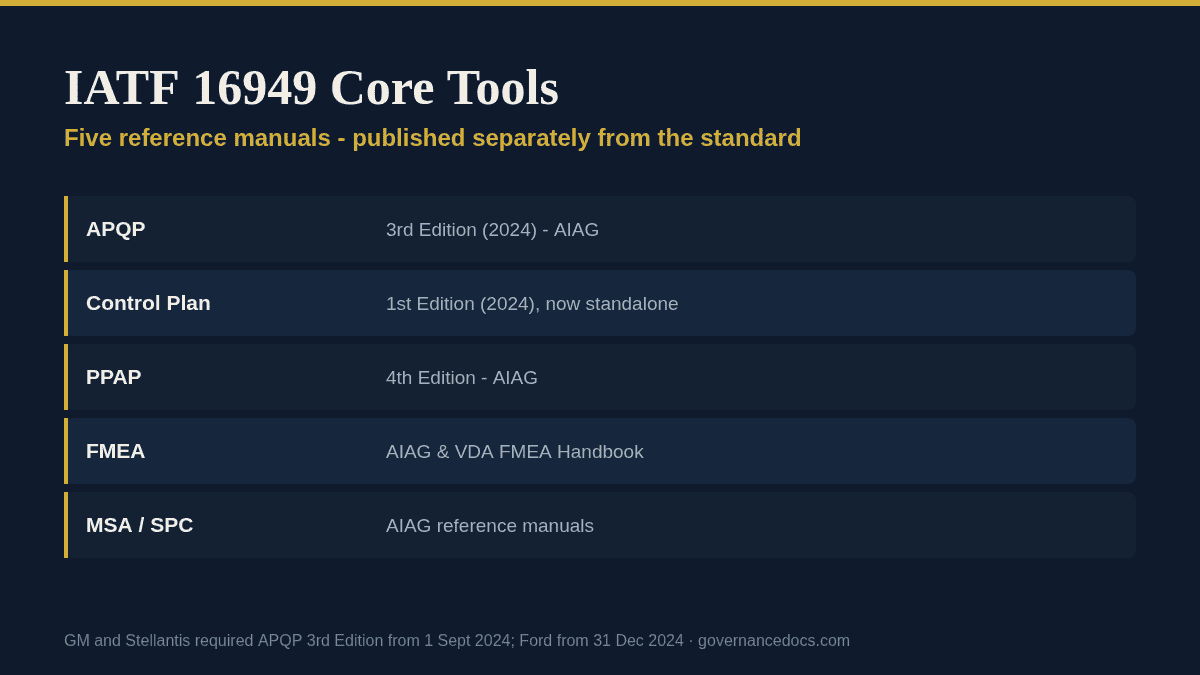
The IATF 16949 core tools are the five reference manuals every automotive supplier
is expected to work to — and the single most common misunderstanding about them is that they
live inside the standard. They do not. IATF 16949:2016 references them; AIAG and VDA publish them
separately, and they move on their own schedules. In 2024 one of them split in two, and the OEMs set
hard deadlines for it.
Free gap assessment
Where do you stand on the automotive supplemental requirements?
Score only what IATF adds to ISO 9001, free, including customer-specific requirements, product safety and the core tools.
Run the free IATF 16949 gap assessment → or View premium report sample
Five disciplines make up the set, and each has its own reference manual:
The relationship matters more than the list. IATF 16949 sets requirements; the manuals describe
the accepted methods for meeting them. That is why an auditor can raise a nonconformity against the
standard for a weak control plan, while the detail of how a control plan should be structured comes
from a document you buy separately from AIAG.
AIAG published APQP 3rd Edition and, for the first time, Control Plan 1st
Edition as a standalone manual. Decoupling the two was deliberate: it lets the control plan
material be revised on its own cycle rather than waiting for an APQP revision.
The revision was not cosmetic. APQP 3rd Edition added material on sourcing, change management,
programme metrics, risk assessment and mitigation planning, gated management and part traceability,
alongside checklists and worked examples. The new Control Plan manual introduced a safe-launch phase,
guidance for highly automated manufacturing, and guidance on managing control plans in software.
Then the OEMs set dates. GM and Stellantis required implementation from 1 September 2024,
and Ford from 31 December 2024. Those are customer requirements, not IATF requirements
— which is exactly the trap. A supplier reading only the standard would have seen nothing
telling them to move.
| Tool | Current reference manual | Publisher |
|---|---|---|
| APQP | APQP 3rd Edition (2024) | AIAG |
| Control Plan | Control Plan 1st Edition (2024), standalone | AIAG |
| PPAP | PPAP 4th Edition | AIAG |
| FMEA | AIAG & VDA FMEA Handbook | AIAG and VDA jointly |
| MSA / SPC | MSA and SPC reference manuals | AIAG |
Always confirm the edition your customer requires against their own customer-specific
requirements, because OEMs adopt new manual editions on their own timetables and a supplier serving
several OEMs can legitimately be working to different editions at once. Our guide to
customer-specific requirements
covers how to keep that straight.
Suppliers who struggle with the core tools almost always treat them as five separate deliverables
produced by five different people. They are one chain, and each link feeds the next.
APQP sets the phases and the gates. Inside those phases, the process flow identifies the steps, the
FMEA identifies what can go wrong at each step and how significant it is, and the control plan
specifies the control that catches it. MSA proves the measurement system used by that control can
actually detect what it claims to. SPC demonstrates the process is stable and capable over time. PPAP
is the package that presents all of it to the customer for approval.
The diagnostic question an auditor will ask is whether the chain holds together: does every high
severity failure mode in the FMEA have a corresponding control in the control plan, and does every
control in the control plan have a measurement system that has been analysed? Broken links between
documents are found far more often than missing documents.
The manuals themselves are copyrighted publications and the detailed submission requirements and
element lists belong to AIAG — buy them, because no summary substitutes for the real text.
What you can plan around without them is the shape of the evidence:
PPAP submission levels run from the lightest to a full submission of everything, and the level is
set by your customer, not by you. Getting written confirmation of the required level before you build
the submission saves more rework than any other single habit in this area.
The core tools chain, already built and linked.
The IATF 16949 Toolkit ships 250+ editable MS Office templates including APQP and PPAP packs, a combined process flow / FMEA / control plan workbook, MSA and SPC calculators, 33 turtle diagrams and a customer-specific requirements matrix — so the links between documents exist from day one instead of being retrofitted before an audit.
Auditors rarely ask to see “your FMEA.” They pick a part, often one with a recent
customer complaint or a recent change, and walk the chain around it. That is a deliberately harder
test than a document review, and it is where the difference between a maintained system and an
assembled one becomes visible in minutes.
A typical trail runs: what is the process flow for this part, which failure modes did you identify
at this operation, what control catches the highest severity one, show me that control on the line,
show me the MSA for the gauge that control depends on, show me the capability data, and show me the
customer approval. Any break in that trail is a finding, and the break is almost never a missing
document — it is a document that no longer agrees with the one before it.
Ownership is the underlying issue. Where the IATF 16949 core tools are owned by the quality
department, they describe what quality believes happens. Where they are owned by the multidisciplinary
team that actually runs the process — manufacturing engineering, production, maintenance, quality
together — they describe what happens. IATF 16949 requires a multidisciplinary approach for
precisely this reason, and auditors probe for it by asking who wrote a given entry and when it was last
challenged.
None of this requires new documents. It requires the documents you already have to agree with each
other, which is both cheaper and considerably harder than producing them in the first place.
Are the IATF 16949 core tools mandatory?
The standard requires the outcomes and references the manuals as the accepted methods, and customers
routinely mandate the manuals directly through their customer-specific requirements. In practice, for
a supplier to an IATF OEM, yes.
Do I have to buy the AIAG manuals?
If you are audited to IATF 16949 you need access to the editions your customers require. They are
copyrighted publications sold by AIAG; there is no free authorised equivalent, and no summary is a
substitute during an audit.
Is the control plan still part of APQP?
No. Since 2024 AIAG publishes Control Plan 1st Edition as a standalone manual, separate from APQP 3rd
Edition, so that the two can be revised independently.
Which FMEA method should we use?
The AIAG & VDA FMEA Handbook is the joint method and is what current bundles and training are
built around. Confirm against your customer’s requirements, because adoption dates differ by OEM.
Will the core tools change in the IATF 16949 second edition?
Nothing published says so. The five priorities in IATF’s July 2026 communiqué do not mention APQP,
PPAP, FMEA, MSA or SPC at all. See our guide to the
IATF 16949 second edition.
All of these are covered by the IATF 16949 Toolkit, or start with the free ISO templates.

October 11, 2026
October 11, 2026
October 11, 2026
October 11, 2026
October 11, 2026

