CART
The IATF 16949 second edition is now formally under development, and for the first
time there is a published timeline to plan against rather than rumour. This guide sets out what the
International Automotive Task Force has actually committed to in writing, what it has not, and what a
certified supplier should sensibly do between now and publication.
Free gap assessment
Where do you stand on the automotive supplemental requirements?
Score only what IATF adds to ISO 9001, free, including customer-specific requirements, product safety and the core tools.
Run the free IATF 16949 gap assessment → or View premium report sample
IATF 16949:2016 is the current automotive quality management standard and remains the standard you
are audited and certified against today. It is a sector-specific supplement that sits on top of
ISO 9001 rather than replacing it, which is why the two revisions are moving together.
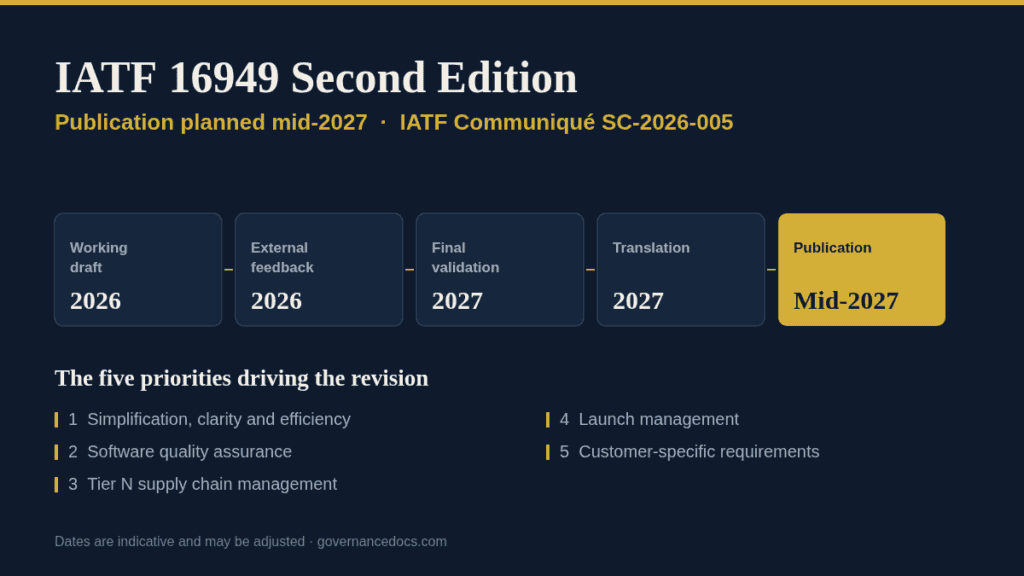
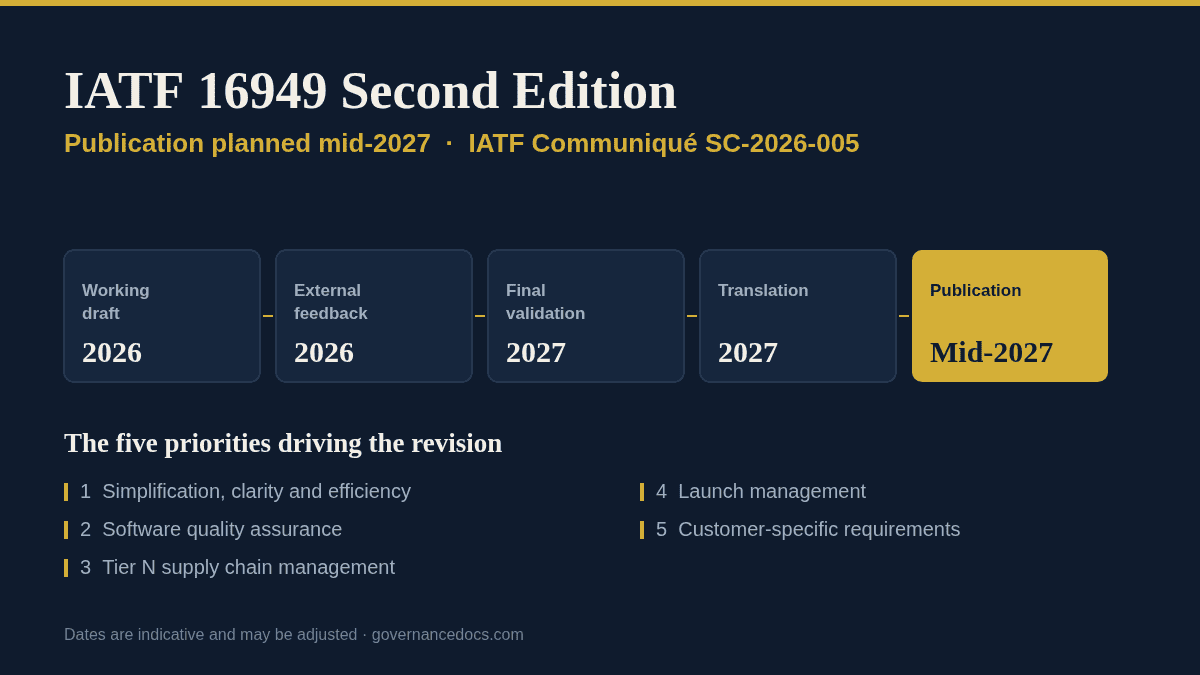
In July 2026 IATF Global Oversight issued Stakeholder Communiqué SC-2026-005,
confirming the status of the revision and publishing a high-level plan. The headline: publication of
the IATF 16949 second edition is planned for mid-2027, and the end of the transition
period will be aligned with the end of the ISO 9001 transition.
That date matters because a good deal of commentary in circulation says late 2026 or early 2027.
The communiqué does not say that. It says mid-2027, and it says explicitly that the dates
“remain indicative and may be adjusted as the work progresses.”
| Phase | Planned timing |
|---|---|
| Working draft development | 2026 |
| External feedback | 2026 |
| Final validation | 2027 |
| Translation and supporting documents | 2027 |
| Publication (planned) | Mid-2027 |
| Transition | End aligned with end of the ISO 9001 transition |
The alignment clause is the practically important one. ISO 9001’s sixth edition is at stage
60.00 on iso.org with a publication date of September 2026, and the International Accreditation Forum
publishes binding transition rules when a standard publishes, not before. Three years is the usual
shape, which would put both deadlines somewhere around late 2029 — but until the IAF resolution
exists, that is an estimate and should be treated as one. Our
ISO 9001:2026 guide tracks that side.
SC-2026-005 states that the revision is driven by stakeholder feedback, and that five priority
topics were identified from that input. These are the only substantive contents IATF has published,
and everything else you read about the IATF 16949 second edition today is inference.
| Priority | Stated objective |
|---|---|
| 1. Simplification, clarity and efficiency | Easier to understand, implement and audit; less duplication with ISO 9001; less variability in interpretation |
| 2. Software quality assurance | Apply existing quality principles consistently across the embedded software lifecycle |
| 3. Tier N supply chain management | A more consistent risk-based approach to lower-tier suppliers and better deployment of customer requirements |
| 4. Launch management | A more structured approach to new products, change management and industrialization |
| 5. Customer-specific requirements | Better identification and management of applicable CSRs, and possible incorporation of common CSRs into the standard |
IATF describes customer-specific requirements as “one of the most discussed topics within the
IATF 16949 scheme,” and says stakeholders consistently identify them as a significant challenge.
The stated goal — identifying common CSRs with a view to pulling them into the standard itself
— would be the single biggest practical change for a multi-OEM supplier, because it moves
requirements out of a per-customer matrix and into the baseline everyone is audited against.
Priority 2 is carefully worded. It talks about applying existing quality principles across
the software lifecycle “without creating unnecessary complexity.” That is not the same as
adopting Automotive SPICE or a functional-safety standard by reference, and nobody should read it that
way yet. If you build product with embedded software, the sensible preparation is being able to show
how your existing design control, change control and verification processes already reach it.
Priority 3 talks about “lower-tier suppliers,” a risk-based approach and
“improving the deployment of customer requirements” through the chain. The current
standard already requires you to develop your suppliers and pass requirements down; naming Tier N as a
priority in the IATF 16949 second edition is a statement that this is not reliably happening past the
first tier. The objective given
is improved supply chain robustness “while maintaining practical and auditable
requirements,” which reads as a warning that the drafting team knows how easily this becomes
unauditable paperwork.
If you buy sub-assemblies whose own inputs you have never assessed, that is the exposure. A
supplier register that stops at your direct suppliers answers the current standard and probably not
the next one.
IATF calls product and process launches “one of the highest-risk phases of the automotive
lifecycle” and wants a more structured approach to new products, change management and
industrialization. Nothing in that sentence is controversial — launch is where warranty
exposure, containment cost and customer escalations concentrate. The realistic reading of the IATF 16949 second edition here is tightened evidence requirements around
launch readiness rather than a new process, and that is preparation you
can start on today without seeing a word of the draft.
Priority 1 promises less complexity, clearer requirements and less duplication with ISO 9001. Every
standards revision opens with that intention and not all of them deliver it. What makes this one more
credible is the sequencing: because ISO 9001 publishes first, the drafting team can see the parent
text before finalising the automotive supplement, which is exactly the condition needed to remove
overlap rather than guess at it.
Three things are worth stating plainly, because revision announcements reliably produce panic
buying.
A documentation set built on the process approach, not on clause numbers.
The IATF 16949 Toolkit ships 250+ editable MS Office templates — 33 turtle diagrams, APQP and PPAP packs, a process flow / FMEA / control plan workbook, MSA and SPC calculators, supplier evaluation and development files, and a customer-specific requirements matrix. Documentation organised by process survives a clause renumber; documentation organised by clause does not.
When will the IATF 16949 second edition be published?
Mid-2027 is the planned date given in IATF Stakeholder Communiqué SC-2026-005, issued July 2026. IATF
states that all dates in that plan are indicative and may move.
When does the transition deadline fall?
It has not been set. IATF has committed only to aligning the end of the transition with the end of the
ISO 9001 transition, and the binding ISO 9001 transition rules are published by the IAF when that
standard publishes.
Does my current certificate become invalid?
No. IATF 16949:2016 remains in force, and transitions are structured so that certified organisations
move within their normal three-year audit cycle rather than through an emergency rebuild.
Is this the same thing as the IATF Rules 6th Edition?
No. The Rules 6th Edition governs certification body conduct and auditor qualification, was published
in April 2024 and took effect on 1 January 2025. The second edition is a revision of the standard
itself.
Should I buy documentation now or wait for the IATF 16949 second edition?
Buy on need, not on edition. A system that is genuinely weak on CSR control, launch readiness or
supplier management needs that work regardless, and it will all count toward the transition. What you
should not buy is anything advertised today as “second edition ready” — no supplier
has read the final text, because it does not exist.
All of these are covered by the IATF 16949 Toolkit, or start with the free ISO templates.

October 11, 2026
October 11, 2026
October 11, 2026
October 11, 2026
October 11, 2026

