CART
A layered process audit is a short, frequent check of a manufacturing process carried out by successive layers of management — the supervisor daily, the plant manager weekly or monthly — using a fixed checklist, to confirm that the process is being run the way it was designed. IATF 16949 does not require one by name. General Motors and Stellantis do, through their customer-specific requirements, and GM’s version comes with nine numbered rules. This guide explains what a layered process audit is, what the OEMs actually require, how it differs from the manufacturing process audit in IATF 16949 clause 9.2.2.3, and how to build one that survives a certification body auditor reading the CSRs beside your records.
Free gap assessment
Are you ready for the 2026 edition of ISO 9001?
Score yourself against the new edition, free, including the risk and opportunity split and the clause 10 renumbering that breaks converted checklists.
Run the free ISO 9001 gap assessment → or View premium report sample
The reference document is AIAG’s CQI-8 Layered Process Audit Guideline, revised in a second edition in 2014 after further work with OEMs and tier-one suppliers. Its premise is simple: most nonconformances in a plant come not from a bad process design but from the process drifting away from its standard — a setting changed, a step skipped, a gauge missed. A layered process audit checks the inputs to the process against the standard, frequently, rather than inspecting the output after the fact.
Three features define it:
It is not a product audit, which checks the part; not a system audit, which checks the quality management system; and not the IATF manufacturing process audit, which is a deeper, less frequent examination of a process’s effectiveness. It is the frequent, shallow, management-owned layer that sits underneath all three.
IATF 16949:2016 clause 9.2.2.3, Manufacturing process audit, requires the organization to audit all manufacturing processes over each three-calendar-year period, using a customer-specific required approach where one exists, to determine their effectiveness and efficiency. The audit must include the effective implementation of the process risk analysis (the PFMEA), the control plan and associated documents, and must be conducted on all shifts including shift handover. Nothing in that clause says “layered”. The requirement enters through the words “customer-specific required approach” — and through the CSRs themselves, which IATF makes binding on any supplier certified to the standard. Our guide to customer-specific requirements for ten OEMs explains how CSRs attach to the certificate.
GM’s Customer Specific Requirements for IATF 16949, effective 30 October 2025, place the requirement directly under 9.2.2.3: “The organization shall incorporate an internal layered process audit process to assess compliance to standardized processes, to identify opportunities for continuous improvement, and to provide coaching opportunities. The layered process audit is led by Management who are competent to conduct the audits.” The process shall include:
| # | GM requirement (9.2.2.3) | What the evidence looks like |
|---|---|---|
| 1 | A schedule including frequency of audits and locations of planned audits | A layer-by-layer calendar naming areas and dates |
| 2 | Audit layers must be used and include different levels of employees, including top management | Completed audits signed by the plant manager, not only supervisors |
| 3 | Customer complaints (including SPPSs) or rejections trigger a layered audit on the process that was cause of the issue | A complaint log cross-referenced to an unscheduled audit |
| 4 | All departments within the organization | Layered audits in logistics, maintenance, the lab — not only production |
| 5 | All findings are recorded and measured for improvement | A findings database with trend charts by question and area |
| 6 | Findings that cannot be corrected during the audit shall move to an action plan for monitoring to closure | Open actions with owners, dates and closure evidence |
| 7 | Records of audits shall be maintained | Retained completed checklists, paper or electronic |
| 8 | Layered audit questions shall be reviewed periodically and changed if needed to focus on the organization’s weaknesses | Version history on the checklist with the reason for each change |
| 9 | Layered process audit shall be done as part of corrective action verification activities | 8D reports whose verification step cites a layered audit |
Item 9 has been in GM’s list since the November 2017 revision; the October 2025 revision widened item 3 to include SPPS (Supplier Practical Problem Solving) records. GM also requires, separately and in addition, annual assessments of specific manufacturing processes against the current CQI standards — heat treat, plating, coating, welding, brazing, rubber and the rest — uploaded to GM’s Supplier Certification Management System. Those are separate obligations.
Stellantis’s CSR for use with IATF 16949 (version 1, June 2025) requires under 9.2.2.3 that “the supplier must conduct Layered Process Audits (LPA), the aim of which is to ensure consistent application and execution of standards. LPA are to be performed by Operational Managers.” No specific auditor qualification is required, but performers must be trained in the LPA process. LPA must cover all operational manufacturing and logistics areas, all shifts must be audited, all management levels should be involved from team leader to top management — at minimum the management of operational teams — and reaction plans must be in place to respond immediately to nonconformances. The auditor’s checks are listed too: a specific checklist integrated into supplier processes, an established and regularly updated schedule, and regular review with top management.
Ford’s current CSR (effective 15 June 2026) does not use the term. Ford suppliers still need a 9.2.2.3 manufacturing process audit program, and many run layered audits because their other customers require it, but do not cite Ford as the source of a layered audit obligation.
Certification body auditors regularly find plants that present their layered audits as the 9.2.2.3 manufacturing process audit. They are different instruments and the standard wants both.
| Attribute | Layered process audit | Manufacturing process audit (IATF 9.2.2.3) |
|---|---|---|
| Frequency | Every shift / daily at layer 1; weekly and monthly above | Each process at least once per three calendar years |
| Duration | About 10 minutes | Hours; a full process walk |
| Who | Line management, layered up to top management | Trained internal auditors independent of the process |
| Checks | Adherence to standard: settings, instructions, gauges, error-proofing | Effectiveness and efficiency; PFMEA and control plan implementation; all shifts and handover |
| Output | On-the-spot correction or an action-plan item | Audit report, nonconformities, corrective action |
| Required by | GM and Stellantis CSRs (and other customers by contract) | IATF 16949 itself |
The two connect at the point IATF cares about: the manufacturing process audit checks whether the control plan is implemented, and the layered audit is the daily evidence that it is. A layered audit question set built from the control plan’s reaction plans and the PFMEA’s prevention controls makes the three-year audit far easier to pass, because the adherence data already exists. Our guide to special characteristics covers the control plan entries the questions should be drawn from.
Start with the PFMEA’s highest-rated failure modes and the control plan’s special characteristics. Each becomes a binary question about the input that prevents it: “Is the torque tool set to the value on the control plan and verified this shift?” A question that cannot be answered with a glance at the station is the wrong question.
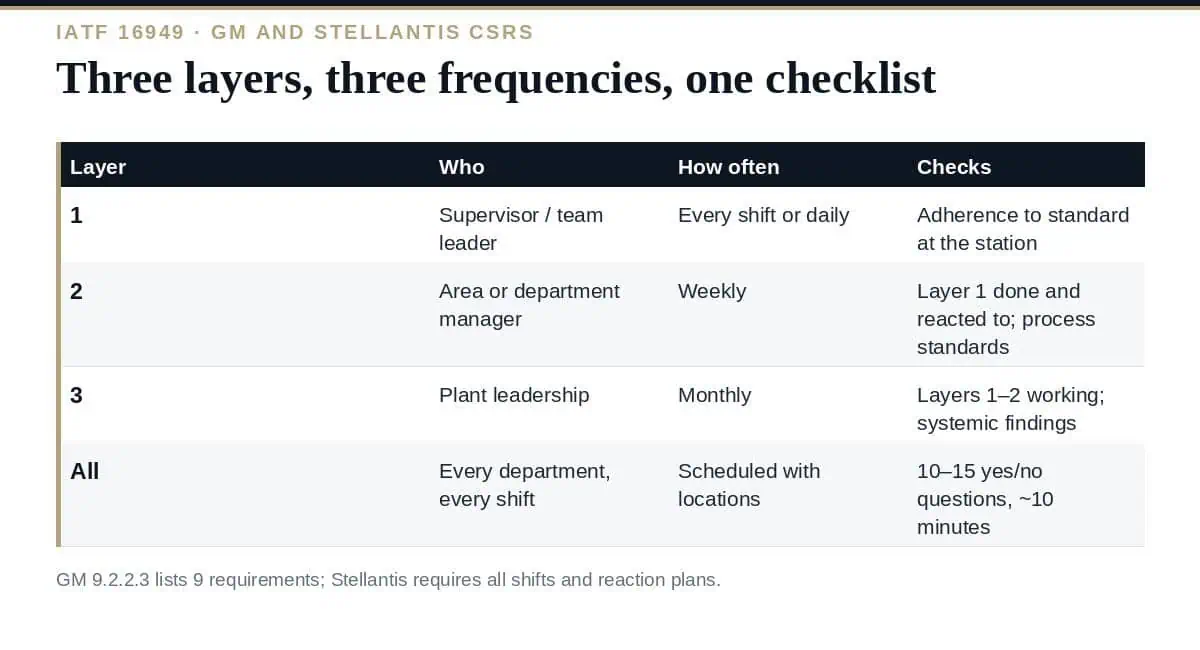
Three layers is the CQI-8 shape and satisfies both GM’s “including top management” and Stellantis’s “from team leader to top management”. Put the calendar on the wall and in the system. Item 1 of GM’s list is a schedule with frequency and locations; a rota that names people but not areas does not meet it.
GM item 4 and Stellantis’s “all shifts” are the two most common findings. Night shift and the warehouse both need layered audits with the same frequency logic as day-shift assembly.
GM item 5 says “recorded and measured for improvement”. A stack of completed sheets is a record; a chart showing which question fails most, by area, by month, is a measurement. The second is what drives item 8, the periodic review of the questions themselves.
Items 3 and 9 make the layered audit part of the problem-solving loop: a customer complaint triggers an unscheduled layered audit on the causal process, and the 8D’s verification step uses layered audit results as evidence that the fix held. Both need a written link in the procedure and a visible cross-reference in the records.
GM wants management “competent to conduct the audits”; Stellantis wants performers “trained to LPA process”. A one-hour session covering the purpose, the checklist, how to react to a “no” and how to coach without blame, recorded as training, closes both.
Does IATF 16949 require a layered process audit?
Not by name. Clause 9.2.2.3 requires a manufacturing process audit using a customer-specific required approach where one exists. GM and Stellantis require layered process audits in their CSRs, which are binding on their suppliers’ IATF certificates.
What is CQI-8?
AIAG’s Layered Process Audit Guideline, the reference document for LPA design. The second edition was published in 2014. GM’s CSR refers to CQI standards for its annual special-process assessments; the layered audit requirements themselves are written out in the CSR.
How many questions should a layered process audit have?
CQI-8 practice is a short binary checklist, commonly 10 to 15 questions taking about 10 minutes, drawn from the control plan and PFMEA. Longer checklists stop being done.
Who performs the audits?
Management at successive layers: supervisors or team leaders daily, area managers weekly, plant leadership monthly. Stellantis specifies operational managers; GM requires layers up to and including top management.
Can our layered audits replace the three-year manufacturing process audit?
No. The manufacturing process audit examines effectiveness, PFMEA and control plan implementation across all shifts and is performed by independent auditors. Layered audits are the frequent adherence check that feeds it.
Build it as the OEMs wrote it: a scheduled, layered, all-department, all-shift adherence check with questions drawn from your own risk documents, findings measured as data, and a written link to complaints and corrective action verification. Do that and GM’s nine items, Stellantis’s checklist and the IATF auditor’s 9.2.2.3 questions are all answered by the same records.
Layered audit checklists, the audit calendar, the findings tracker and the control plan and PFMEA templates the questions are drawn from are in the IATF 16949 Toolkit, or start with the free templates.

October 11, 2026
October 11, 2026
October 11, 2026
October 11, 2026
October 11, 2026

