The IATF 16949 control plan is one of the most examined documents in an automotive quality audit. It translates the risk analysis and process design into the checks that operators, inspectors and supervisors carry out every day, and it is the link between what engineering intended and what happens on the shop floor. Auditors read it against the process flow, the FMEA and the actual workstation, so any mismatch shows up quickly.
This guide explains what the IATF 16949 control plan must include, how the three phases differ, how it connects to the core tools, when it must be reviewed and what commonly goes wrong.
Free gap assessment
Where do you stand on the automotive supplemental requirements?
Score only what IATF adds to ISO 9001, free, including customer-specific requirements, product safety and the core tools.
What the standard requires of the IATF 16949 control plan
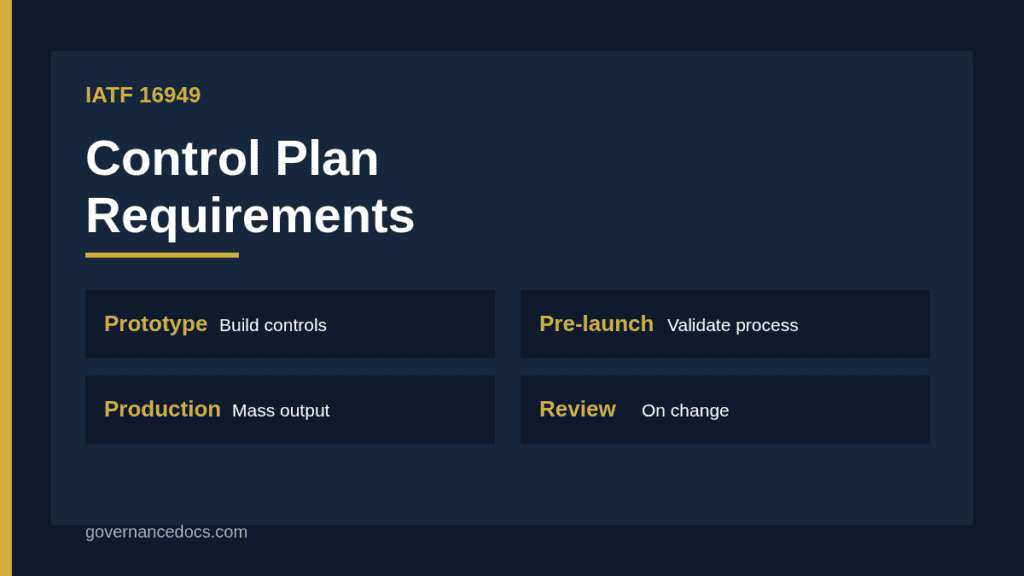
IATF 16949:2016 clause 8.5.1.1 requires the organisation to develop control plans at the system, subsystem, component and material level for the relevant manufacturing site and all products supplied, including those for processes producing bulk materials as well as parts. Control plans must cover the prototype, pre-launch and production phases, where required by the customer. The full requirements are in the standard, which you can purchase through the IATF global oversight channels.
The clause also lists what the plan must contain. Summaries of the requirement describe it as including the controls used for manufacturing process control, verification of job setups, first-off and last-off part validation, methods for monitoring of control exercised over special characteristics, customer-required information and a specified reaction plan when a nonconformity is detected. Check the exact wording against your licensed copy of the standard before quoting it in a procedure.
The three phases of the IATF 16949 control plan
Phase
Purpose
Typical content
Prototype
Control dimensional measurements, material and performance tests during prototype build
Characteristics to be verified, test methods, sample sizes
Pre-launch
Control checks after prototype and before full production
Additional controls for new or changed processes; more frequent inspection
Production
Document the controls used in mass production
Process parameters, product characteristics, measurement systems, reaction plans
Pre-launch control plans usually carry tighter monitoring than production, because the process is new and its variation is not yet proven. Once capability is shown and the process is stable, controls can be relaxed with customer agreement where required, and the production control plan takes over. Each phase links to the APQP timeline: see the overview of the IATF 16949 core tools for how APQP, FMEA, MSA, SPC and PPAP feed the plan.
Building the control plan from its inputs
A control plan is not written from a blank page. It draws on several sources, and each should be traceable.
Process flow diagram. Each process step in the flow should appear in the plan, in the same order.
Process FMEA. High-risk failure modes need a control, and the plan should show which control addresses which cause.
Special characteristics. Characteristics identified by the customer or by you need designated controls; see our guide to special characteristics.
Lessons learned. Field failures, complaints and internal defects on similar products.
What each line of the control plan must show
A production control plan is normally a table with one row per process step or characteristic. Each row should identify the process or operation, the machine or tool, the product or process characteristic, the specification or tolerance, the evaluation or measurement technique, the sample size and frequency, the control method and the reaction plan. It should also identify the measurement system and gauge, and mark special characteristics with the agreed symbols.
Sample size and frequency
These should be based on risk, capability and history rather than habit. A characteristic with proven capability and a robust process may need less frequent checks, while one with a history of drift needs more. Record the reasoning, and be ready to explain it. “Once per shift” is not an answer unless someone can say why once per shift is enough.
Reaction plans
The reaction plan tells operators what to do when a check fails: stop, contain suspect product, notify a named role, adjust and reverify. It should be specific enough to act on. “Inform supervisor” is weak; “stop the line, quarantine product since the last good check, call the shift quality technician” is a real instruction. Auditors often ask an operator to explain the reaction plan, so make sure operators know it.
Linking the control plan to FMEA and PPAP
The control plan, the process FMEA and the process flow should agree. If the FMEA shows a high-severity failure mode with weak detection, the control plan should include a strong detection method or a preventive control. If the control plan lists a check that the FMEA does not mention, one of them is out of date. In a PPAP submission, the control plan is a required element, and customers may review it in detail; see our guide to PPAP submission levels for what is sent at each level.
When to review and update the control plan
The standard requires control plans to be reviewed and updated when certain events occur. Summaries list them as including when nonconforming product has been shipped to the customer, when changes affect the product, manufacturing process, measurement, logistics, supply sources, production volumes or the FMEA, after customer complaints and related corrective action, and at a frequency set by risk analysis. Customer approval may also be required for some changes.
Treat the control plan as a living document. Give it a revision history, link it to the change management procedure, and check it during every process audit. A plan that has not changed in three years on a process that has changed twice is a red flag.
A hypothetical example of an IATF 16949 control plan row
The following is a hypothetical example invented for illustration. A machining line produces a shaft with a bearing journal diameter marked as a special characteristic. The process FMEA identifies tool wear as a cause of oversize diameter with high severity. The production control plan row for the finishing operation shows the journal diameter, the tolerance, an air gauge covered by a current MSA study, a sample of five parts every hour plus first-off and last-off checks, and SPC charting with defined control limits.
The reaction plan states that a point outside limits or a trend of seven points stops the machine, quarantines parts since the last good check, calls the quality technician to sort and measure the batch, and requires a tool change and first-off approval before restart. Because the characteristic is special, the plan also notes the customer symbol and the requirement for capability data with each PPAP submission.
Ownership of the IATF 16949 control plan
Give each IATF 16949 control plan an owner, typically the quality or process engineer for the product family, and involve a cross-functional team of production, maintenance, quality and, where relevant, purchasing. The owner keeps the plan aligned with the FMEA, arranges reviews after changes and confirms that gauges and methods listed in the plan are available and calibrated. Record team members and approval dates in the header so an auditor can see who agreed the plan.
Common audit findings on the IATF 16949 control plan
Frequent findings include plans that do not match the actual process flow, missing special characteristics, no link to the FMEA, sample sizes without justification, reaction plans that are vague, gauges not covered by an MSA study, plans not updated after a change or a complaint, plans that are not available at the workstation and operators who do not know what the plan requires. Another is a single generic plan covering several product families with different risks.
Making the control plan useful on the shop floor
A control plan that lives only in a folder does little. Turn the relevant rows into work instructions and inspection sheets that operators can follow, and cross-check them at layered process audits, which are described in our guide to the layered process audit. Involve operators when writing and reviewing plans, because they know which checks are practical and which are being skipped.
Templates and tools for the control plan
Consistent templates reduce errors and speed up preparation for each new program. The IATF 16949 Toolkit provides documents for the quality system and core tools you will need to support your control plans. Whichever format you use, keep the same layout across products so customers and auditors can read them easily.
IATF 16949 control plan FAQ
Which clause covers the control plan?
Clause 8.5.1.1 of IATF 16949:2016 covers control plans, including phases, content, review and update requirements.
Do we need separate plans for prototype, pre-launch and production?
The standard requires control plans to cover all three phases where the customer requires them. Many organisations keep separate plans per phase, and some customers specify the format.
How often must the control plan be reviewed?
When defined trigger events occur, such as shipping nonconforming product, changes to the product or process, and customer complaints, and at a frequency set by risk analysis.
Is the control plan the same as the FMEA?
No. The FMEA analyses risk and identifies failure modes and causes. The control plan defines the checks and reactions that manage those risks. They must be consistent with each other.
Who must approve the control plan?
It should be approved through your internal system by a cross-functional team, and by the customer where the customer requires approval, for example as part of a PPAP submission.