A GovRAMP 3PAO is the independent assessor that decides, in practice, how smoothly your path to state and local government contracts will go. If you sell cloud services to a state agency, a university or a school district, sooner or later someone will ask who your third-party assessment organization is, and the answer shapes your timeline, your budget and your odds of passing on the first attempt.
This guide explains what a third-party assessment organization does in the GovRAMP program (formerly StateRAMP), who qualifies, what to ask when you interview candidates, and how to prepare so the assessor spends time validating controls instead of chasing documents. Figures and timelines below are typical ranges, not quotes, and program rules change, so confirm the current details with the GovRAMP Program Management Office.
Free gap assessment
Are you working to the 2026 FedRAMP rules or the old ones?
Score the Key Security Indicators and the CR26 obligations, free, including the Security Decision Record that replaced the SSP.
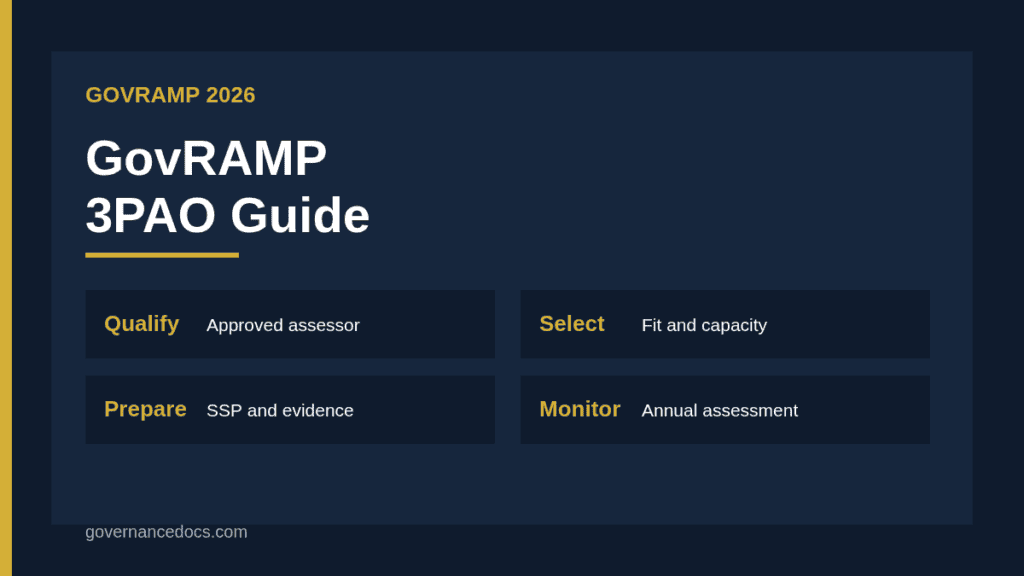
A GovRAMP 3PAO is an independent assessor that tests whether a cloud product meets the program’s security requirements. According to the program’s published FAQs, approved assessors must be accredited by A2LA to the ISO/IEC 17020 inspection standard and be recognized as an authorized 3PAO under FedRAMP. That dual requirement is why many of the same firms appear in both programs.
The assessor does not write your controls for you. It examines your system security plan, interviews your staff, inspects configurations and reviews evidence, then reports what passes and what does not. Independence is the point: a consultant who built your program cannot also be the one who certifies it.
You are the one who engages and pays the assessor. That makes the relationship commercial, so you want a firm that is rigorous but also responsive. The GovRAMP Program Management Office then reviews the package before a status is awarded. For how statuses differ, see our explainer on GovRAMP status levels.
Who can be a GovRAMP 3PAO?
Only assessors on the program’s approved list can perform assessments that count. The GovRAMP list of approved assessors is the authoritative source, and you should check it on the day you sign, not rely on an old blog post or a vendor claim.
When you review the list, look past the logo. Ask how many assessments the firm has completed at your target impact level, whether the team that will work on your engagement has done them before, and whether the firm is currently accepting new work. Capacity is a real constraint; a popular assessor may quote a start date months out.
How to choose a GovRAMP 3PAO
Choosing a GovRAMP 3PAO is less about price than about fit. A low quote from a firm that misreads your architecture produces change orders, long delays and sometimes a failed assessment. Interview at least three candidates and compare them on the same criteria.
Questions worth asking every candidate:
Phase
What the 3PAO does
What you provide
Scoping
Reviews system boundary and impact level
Boundary diagram, data flows, inventory
Readiness
Tests against the Ready or Core requirements
System security plan, policies, evidence
Full assessment
Tests controls for the impact level and writes the report
Procedures, logs, configurations, interviews
Remediation
Re-tests fixed findings
Plan of action and milestones, fixes
Continuous monitoring
Performs annual assessments and reviews significant changes
Monthly reporting, scans, change records
Which impact levels and cloud architectures have you assessed recently?
Who, by name, will lead my engagement, and what is their experience?
How do you handle inherited controls from AWS, Azure or Google Cloud?
What is your typical timeline from kickoff to draft report?
How are findings communicated, and how many re-test rounds are included?
What do you charge for annual continuous monitoring assessments?
What a GovRAMP 3PAO engagement costs and how long it takes
Costs vary with impact level, system complexity, the number of environments and how much evidence is ready. As a typical range, assessment fees alone run from tens of thousands to well over a hundred thousand dollars for a moderate-impact system, and that is before internal staff time, tooling and remediation. Program fees are separate and follow the published schedule. Our page on GovRAMP cost breaks down the other line items.
Timelines also vary. Well-prepared teams often spend a few months from kickoff to final report; teams that discover gaps during the assessment take much longer. Remember that the assessor’s calendar plus the program review period can add weeks you did not plan for.
Readiness, Core and full assessments: where the 3PAO fits
Not every step needs a full assessment at once. The program offers a Progressing Snapshot Program, described as an early-stage assessment that helps providers benchmark their security maturity, with confidential results. Our guide to the GovRAMP Security Snapshot covers how it works.
Core status confirms implementation of 60 foundational NIST controls. Ready status confirms the product meets the program’s minimum mandatory requirements, and Authorized status confirms full compliance with the controls required for the impact level. A 3PAO is involved as you move up the ladder, so ask early which status your target customers actually require. Some states accept a lower status as a stepping stone while you progress; see which states accept GovRAMP.
Preparing so your GovRAMP 3PAO can work efficiently
The fastest assessments are the ones where the auditor never has to ask twice for the same document. Build your evidence package before kickoff, not during it. The work divides into five practical steps.
Define the authorization boundary and draw data flows accurately
Finish the system security plan and assign an owner to every control
Collect evidence: configurations, scans, logs, tickets, training records
Run an internal gap review against the NIST SP 800-53 Rev. 5 baseline for your level
Fix known gaps and document any that remain in a plan of action and milestones
Using templates to shorten preparation
Most of the preparation is documentation: policies, procedures, the system security plan, incident response plans and contingency plans. Starting from blank pages costs weeks. The GovRAMP and StateRAMP Toolkit offers editable templates for those documents, so your team can focus on the technical evidence the assessor will test.
Templates do not replace real controls. An assessor will verify that what you wrote is what you actually do, and will sample logs and configurations to prove it. Treat the documents as the description of a working system, not as the evidence of one.
Working with your GovRAMP 3PAO after the assessment
The relationship does not end with the report. Continuous monitoring begins once a status is awarded and includes regular reporting, annual assessments and remediation of findings. Per the program FAQs, remediation windows are tied to risk: shorter for high-risk findings, longer for lower-risk ones. Our article on GovRAMP continuous monitoring explains the monthly cycle.
Ask your assessor up front whether the same team will perform the annual assessment and how significant changes are handled. A major architecture change, such as moving regions or adding a subservice provider, can trigger an additional review. Plan for that in your engineering roadmap.
What assessors usually test first
Assessors tend to begin with the areas where cloud providers most often fall short, because those findings drive the schedule. Expect early attention on access control and multi-factor authentication, vulnerability scanning and patch timelines, logging and alerting, configuration baselines, encryption of data at rest and in transit, and incident response testing. Each of these needs more than a written policy: the assessor will ask to see a scan report, a sample of access reviews, a recent tabletop exercise and the tickets that show issues being closed.
Staff interviews matter as well. An engineer who cannot explain how a control works, even though the document says it does, creates a finding. Brief the people who will be interviewed, keep answers factual and consistent with the documentation, and assign one coordinator who tracks every evidence request to closure. That single habit often saves more time than any tool, and it keeps the assessment calendar, the remediation window and your sales deadlines aligned with one another.
Common mistakes when hiring a GovRAMP 3PAO
The most common mistake is engaging an assessor before the system security plan is stable. The second is assuming inherited controls need no evidence; you still have to show how your cloud provider’s controls map to your boundary. The third is choosing on price alone.
A fourth is forgetting the relationship to FedRAMP. If you also sell to federal agencies, ask whether the assessment can be leveraged; our comparison of GovRAMP vs FedRAMP and the notes on the fast-track path show where work carries over. Finally, do not skip written scoping: a signed statement of work that names the boundary, impact level and deliverables prevents arguments later.
GovRAMP 3PAO FAQ
What is a GovRAMP 3PAO?
A GovRAMP 3PAO is an independent, program-approved assessor that tests a cloud product against GovRAMP security requirements and reports the results for program review.
Who pays the 3PAO?
The cloud service provider engages and pays the assessor. Program fees for the verification status are separate and follow the published fee schedule.
Can any auditor act as a GovRAMP 3PAO?
No. Only assessors on the program’s approved list count. They must hold the required accreditation and FedRAMP recognition. Check the official list before signing.
Do I need a 3PAO for the Progressing Snapshot Program?
The Snapshot is an early-stage benchmark, but check current program rules to see what it requires. Higher verification statuses involve a 3PAO assessment.
Does a 3PAO assess my system every year?
Yes. Continuous monitoring includes annual assessments by an approved assessor, plus review of significant changes, alongside your regular reporting.