CART

A generative AI risk assessment is the step most organizations skipped on the way to rolling out chatbots, writing assistants and AI coding tools. The tools arrived first, often through a free trial or a feature a supplier switched on, and the questions came later: what happens when the model makes something up, what staff are pasting into it, and who is accountable when a customer acts on a wrong answer. This guide shows how to assess those risks properly, using the ISO/IEC 42001 method, and walks through a worked example you can compare with your own.
It is written for the people who have to sign off the use of generative AI: a CISO, a compliance lead, a product owner or a founder who has been asked “is this safe?” and needs an answer an auditor or a board can follow.
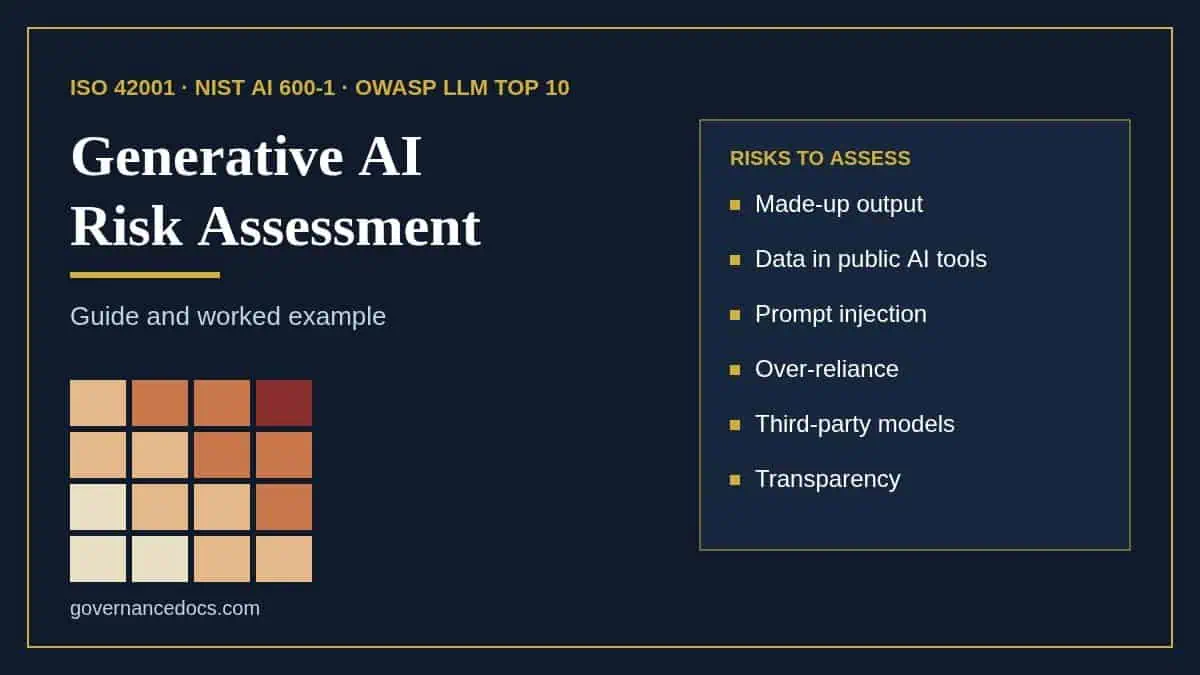
The method is the same as any management-system risk assessment: set criteria, list what is in scope, identify risks, rate them and decide how to treat each one. What changes is the kind of risk. A traditional model predicts a number or a category from a fixed set; a large language model produces open-ended text, code or images, takes instructions in plain language from anyone who can type, and is usually built by someone else. That creates risks that a standard information security assessment does not look for.
| Question | Traditional AI or software | Generative AI |
|---|---|---|
| What can go wrong with the output? | A wrong score or classification | Fluent, confident content that is false, biased, harmful or infringes someone’s rights |
| How can it be attacked? | Through code, access and data | Also through words: prompt injection in a message, document or web page |
| Where does sensitive data go? | Into defined fields and databases | Into free-text prompts, which may reach a third party |
| Who built the model? | Often you | Usually a provider whose training data and testing you cannot see |
| Does behaviour stay the same? | Until you change it | It can change when the provider updates the model or a prompt is edited |
Two public references help you find the risks. The NIST Generative AI Profile (NIST AI 600-1), published in July 2024, lists 12 risks that generative AI creates or makes worse, including confabulation, data privacy, harmful bias, information integrity, information security, intellectual property and value chain and component integration. The OWASP Top 10 for LLM Applications 2025 covers the security side, from prompt injection and sensitive information disclosure to excessive agency and misinformation. Our guide to the NIST AI RMF Generative AI Profile covers the NIST list in more depth.
ISO/IEC 42001:2023 asks for an AI risk assessment in clause 6.1.2 and AI risk treatment in clause 6.1.3. The requirements that matter most here are simple to state. Risk criteria must tell acceptable risks from unacceptable ones. Consequences must be assessed for the organization, for individuals and for society, not only for the business. And the controls chosen to treat each risk must be compared with the 38 controls in Annex A and recorded in a Statement of Applicability, with a reason for every inclusion and exclusion. Our pillar guide to the ISO 42001 risk assessment covers the full method.
Clause 6.1.4 adds a separate AI system impact assessment, which looks in depth at what a particular system could do to the people and groups it affects. For a customer-facing generative AI system, the two usually go together: the risk assessment tells you where the impact assessment matters most. Our article on the AI system impact assessment explains how to run one.
Most generative AI risk assessments end up with the same core set of scenarios. Write each one as an event, the weakness that lets it happen and the consequence, so it can be rated and owned.
Brightwater Insurance (a fictional company) runs a customer service chatbot built on a third-party large language model, gives claims handlers a generative AI assistant for summarizing files, and has found staff using several public AI tools. It rates likelihood and impact on 1 to 5 scales, with impact described for customers and staff as well as for the company, and its appetite line is level 9 on a 1 to 25 scale. An extract from its register:
| Ref | Risk | L | I | Level | Decision and ISO 42001 Annex A controls |
|---|---|---|---|---|---|
| R-01 | Chatbot misstates policy cover or claim terms; answers are not grounded in the policy wording | 4 | 4 | 16 | Modify: answer only from approved documents and hand coverage questions to a person (A.6.2.4, A.9.4, A.8.2) |
| R-02 | Claims data pasted into public AI tools; no rules and no approved alternative | 4 | 3 | 12 | Modify: roll out the approved assistant and block unapproved tools (A.9.2, A.2.2, A.10.3) |
| R-03 | Prompt injection through documents uploaded to the claims assistant | 3 | 4 | 12 | Modify: restrict the assistant’s access and test it against injected instructions (A.6.2.2, A.6.2.4) |
| R-04 | Model provider changes the model version without notice | 3 | 3 | 9 | Retain, within appetite; monitor release notes |
| R-05 | Claims handlers accept AI summaries without checking the file | 3 | 4 | 12 | No decision yet |
| R-06 | Customers not told they are talking to AI | 2 | 3 | 6 | Within appetite; disclosure already shown at the start of each chat |
Read as a board would, this generative AI risk assessment says three things. The highest risk is the one customers see: wrong answers about their cover. Two of the risks above the line come from people rather than technology, which means training and clear rules will do as much as any technical control. And one risk, over-reliance on AI summaries in claims, has no decision yet, which is the first gap a reviewer would raise.
You can do the whole generative AI risk assessment in our free AI risk assessment tool. Its library of 38 scenarios includes made-up output, prompt injection, data leaking into public AI tools, weak human oversight and third-party models, each mapped to the ISO/IEC 42001 Annex A controls that usually treat it. You get a heat map, a process score and the findings an auditor would raise, free.
Yes. Most of the risk in off-the-shelf use sits on your side: what data goes in, who relies on the output and what customers are told. ISO/IEC 42001 applies to organizations that use AI, not only those that build it.
It covers security risks such as prompt injection and data leakage, but also risks with no security element: false output, bias, over-reliance, intellectual property and transparency. It also rates consequences for the people affected, not only for the organization.
They work together in one generative AI risk assessment. ISO/IEC 42001 gives you the certifiable management system and the Annex A controls; the NIST Generative AI Profile and the OWASP list are good sources for identifying generative AI risks within it.
Repeat the generative AI risk assessment at least once a year, and whenever a model, provider, prompt, data source or use case changes significantly. Generative AI systems change more often than most software, so event-driven reviews matter more than the annual cycle.
For the AI policy, risk methodology, impact assessment and Statement of Applicability templates around this work, see the ISO 42001 Toolkit.

October 19, 2026
October 18, 2026
October 18, 2026
October 15, 2026
October 15, 2026

