CART
An AI system impact assessment is the document that says who could be harmed by an AI system, how, and what you did about it. ISO/IEC 42001 requires one; since 2025 there is a dedicated standard telling you how to run it — ISO/IEC 42005 — and the two are designed to be used together.
This guide covers what the assessment has to cover, how it differs from a risk assessment and from a DPIA, and when it has to be repeated.
Free gap assessment
How much of ISO 42001 could you evidence today?
Score every clause and Annex A control of the AI management standard, free, and see where the programme really sits.
Run the free ISO 42001 gap assessment → or View premium report sample
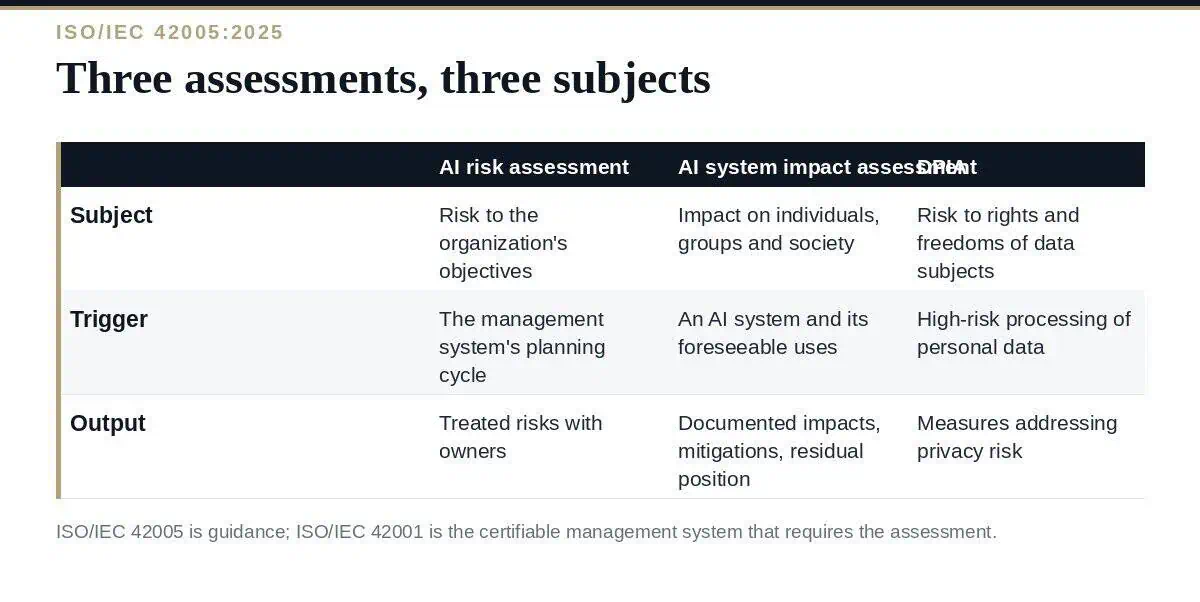
A risk assessment asks what could go wrong for the organization. An AI system impact assessment asks what the system could do to other people — individuals, groups and society — including effects the organization would happily live with.
Free AI impact assessment (ISO 42005)
Who could this AI system affect, and how?
Screen the system against sensitive and prohibited uses, describe it, check the safeguards for fairness, transparency and oversight, and rate its impacts on people and society from 26 scenarios with ISO 42001 Annex A measures. Free, with findings.
Start the free AI impact assessment → or View premium report sample
That difference is the whole point. A recommendation engine that quietly narrows what a group of users ever sees is not an organizational risk until it becomes a news story; it is an impact from the first day it ships. ISO/IEC 42001 builds the requirement into the management system, and ISO/IEC 42005:2025 — published in 2025 by ISO/IEC JTC 1/SC 42 — provides the guidance for performing it and for integrating it with AI risk management.
| AI risk assessment | AI system impact assessment | DPIA | |
|---|---|---|---|
| Subject | Risk to the organization’s objectives | Impact on individuals, groups and society | Risk to the rights and freedoms of data subjects |
| Trigger | The management system’s planning cycle | An AI system and its intended and foreseeable uses | High-risk processing of personal data |
| Output | Treated risks with owners | Documented impacts, mitigations and residual position | Measures to address privacy risk |
They overlap and they do not substitute. An AI system processing personal data needs both an impact assessment and a DPIA, and the honest way to run them is one evidence-gathering exercise producing two documents with different framings.
Working from ISO/IEC 42005’s structure, a defensible assessment answers these in order:
Step two. An AI system impact assessment that lists “users” as the affected party will find user-experience issues and nothing else. The impacts that damage organizations sit with people who are not users: the applicant screened out, the claimant whose payout is delayed, the small supplier deprioritized by an optimization. Write the list of affected groups before you write anything else, and have somebody outside the product team challenge it.
At design, before deployment, and then on change. The triggers worth writing into the procedure:
The assessment is also where AI governance meets regulation. The EU AI Act’s obligations for high-risk systems cover much of the same ground from a legal angle, and a well-run impact assessment is most of the evidence you would need — see our guide to ISO 42001 versus the EU AI Act. Our ISO 42001 controls guide covers where the assessment sits in the management system.
Does ISO 42001 require an AI system impact assessment?
Yes — it is a requirement of the management system, and ISO/IEC 42005:2025 was published to provide the how.
Is ISO 42005 certifiable?
No. It is guidance. ISO/IEC 42001 is the certifiable management system standard; 42005 supports one of its requirements.
How is it different from a DPIA?
A DPIA addresses risk to data subjects from processing personal data. An AI system impact assessment addresses impacts of the AI system on individuals, groups and society, whether or not personal data is involved.
Who should perform it?
A group, not a person. Product, engineering, legal, privacy and someone who can represent affected groups. A single author produces a document that reflects one perspective.
How long should it be?
Proportionate to the system’s potential impact. A low-impact internal tool warrants a short record; a system making decisions about people’s access to services warrants a real one, with evidence behind each claim.
Run the AI system impact assessment as a design activity rather than a pre-launch formality. Name the affected groups first and widely, take foreseeable misuse seriously, record mitigations and what remains after them, and set explicit re-assessment triggers so the document tracks the system rather than the launch date. Use ISO/IEC 42005 for the method and keep the output inside the ISO/IEC 42001 management system, where the risk register and the monitoring data can actually reach it.
Impact assessment templates, risk records and the AI policy set are in the ISO 42001 AI Management Toolkit, or start with the free ISO templates.

October 14, 2026
October 13, 2026
October 12, 2026
October 12, 2026
October 12, 2026

