CART
NQA-1 is the quality assurance standard for nuclear facilities — and unlike most standards, being on the newest edition is not automatically the right answer.
Which edition binds you is set by your regulatory commitment, licence or contract. Moving to a newer one is a controlled change to your quality assurance programme, not a routine upgrade. That single point causes more confusion in nuclear QA than anything else in the standard.
Free gap assessment
Are you ready for the 2026 edition of ISO 9001?
Score yourself against the new edition, free, including the risk and opportunity split and the clause 10 renumbering that breaks converted checklists.
Run the free ISO 9001 gap assessment → or View premium report sample
ASME’s Quality Assurance Requirements for Nuclear Facility Applications provides quality assurance requirements and guidance across all phases of a nuclear facility’s life cycle.
Its scope reaches every structure, system, component, activity or organisation essential to the safe, reliable and efficient performance of the facility. ASME states it applies to all large light water reactors and to future advanced reactors, including SMRs.
That last point is why NQA-1 has become relevant to organisations that never expected to encounter it. Small modular reactor developers, and their supply chains, inherit a QA regime designed for gigawatt-scale plants.
The applications ASME lists give a sense of the range: design of advanced reactors including SMRs, facilities for power generation, spent fuel and high-level waste storage, waste management, and fuel reprocessing.
The requirements ASME highlights for the current revision cover the working substance of a nuclear QA programme:
Commercial grade dedication is where most suppliers new to nuclear QA struggle. The question is not whether a component is good — it is whether you can demonstrate, through identified critical characteristics and an accepted verification method, that a commercially procured item performs its safety function. That is an evidence discipline, not a purchasing one.
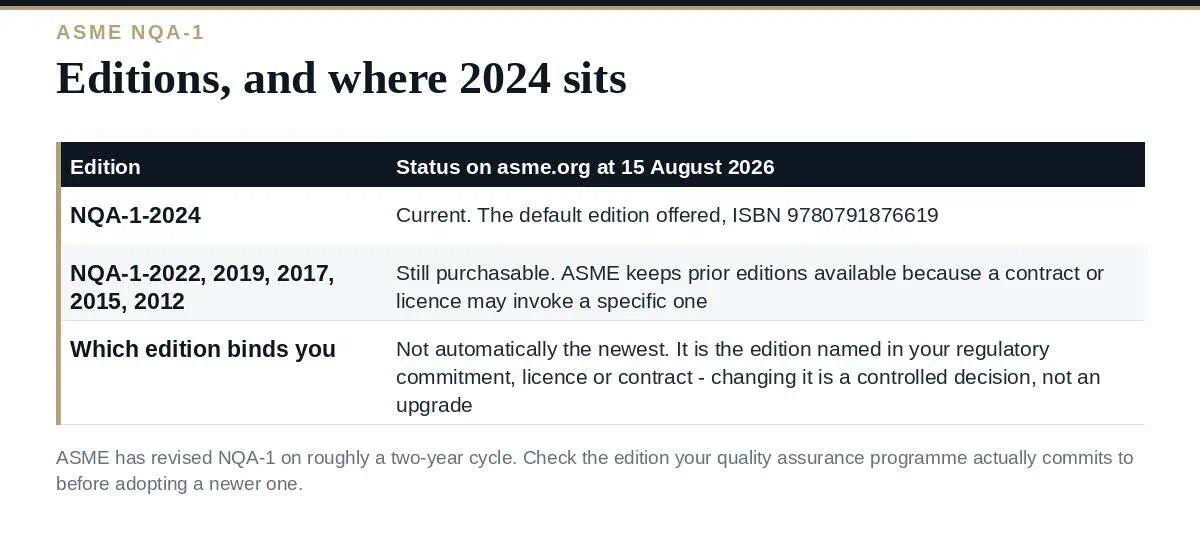
NQA-1-2024 is the current edition. ASME also keeps 2022, 2019, 2017, 2015 and 2012 available for purchase, and that is deliberate — an organisation may be committed to a specific earlier edition and needs to be able to buy it.
The revision cycle has run at roughly two years. Treat that as a planning assumption rather than a promise, and check before assuming 2024 will remain current through a long project.
Practically, three questions settle the edition problem:
| Standard | Relationship |
|---|---|
| ISO 9001 | The closest general analogue and a genuine head start on document control, records, audits and corrective action. But ISO 9001 does not reach design control at nuclear depth, and has no concept of commercial grade dedication. It is a foundation, not a substitute |
| ISO 19443 | Written for nuclear supply chains on top of ISO 9001 and much closer in intent. Where a customer accepts it, it is a shorter path than a full NQA-1 programme — but it is a different scheme, not an NQA-1 equivalent |
| ISO 45001 | Occupational health and safety runs alongside rather than inside nuclear QA, but the audit and improvement machinery is shared |
| ISO 31000 | Supplies a common risk method so nuclear QA risk is comparable with the rest of the business |
The honest summary for a supplier approaching NQA-1 for the first time: an ISO 9001 certificate gets you perhaps half of the management system and none of the nuclear-specific disciplines.
This guide reflects ASME’s published catalogue at 15 August 2026, on which NQA-1-2024 is the current edition.
The NQA-1:2024 Nuclear Quality Assurance Toolkit provides 100+ editable templates covering the Quality Assurance Program, design control, commercial grade dedication, procurement, inspection, non-conformance and corrective action, and the records regime the standard expects.

October 15, 2026
October 15, 2026
October 14, 2026
October 14, 2026
October 14, 2026

