

ESG Regulations Food Sector Guide: The Essential 2026 Rule Map
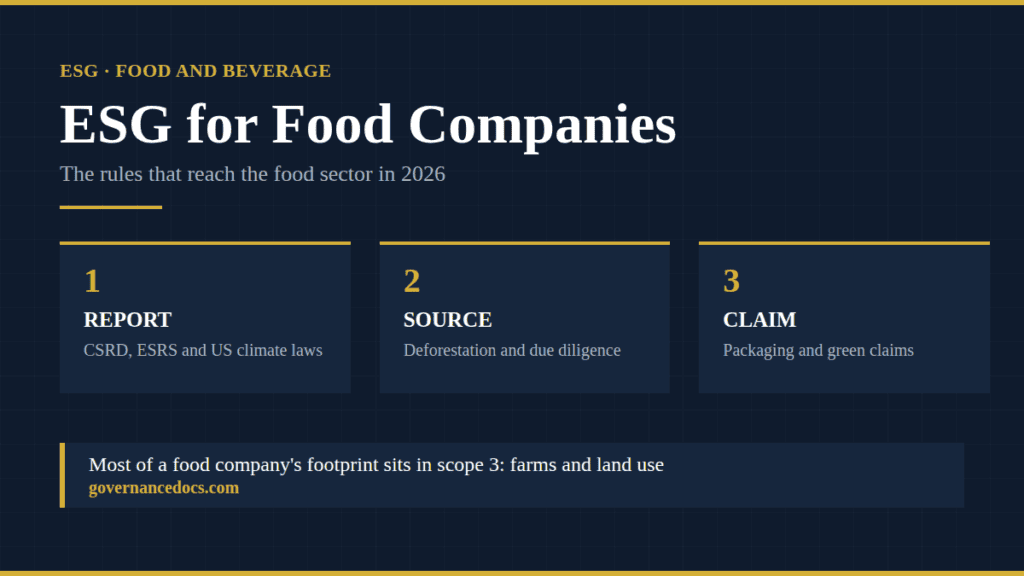
The ESG regulations food sector companies face in 2026 changed more in one year than in the previous five. The EU cut the scope of its reporting and due diligence laws, delayed its deforestation rule again, and switched on new packaging and green-claims rules. In the US, the federal climate rule stalled while California’s first emissions reports fell due.
This guide sets out the ESG regulations food sector businesses must meet, rule by rule, with dates checked against official sources at the end of November 2026. Where a rule is still moving, we say so.
Free gap assessment
Are you ready for the 2026 edition of ISO 14001?
Score every clause of the new edition, free, including the aspects, life cycle and compliance evaluation work that carries most of the findings.
Run the free ISO 14001 gap assessment → or View premium report sample
ESG regulations food sector teams must track: the 2026 table
Start here. Each row lists who is caught, the duty that bites hardest for food and beverage businesses, and the date that applies today. Rows marked “in flux” are under litigation or pending formal steps.
| Rule | Who it applies to | Key food-sector duty | Date and status |
|---|---|---|---|
| EU CSRD as amended by Directive (EU) 2026/470 (Omnibus I) | EU companies with more than 1,000 employees and more than €450M net turnover; non-EU groups with more than €450M EU turnover and an EU subsidiary or branch above €200M | Double-materiality sustainability statement, including value-chain emissions and impacts | Omnibus published 26 Feb 2026; member states transpose by 19 Mar 2027; remaining second-wave companies report from FY2027 |
| Revised ESRS (Commission delegated act) | All CSRD reporters | Fewer datapoints: mandatory datapoints cut by over 60% | Adopted 3 Jul 2026; reported to apply to financial years from 1 Jan 2027, with early use for FY2026 (in flux: confirm Official Journal publication) |
| EU Deforestation Regulation (EU) 2023/1115, as amended | Operators and traders placing cattle, cocoa, coffee, oil palm, rubber, soya or wood, and listed derived products, on the EU market or exporting them | Due diligence, plot geolocation and proof the commodity is deforestation-free | 30 Dec 2026 for large and medium operators; 30 Jun 2027 for micro and small |
| EU CSDDD (EU) 2024/1760 as amended by the Omnibus | Companies with more than 5,000 employees and more than €1.5bn worldwide turnover | Risk-based human rights and environmental due diligence across the chain of activities | Applies from 26 Jul 2029 |
| Packaging and Packaging Waste Regulation (EU) 2025/40 | Manufacturers, importers and distributors of packaging, including food brands | PFAS limits in food-contact packaging; later recyclability, recycled content and labelling | General application from 12 Aug 2026; labelling from 2028; recyclability and recycled content from 2030 |
| Empowering Consumers Directive (EU) 2024/825 | Traders selling to EU consumers | No generic “green” claims or offset-based “carbon neutral” product claims without the required proof | National rules apply from 27 Sep 2026 |
| California SB 253 | US entities doing business in California with more than $1bn total annual revenue | Annual Scope 1 and 2 emissions report | First report due 10 Nov 2026; Scope 3 enjoined by the Ninth Circuit on 9 Nov 2026 (in flux) |
| California SB 261 | Entities with more than $500M total annual revenue | Climate-related financial risk report | Enjoined; Ninth Circuit found it likely unconstitutional on 9 Nov 2026 (in flux) |
| SEC climate disclosure rule | SEC registrants | None in force: the rule was stayed in 2024 and never took effect | SEC proposed full rescission on 29 May 2026 (in flux) |
If you are a mid-sized food business, read the thresholds carefully. Many companies that prepared for the CSRD in 2024 are now out of scope, but the ESG regulations food sector customers face still flow down to them.
CSRD after the Omnibus: food industry sustainability reporting in 2026
Directive (EU) 2026/470 rewrote the scope of the Corporate Sustainability Reporting Directive. An EU company now reports only if it exceeds both 1,000 employees and €450 million net turnover. Listed SMEs left mandatory scope.
For food industry sustainability reporting, that concentrates the duty on large processors, brand owners and grocery retailers. Our guide to what the EU simplification changed in ESG reporting walks through the wider reform.
The value-chain cap protects small suppliers
The Omnibus added a cap that matters a great deal in food. Suppliers with 1,000 employees or fewer may refuse data requests that go beyond the EU voluntary reporting standard. Contract clauses demanding more are ineffective.
Farms, co-packers and ingredient suppliers sit almost entirely below that line. If you are one of them, answer requests using the voluntary standard’s datapoints. If you are the buyer, design questionnaires around those datapoints and estimate the rest.
The revised ESRS
The Commission adopted the revised European Sustainability Reporting Standards on 3 July 2026. It says mandatory datapoints fall by over 60%. The double-materiality test stays, so climate, water, biodiversity and value-chain workers will usually still be material for food.
Fewer datapoints does not mean weaker data. Assurance still applies, so build data quality controls for ESG reporting before the first audited year.
Scope 3 emissions: food companies’ biggest number
For most food brands, Scope 3 is where the footprint lives. Scope 3 emissions food businesses report are dominated by purchased goods: the crops, livestock, dairy and ingredients they buy.
Those emissions come from sources that factories never see:
- Enteric fermentation and manure: methane and nitrous oxide from livestock.
- Fertilizer use: nitrous oxide released from soils.
- Land-use change: carbon lost when forest or grassland is cleared for crops or grazing.
- Packaging, transport and refrigeration: smaller, but easier to measure and cut.
The land-based share is called FLAG emissions (forest, land and agriculture). In January 2026 the GHG Protocol released its Land Sector and Removals Standard, effective from 1 January 2027, which sets how companies account for these emissions and removals.
If your team is new to the categories, start with our guide to Scope 1, 2 and 3 emissions. Then map your top 20 purchased ingredients by spend and volume; that usually covers most of the agricultural footprint.
EUDR: the most operational of the ESG regulations food sector firms face
The EU Deforestation Regulation is not a reporting law. It is a market-access law: covered products that fail due diligence cannot be placed on the EU market or exported from it.
It has been postponed twice. After the second amendment in December 2025, it applies from 30 December 2026 for large and medium operators and traders, and from 30 June 2027 for micro and small enterprises.
For food, the exposure is cocoa, coffee, palm oil, soya and cattle products, plus derived products listed in Annex I. Chocolate, roasted coffee, beef and many palm-based ingredients are in scope.
What due diligence requires
- Geolocation of every plot where the commodity was produced.
- Evidence the land was not deforested after 31 December 2020.
- Evidence of legal production under the producing country’s laws.
- A risk assessment and mitigation step before placing the product on the market.
The 2025 amendment eased duties for downstream operators and traders, and replaced the due diligence statement with a simplified declaration for micro and small operators. The Commission also published a simplification review in May 2026, so check the official page before you finalize procedures.
Packaging and green claims: ESG in the food industry reaches the label
Two EU rules now govern what food brands put on and around their products. Both already apply, which makes them the most urgent items on this list for consumer brands.
Packaging and Packaging Waste Regulation
Regulation (EU) 2025/40 began applying in phases on 12 August 2026. From that date, food-contact packaging containing PFAS above set limits can no longer be placed on the EU market. Harmonized sorting labels follow in 2028; recyclability and recycled-content duties follow in 2030.
Empowering Consumers Directive
Directive (EU) 2024/825 applies through national law from 27 September 2026. Generic claims such as “eco-friendly” or “green” need recognized excellent environmental performance behind them. Claims that a product has a neutral or reduced climate impact because of carbon offsets are banned.
Audit every pack, website and ad for “carbon neutral”, “climate positive” and similar wording. Keep only claims you can substantiate from your own reductions.
US rules: the SEC stalled, California moved
The SEC’s 2024 climate disclosure rule was stayed in April 2024 and never took effect. In March 2025 the Commission voted to end its legal defense, and on 29 May 2026 it proposed to rescind the rule entirely.
California is different. Under the California Air Resources Board’s regulation, the first SB 253 Scope 1 and 2 reports were due on 10 November 2026. On 9 November 2026 the Ninth Circuit let Scope 1 and 2 reporting proceed, but found Scope 3 reporting and SB 261 risk reports likely unconstitutional.
Treat both California laws as in flux. A food company above $1bn in revenue should keep its Scope 1 and 2 process running and prepare for limited assurance on later reports.
What food buyers ask for when no law applies
Smaller firms often meet the ESG regulations food sector buyers face second-hand, through questionnaires rather than regulators. Retailers and global brands pass their own targets down the chain. Three frameworks drive most questionnaires.
- SBTi FLAG guidance: companies in food production, food and beverage processing, food and staples retail and tobacco must set separate land-based targets. Version 1.2 was published in March 2026.
- GHG Protocol: the accounting basis for Scope 1, 2 and 3, now joined by the Land Sector and Removals Standard.
- CDP forests questions: customers use them to test deforestation exposure for cattle, palm oil, soy and timber.
Ratings agencies read the same disclosures. Our guide to how ESG ratings are built explains what they score.
A 90-day plan for ESG regulations food sector compliance
Use this sequence to work through the ESG regulations food sector businesses face, whether you are a brand owner in scope or a supplier answering customer requests.
- Days 1–10, scope test: run each row of the table above against your headcount, turnover, markets and commodities. Record the result and the date you checked.
- Days 10–30, commodity map: list every product containing EUDR commodities, its suppliers and whether you hold plot geolocation.
- Days 10–30, claims audit: pull every environmental claim from packs, sites and ads. Remove offset-based neutrality claims.
- Days 30–60, packaging file: collect PFAS declarations for food-contact packaging and start the recyclability inventory.
- Days 30–60, emissions baseline: calculate Scope 1 and 2, then estimate Scope 3 purchased goods using your top ingredients.
- Days 60–90, governance: approve an ESG policy, assign owners and set board reporting. Run the ESG reporting checklist before anything is published.
Tie the plan to a wider ESG strategy so the compliance work also supports targets that customers will ask about next year.
ESG regulations food sector FAQ
Does the CSRD still apply to mid-sized food companies?
Only if they exceed both 1,000 employees and €450 million net turnover. Below that, the duty falls away, but large customers will still ask for data. The value-chain cap lets you limit answers to the voluntary standard.
When does the EUDR apply to food companies?
From 30 December 2026 for large and medium operators and traders, and from 30 June 2027 for micro and small enterprises. It covers cocoa, coffee, palm oil, soya, cattle, rubber and wood, plus listed derived products.
Can we still call a food product carbon neutral in the EU?
Not on the basis of offsets. Since 27 September 2026, national rules under Directive (EU) 2024/825 ban product claims of neutral or reduced impact that rely on offsetting. Claims based on your own verified reductions remain possible if they are specific and substantiated.
Why is Scope 3 so large for food companies?
Because most emissions happen on farms and in land-use change before ingredients reach you. Livestock methane, fertilizer nitrous oxide and cleared land usually outweigh factory energy. That is why buyers push FLAG targets onto suppliers.
Our ESG Toolkit provides 20+ editable templates for building your ESG program and reporting — including ESG policies, an environmental risk register and a gap analysis tool — for $69.
When a standard changes, know first
One email a month: edition changes, new deadlines, and what they mean for documentation you already have. No sales sequence.

Governance Docs
Governance Docs LLC
Recent Posts

November 27, 2026

November 27, 2026

November 26, 2026

November 26, 2026

November 26, 2026