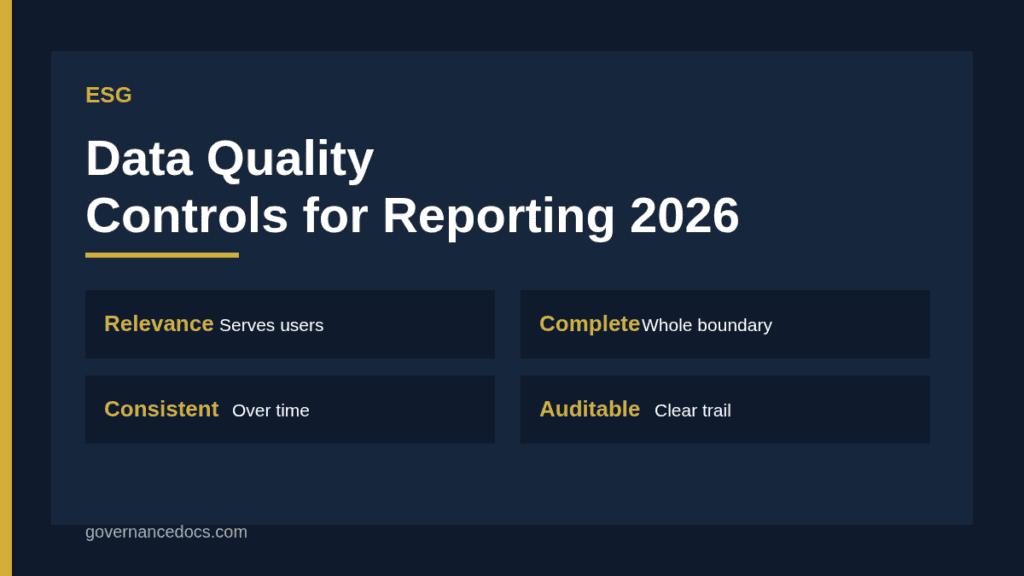
ESG data quality decides whether your sustainability report is believed. Investors, customers and assurance providers increasingly ask not only what your emissions or safety rates are, but how you know. The GHG Protocol Corporate Standard, the most widely used greenhouse gas accounting reference, sets five principles that give a solid base for data quality across ESG topics: relevance, completeness, consistency, transparency and accuracy. This guide shows how to turn them into controls you can run, with owners, checks and evidence.
The GHG Protocol states the principles as follows, and they translate well beyond carbon.
Principle
What the standard says
Control idea
Relevance
The inventory reflects the company’s emissions and serves users’ decision-making needs
Link each metric to a user need or materiality result
Completeness
Account for and report on all sources and activities within the chosen boundary
Boundary register and reconciliation to sites and entities
Consistency
Use consistent methodologies to allow meaningful comparison over time
Documented methods and change log
Transparency
Address relevant issues factually and coherently, based on a clear audit trail
Evidence files and calculation workbooks
Accuracy
Quantification is systematically neither over nor under actual emissions
Validation checks and uncertainty notes
Start with relevance: decide what to measure
Collect only what serves a purpose. Your materiality assessment tells you which topics matter to stakeholders and to the business, and our guide to double materiality assessment explains one approach. For each material topic, define the metric, the unit, the boundary and the intended users. Metrics without a clear user or decision tend to be poorly maintained, and they create audit work with no benefit. The ESG KPIs guide can help you pick measures that matter.
Completeness: set and reconcile the boundary
Define the organizational and operational boundary in writing: which entities, sites and activities are in, and which are out with reasons. Then reconcile. Compare your list of sites against the finance system, and your list of energy accounts against invoices, so that nothing is missed. Track new acquisitions, closures and outsourced activities, since these are the usual causes of gaps. If some data cannot be obtained, say so and estimate with a stated method rather than leaving it out silently.
Consistency: fix the methods and control changes
Write a short methodology note for every metric: source data, calculation, emission factors, assumptions and exclusions. Keep it under version control. When you change a method or a factor, record the change, the reason and the effect on prior years, and restate the comparatives if the change is material. Without this, year-on-year trends can reflect changes in method instead of performance.
Transparency: build an audit trail
An auditor should be able to trace any reported figure back to its source without asking you to explain from memory. Keep a folder or system for each metric containing raw data, invoices or meter reads, calculation files, factor sources and review sign-offs. Use consistent naming and links, and lock final versions. Where data comes from suppliers, keep the request, the reply and any checks you performed.
Accuracy: validate and quantify uncertainty
The standard aims for figures that are systematically neither over nor under actual values. Introduce validation checks: reasonableness tests against prior periods, comparison with independent data such as production volumes, and checks for unit errors and duplicates. Investigate large movements before you finalise. The GHG Protocol also discusses uncertainty assessment as part of inventory quality management, so note the main sources of uncertainty for each metric and how they might affect results.
Organizing ESG data quality: owners and controls
The GHG Protocol chapter on inventory quality points to three connected elements: systematic data collection and management procedures, quality control mechanisms to track and minimise errors, and uncertainty assessment. You can apply the same structure to any ESG data process.
Assign data owners. One named person for each metric at each site, with a backup.
Standardise collection. Use templates with defined fields, units and deadlines.
Add review layers. A site reviewer, a central checker and a final approver.
Run automated checks. Range limits, missing values and year-on-year variance flags.
Log issues. Keep a register of errors found and corrected, with root causes.
Sign off. A senior manager attests to the figures before publication.
Treat this as an internal control framework similar to financial reporting controls. Many companies apply the same discipline, with internal audit reviewing the process.
Preparing for assurance of ESG data quality
Assurance providers test data quality. Prepare by keeping the evidence trail organised, documenting methods and having the data owners available to answer questions. Do a dry run internally, sampling several metrics and following them to source. Fix weaknesses before external assurance, and record actions. Beyond regulation, accuracy protects you against claims of misleading statements. See our guide to greenwashing for the risks of unsupported claims.
Supplier and value chain data
Scope 3 and supply chain metrics are the hardest area for ESG data quality, because you depend on others. Start by ranking categories by likely size, so effort goes to the biggest sources. Where supplier-specific data is unavailable, use average data or spend-based estimates with clear labels, and improve over time by asking major suppliers for actual data. Record the request, response rates and reliability of each source. Present estimates as estimates, and explain the method. A transparent estimate is more credible than a precise-looking number with no basis.
Non-financial data beyond emissions
The same principles apply to safety rates, workforce data, water use, waste and governance metrics. For headcount and turnover, agree definitions with human resources, such as who counts as an employee and how part-time staff are treated, and keep them stable. For safety, define a recordable incident once, and reconcile to incident logs. For waste and water, reconcile to invoices and meter readings. Wherever a definition could reasonably differ, write it down and apply it consistently, so that ESG data quality holds across topics and years.
Systems and tools
Spreadsheets can work for small programmes, but they break down as complexity grows. Consider a system that centralises collection, applies validation rules, records approvals and keeps an audit log. Whatever you use, control access, keep backups and document how calculations work. When you change tools, run old and new in parallel for a period, and reconcile the results before switching. Do not let a new system quietly change your methods.
Reporting data quality to leaders
Leaders should see the reliability of the numbers, not only the numbers. Add a short data quality summary to the ESG report pack: which metrics were measured, which were estimated, known gaps, corrections made and planned improvements. Track simple indicators such as the share of data collected on time, the number of errors found in review and the share of figures backed by primary evidence. Present improvements year on year, which demonstrates progress and builds trust.
A hypothetical example
A hypothetical furniture manufacturer collects energy data from eight plants. The central team builds a template, assigns each plant a data owner and runs checks: a plant reporting a 40 percent drop in electricity use with no change in output is flagged. Investigation reveals a missing meter for one building, and the plant adds it. The methodology note records the emission factor source, and a change log shows that the factor was updated mid-year with the effect on the prior period. At the end of the year the sustainability director signs a data quality statement, and the audit trail lets an assurance provider trace a sample of figures in an afternoon. The example is invented for illustration.
Finally, schedule a lessons-learned review after every reporting cycle. Ask data owners what was slow, what broke and what they would change, and fold the answers into the templates and calendar for the following year. Small fixes to the process compound over time.
Common problems with ESG data quality
Boundary not documented, so sites or activities are missed.
Methods change from year to year without explanation.
Data collected by email in inconsistent formats.
No independent review of figures before publication.
Estimates presented as measured values.
Evidence scattered across personal drives.
The primary reference is the GHG Protocol Corporate Standard. If you report under a specific regime, check its data and assurance requirements too.
Templates for ESG data quality
To avoid building data request templates, methodology notes and review checklists from scratch, the ESG Toolkit provides documents you can adapt. Have your reporting and assurance leads review them.
ESG data quality FAQ
What are the five GHG accounting principles?
Relevance, completeness, consistency, transparency and accuracy.
Who should own ESG data?
A named person for each metric at each site, with central review and senior sign-off.
Do we need an audit trail for every figure?
Yes. A clear audit trail is part of the transparency principle, and assurance providers rely on it.
What if we cannot get complete data?
Disclose the gap, estimate with a documented method and plan improvement for the next cycle.
Should we restate prior years when methods change?
If the change is material, yes, so that comparisons stay meaningful. Record the decision.