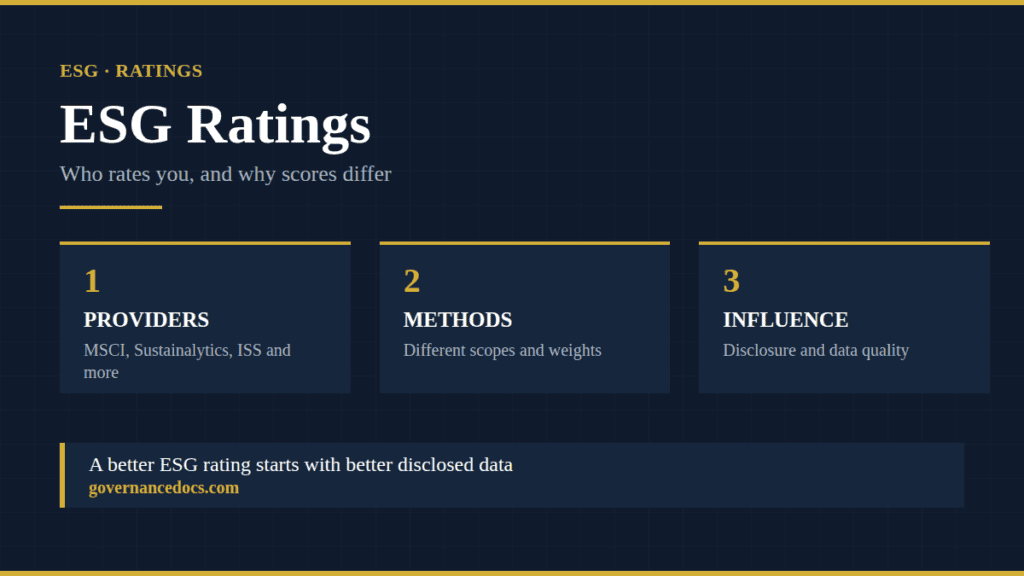
An ESG rating is a third party’s opinion or score of how a company handles environmental, social and governance risks, or of its impact on people and the planet. Investors, lenders and large customers use these ratings to screen, price and select companies. The company being rated rarely chooses who rates it.
This guide explains what these ratings measure, who the main providers are, why their results disagree, what you can do to influence your ESG score, and what the EU ESG Ratings Regulation changed in 2026.
Free gap assessment
Are you ready for the 2026 edition of ISO 14001?
Score every clause of the new edition, free, including the aspects, life cycle and compliance evaluation work that carries most of the findings.
The clearest legal definition comes from the EU. Regulation (EU) 2024/3005 defines an ESG rating as an opinion or a score, or both, about a rated item’s ESG profile, risk exposure or impact. It must rest on an established methodology and a defined ranking system of rating categories.
The same Regulation draws a useful line between two products:
ESG opinion: a rule-based assessment that directly involves a rating analyst.
ESG score: a measure derived from data by a statistical or algorithmic model, without analyst judgment in the rating itself.
Both count as ratings under the Regulation, whatever the provider calls them. What the definition excludes matters too: your own sustainability disclosures are not a rating, and nor is raw ESG data such as an emissions dataset.
ESG rating vs ESG metrics vs ESG reporting
These three terms get blurred. ESG metrics are the numbers you measure, such as emissions, injury rates or board independence. Our guide to the 12 ESG KPIs boards ask for covers the core set.
ESG reporting is how you publish those metrics and your policies. Ratings are what outsiders conclude after reading your reports, public data and news. You control the first two directly and the third only indirectly.
Who issues the ratings: six providers compared
Dozens of firms produce ratings, but a handful dominate investor and procurement requests. The table summarizes what each says about its own product. Methodologies change, so check the provider’s current documentation before you plan around a threshold.
Provider
What it rates
Scale
How companies engage
MSCI ESG Ratings
Resilience to financially relevant, industry-specific sustainability risks and opportunities
AAA to CCC, relative to industry peers
Mainly built from public data; MSCI offers issuer resources for companies it covers to review their data
Morningstar Sustainalytics ESG Risk Rating
Unmanaged exposure to material ESG risks
Points of unmanaged risk in five categories, negligible to severe; lower is better
Public disclosure and data review with the provider
ISS ESG Corporate Rating
Sustainability performance against industry-specific criteria
12 grades from A+ to D-; “Prime” status above an industry threshold
Public disclosure and data verification with ISS ESG
S&P Global Corporate Sustainability Assessment (CSA)
Industry-specific sustainability practices, through a questionnaire
0 to 100
Invited companies complete the CSA questionnaire; undisclosed items with no public information score zero
CDP scores
Environmental disclosure and performance (climate change, forests, water security)
A to D-; F for requested companies that do not disclose enough to be scored
Respond to the CDP questionnaire by the scoring deadline
EcoVadis
Supplier sustainability management across Environment, Labor & Human Rights, Ethics and Sustainable Procurement (21 criteria)
0 to 100, with medals for top performers
Supplier completes an online questionnaire and uploads evidence, usually at a customer’s request
Notice the split. MSCI, Sustainalytics and ISS mostly rate you from public information. S&P Global, CDP and EcoVadis rely heavily on what you submit. Your response strategy should differ for each group.
Why ESG ratings disagree
It is normal for one provider to rate a company highly and another to rate it near the bottom. That is not always an error. The providers are measuring different things.
Risk vs impact. Some ratings ask how ESG issues could hurt the company’s value. Others ask how the company affects the world. The same factory can score well on one and badly on the other.
Relative vs absolute. MSCI rates against industry peers. Sustainalytics describes its risk categories as absolute. A “leader” in a high-risk sector can still carry high absolute risk.
Scope and weighting. Providers choose different topics and weight E, S and G differently. A heavy governance weighting rewards different companies than a heavy climate weighting.
Data sources. Questionnaire-based ratings reward companies that respond. Public-data ratings reward companies that disclose clearly. Missing data is often scored as zero or as the worst case.
Controversies. News events and incidents can pull a rating down quickly, and providers treat them differently.
The practical lesson: don’t chase every rating. Find out which ones your investors, lenders and key customers actually use, and focus there.
How to improve your ESG rating
You cannot buy a better score, and in the EU you cannot influence the methodology. You can improve what the rater sees. Three levers make most of the difference.
Disclosure quality
Analysts can only score what they can find. Publish your policies, targets and metrics in one place, with clear dates and boundaries. A rater who cannot find your anti-bribery policy will usually assume you do not have one.
Your ESG score is only as good as the numbers behind it. Inconsistent emissions figures or restated injury rates make raters cautious. Define each metric once, keep calculation records and apply the same boundary every year.
Controls and evidence
Questionnaire ratings such as EcoVadis and the CSA ask for evidence, not claims. Keep an evidence folder for each answer. The controls in our article on ESG data quality controls make that folder audit-ready.
Rating readiness checklist
List which ratings your investors, lenders and top customers ask for.
Name one owner for each rating relationship and each questionnaire.
Download each provider’s current methodology and note the topics it weights most.
Map those topics to your existing policies, metrics and evidence.
Close the largest gaps first: missing policies, missing targets, unpublished metrics.
Review the data each provider holds on you and report factual errors through its issuer process.
Submit questionnaires early, with document references for every answer.
Log each result, the reasons given and the actions you will take before the next cycle.
EU rules for ESG rating providers
Regulation (EU) 2024/3005 on the transparency and integrity of ESG rating activities was adopted on 27 November 2024. It has applied since 2 July 2026. It regulates the providers, not the companies they rate.
The key points for a rated company:
Supervision. Providers that offer ratings in the EU need ESMA authorisation or recognition. ESMA’s page on rating providers says the transitional period ended on 2 November 2026.
Methodology transparency. Providers must publish key methodology information. Where one rating combines E, S and G, they must disclose the weighting of each.
Your data. The Regulation is designed to let rated companies check the dataset used and point out factual errors. It does not let you influence the method or the outcome.
Conflicts of interest. Providers must keep rating activity separate from consulting, auditing and credit rating work.
Exclusions. Private ratings ordered by one client and not distributed are outside scope, as are certain ratings used only internally by regulated financial firms.
For companies, the Regulation improves the odds of an accurate ESG rating. It does not remove the need for good disclosure. For the reporting side of the EU picture, see our summary of what the EU simplification changed for ESG reporting.
If your team is still debating whether this is an ESG matter or a CSR matter, our ESG vs CSR comparison explains why investors frame it as ESG.
ESG rating FAQ
Is an ESG rating the same as an ESG score?
People use the terms interchangeably. The EU Regulation treats an ESG score as one type of rating: a model-driven measure without analyst judgment. An ESG opinion involves a rating analyst directly.
Can a private company get an ESG rating?
Yes. Investor-focused ratings mostly cover listed companies, but supplier ratings such as EcoVadis and questionnaire-based scores such as CDP are open to private companies. They are often requested by a customer.
How often are ratings updated?
Questionnaire-based ratings follow an annual cycle. Public-data ratings are reviewed periodically and can change at any time after a controversy. Check each provider’s methodology for its review frequency.
Which provider matters most for us?
The one your stakeholders use. Listed companies should ask investor relations which ratings shareholders cite. Suppliers should ask their largest customers which questionnaire they require, then put the effort there first.
Can we dispute a low ESG rating?
You can correct factual errors in the data used, and most major providers have an issuer channel for that. You cannot negotiate the methodology or the judgment. Better disclosure is the reliable fix.
Our ESG Toolkit provides 20+ editable templates for building and reporting your ESG framework — including an ESG Gap Analysis Tool, an Anti-Bribery and Anti-Corruption Policy and an ESG Report Template — for $69.
When a standard changes, know first
One email a month: edition changes, new deadlines, and what they mean for documentation you already have. No sales sequence.