CART
Data catalog vs data dictionary is a comparison between two kinds of metadata that are often bought as one product and are never the same thing. A data dictionary describes the structure of data in a system: for each table and column, the name, data type, length, allowed values, constraints, relationships and a technical description — metadata about the container, produced close to the database and read by developers, DBAs and integration engineers. A data catalog is an inventory of the organisation’s data assets across systems, enriched with business metadata — owners, business definitions from the glossary, classification, quality status, lineage, usage — and searchable by people who want to find, understand and trust data before they use it.
In the DAMA-DMBOK’s terms both live in the Metadata knowledge area, and both are governed under the data governance framework, but the dictionary is technical metadata and the catalog is the business and operational metadata layered over it. This guide sets the two side by side on five differences, shows where a business glossary fits between them, explains which to build first for four common situations, and describes how the three are connected so that a term, a field and a dataset all point to each other.
Free gap assessment
How mature is your data management, area by area?
Score all eleven DAMA knowledge areas, free, plus the ethics, AI and organisational change chapters that sit off the wheel.
Run the free data governance maturity assessment → or View premium report sample
| Data dictionary | Data catalog | |
|---|---|---|
| What it describes | The structure of data in one system or database: tables, columns, types, lengths, nullability, keys, constraints, allowed values, technical descriptions | Data assets across the organisation: datasets, tables, reports, files, APIs — what they are, who owns them, what they mean, where they come from, how good they are, who uses them |
| Kind of metadata | Technical (structural) | Business, operational and technical, with the technical layer often imported from dictionaries |
| Produced by | Database and application teams; often generated from the schema | Stewards and owners (business metadata), automated scanners (technical), usage logs (operational) |
| Read by | Developers, DBAs, integration and reporting engineers | Analysts, data scientists, business users, auditors, privacy and security teams |
| Scope | One system, or one database at a time | The enterprise, or a governed subset of it |
| Governance role | Custodian-maintained; a control over structural change | Owner- and steward-maintained; the register the governance framework operates on |
Our guide to the data governance framework places both in layer 4, the data assets and metadata layer; data governance and the DMBOK covers the Metadata knowledge area they belong to.
| Difference | Data dictionary | Data catalog |
|---|---|---|
| 1. Question answered | What is this field, technically? | What data do we have, what does it mean, can I trust it, may I use it? |
| 2. Unit | Column and table | Dataset and asset, with columns beneath |
| 3. Meaning | A technical description, if any; the business meaning is usually absent or informal | Business definitions linked from the glossary, with owners and stewards |
| 4. Context | None beyond the schema | Lineage, classification, quality scores, usage, related assets, certification |
| 5. Currency | Regenerated from the schema; accurate for structure, silent on meaning | Curated; accurate only if stewardship keeps it so |
The first data catalog vs data dictionary difference is the question asked. A developer joining two tables needs the dictionary: which column is the key, what type is it, can it be null. An analyst deciding whether to use a dataset for a board report needs the catalog: who owns it, what “active customer” means in it, when it was last refreshed, whether it is certified. The same column appears in both, but the questions are different and so is the audience.
Dictionaries are exhaustive at column level and say nothing about which columns matter. Catalogs start from the asset and attach meaning: the customer dataset, owned by the customer domain owner, whose “customer_status” column implements the glossary term “active customer” as the customer steward defined it. The glossary is the bridge — without it, a catalog is a dictionary with better search.
Lineage, classification and quality are catalog metadata because they cross systems. A dictionary is regenerated from the schema and is therefore always structurally correct and never semantically informative; a catalog is curated and is only as current as the stewards who maintain it — which is why catalogs need the governance framework’s layer 2 roles and layer 3 processes to stay true.
| Artefact | Owner | Content | Links to |
|---|---|---|---|
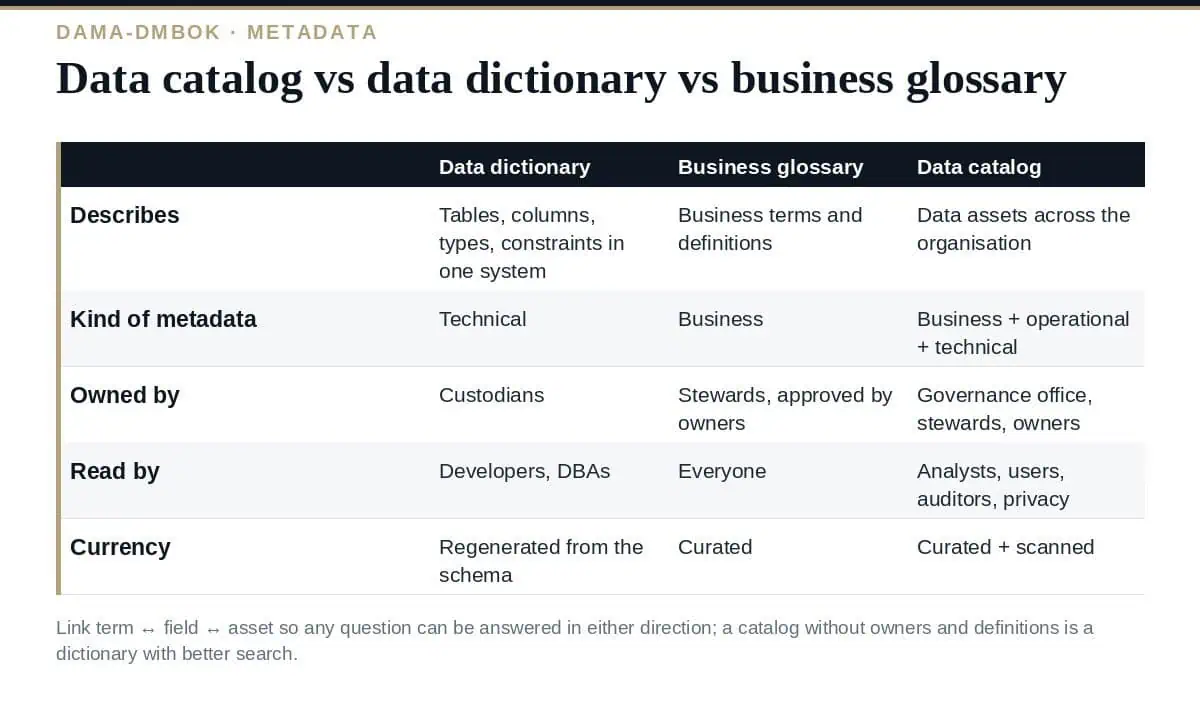
| Business glossary | Stewards, approved by owners | Business terms, definitions, synonyms, calculation rules, authoritative source | Catalog assets that implement each term; dictionary fields that hold it |
| Data dictionary | Custodians | Technical structure per system | Glossary terms the fields implement; catalog assets the tables belong to |
| Data catalog | Governance office, stewards, owners | Asset inventory with business, operational and technical metadata | Glossary terms; dictionary fields; lineage between assets |
Connected, the three answer any question in either direction: from a term to the fields and datasets that carry it, from a field to the term it means and the datasets it feeds, from a dataset to its owner, terms, sources and users. Our guide to data lineage covers the link that runs between catalog assets.
| Situation | Start with | Then |
|---|---|---|
| No metadata at all; one or two core systems | Data dictionary, generated from the schema, with business descriptions added for critical fields | A glossary for the critical terms, then a catalog when there are more systems than people can hold in their heads |
| Many systems, analysts cannot find data | Data catalog with automated technical scanning, populated for the governed domains first | Glossary terms linked to the catalog’s critical assets; dictionaries imported as the technical layer |
| Regulatory driver — privacy, BCBS 239, SOX reporting | Catalog scoped to the regulated data, with classification, lineage and owners | Dictionaries for the systems in the regulated flows |
| Data governance programme starting | Glossary and critical data element inventory (framework layer 4), in whatever tool exists | Catalog once owners, stewards and standards are in place — tooling before roles is the classic failure |
What is the difference between a data catalog and a data dictionary?
A data dictionary describes the technical structure of data in one system — tables, columns, types, constraints — for developers and DBAs. A data catalog is an enterprise inventory of data assets with business metadata — owners, glossary definitions, classification, lineage, quality, usage — for anyone who needs to find, understand and trust data. The dictionary is technical metadata; the catalog layers business and operational metadata over it.
Do I need both?
Usually. The dictionary is generated from the schema and controls structural change; the catalog is curated and supports discovery and governance. Small organisations with one or two systems can live with dictionaries and a glossary; larger ones need the catalog to make the estate findable.
Where does the business glossary fit?
Between them: stewards define business terms in the glossary, dictionary fields are mapped to the terms they implement, and catalog assets link to both — so a term, a field and a dataset all point to each other.
Is a data catalog the same as a metadata repository?
A catalog is a metadata repository with a discovery front end and governance workflow. The DMBOK treats all of it under the Metadata knowledge area; the catalog is the current form of the metadata repository.
Which should a data governance programme build first?
The glossary and the critical data element inventory, in whatever tool exists, once owners and stewards are appointed; then dictionaries generated for the systems in scope; then a catalog when there is governed content to put in it.
Settle data catalog vs data dictionary by the question each answers: the dictionary tells engineers what a field is, the catalog tells everyone else what data exists, what it means, whether it can be trusted and whether they may use it — and the business glossary joins them. Generate the dictionaries, define the glossary, build the catalog on governed content, link term to field to asset, and measure coverage, because a catalog without owners and definitions is a dictionary with better search.
The business glossary standard and template, the data dictionary template, the data catalog metadata standard with the owner, definition, classification, lineage and quality fields, and the critical data element inventory are in the Data Governance Toolkit, or start with the free templates.

October 11, 2026
October 11, 2026

October 11, 2026

October 11, 2026

October 11, 2026

