CART

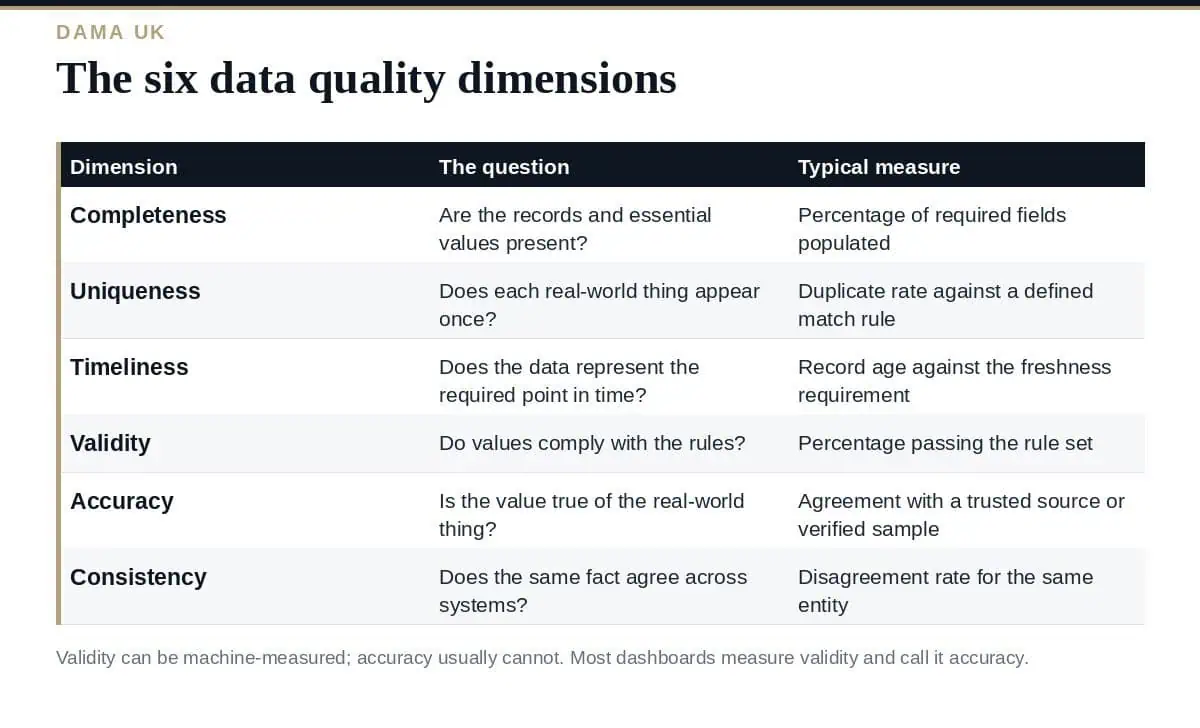
Data quality dimensions are what turn “the data is bad” into something a team can measure and fix. DAMA UK’s 2013 working group settled on six primary dimensions for data quality assessment — completeness, uniqueness, timeliness, validity, accuracy and consistency — and they remain the reference set because they are narrow enough not to overlap and broad enough to cover what actually goes wrong.
This guide defines each one, gives the measure that goes with it, and covers the two dimensions that cannot be assessed the way the others can.
Free gap assessment
How mature is your data management, area by area?
Score all eleven DAMA knowledge areas, free, plus the ethics, AI and organisational change chapters that sit off the wheel.
Run the free data governance maturity assessment → or View premium report sample
| Dimension | The question it answers | Typical measure |
|---|---|---|
| Completeness | Are the records that should be there present, and are the essential values populated? | Percentage of required fields populated |
| Uniqueness | Does each real-world thing appear only once? | Duplicate rate against a defined match rule |
| Timeliness | Does the data represent reality from the point in time required? | Age of the record against the freshness requirement |
| Validity | Do the values comply with the rules — format, range, reference list? | Percentage of values passing the rule set |
| Accuracy | Does the value match the real-world thing it describes? | Agreement with a trusted source or verified sample |
| Consistency | Does the same fact agree wherever it is held? | Disagreement rate across systems for the same entity |
This is the distinction that decides whether a data quality programme finds real problems. Validity asks whether a value obeys the rules; accuracy asks whether it is true. A date of birth of 01/01/1900 is perfectly valid — correct format, plausible range, passes every rule you wrote — and almost certainly wrong. A postcode that exists is valid; whether it is the customer’s postcode is accuracy.
Validity can be measured by machine against a rule set, cheaply and continuously. Accuracy generally cannot: it requires comparison against a trusted external source or a sampled verification exercise with a human in it. That difference in cost is why most dashboards quietly measure validity and label it accuracy.
Consistency only means something once you have named the systems being compared. The same customer’s address in the CRM, the billing platform and the support tool either agrees or does not, and the disagreement rate is the measure. Within a single table, what people usually call consistency is validity with a conditional rule.
Measuring all six data quality dimensions across every attribute in the estate is how data quality programmes die. The version that survives is narrower:
Data quality is one knowledge area among several, and the dimensions are the measurement layer beneath it. They connect outward in three directions worth wiring deliberately:
How many data quality dimensions are there?
Six primary dimensions in the DAMA UK reference set: completeness, uniqueness, timeliness, validity, accuracy and consistency. Longer lists exist, but they tend to subdivide these rather than add genuinely new ones.
What is the difference between validity and accuracy?
Validity means the value obeys the defined rules; accuracy means it is true of the real-world thing. A value can be perfectly valid and completely wrong.
Which dimension should we measure first?
Completeness and validity, because they can be measured automatically and usually surface the largest volume of fixable defects. Accuracy is the most valuable and the most expensive.
Do we need a tool?
Not to start. A rule set, a schedule and a spreadsheet of results will prove the value; tooling earns its place once the rule count grows past what a person can run.
Who owns data quality?
The data owner sets the acceptable threshold; a steward operates the measurement and chases remediation. Handing both to a central team is what makes quality “IT’s problem” and keeps it unfixed.
Use the six data quality dimensions as a vocabulary, not a checklist. Pick your critical data elements, choose the dimensions that carry the risk for each, agree the rules and thresholds with the people who own the data, and be honest about which of your measures are validity wearing accuracy’s name. Then report exceptions and trend rather than a grid of percentages — the point of measuring quality is that somebody fixes something.
Rule sets, stewardship roles and quality reporting templates are in the Data Governance Toolkit, or start with the free ISO templates.

October 14, 2026
October 13, 2026

October 12, 2026
October 12, 2026

October 12, 2026

