

ISO 14001 Certification Body: The Essential 2026 Selection Guide
Choosing an ISO 14001 certification body decides who audits your environmental management system for the next three years, how many audit days you pay for, and whether your certificate carries weight with customers and regulators. In 2026 there is a new test to add: whether the body is accredited for ISO 14001:2026 yet. This guide shows how an auditor would check a certification body before you sign a quote.
If you are still mapping the whole route, read our ISO 14001 certification process guide first and come back here when you are ready to request quotes.
Free gap assessment
Are you ready for the 2026 edition of ISO 14001?
Score every clause of the new edition, free, including the aspects, life cycle and compliance evaluation work that carries most of the findings.
Run the free ISO 14001 gap assessment → or View premium report sample
What an ISO 14001 certification body actually does
An ISO 14001 certification body (in the US, often called an ISO 14001 registrar) audits your environmental management system against ISO 14001:2026. If the system conforms, it issues a certificate. Accredited bodies work to ISO/IEC 17021-1, the general standard for bodies that certify management systems.
For environmental systems they must also meet ISO/IEC 17021-2:2016. That short standard adds competence requirements for the people who audit and certify an EMS. In practice, it means the auditor should understand environmental aspects, compliance obligations and the operational controls typical of your sector.
Two rules shape the relationship from day one:
- ISO/IEC 17021-1 clause 5.2.5 bars a certification body from offering management system consultancy. A body that offers to “get you ready” through the same legal entity is a red flag.
- Legal compliance stays your job. The auditor checks that you identify your compliance obligations and evaluate compliance, but the certificate is not a legal compliance opinion.
The 2026 test: is the body accredited for ISO 14001:2026?
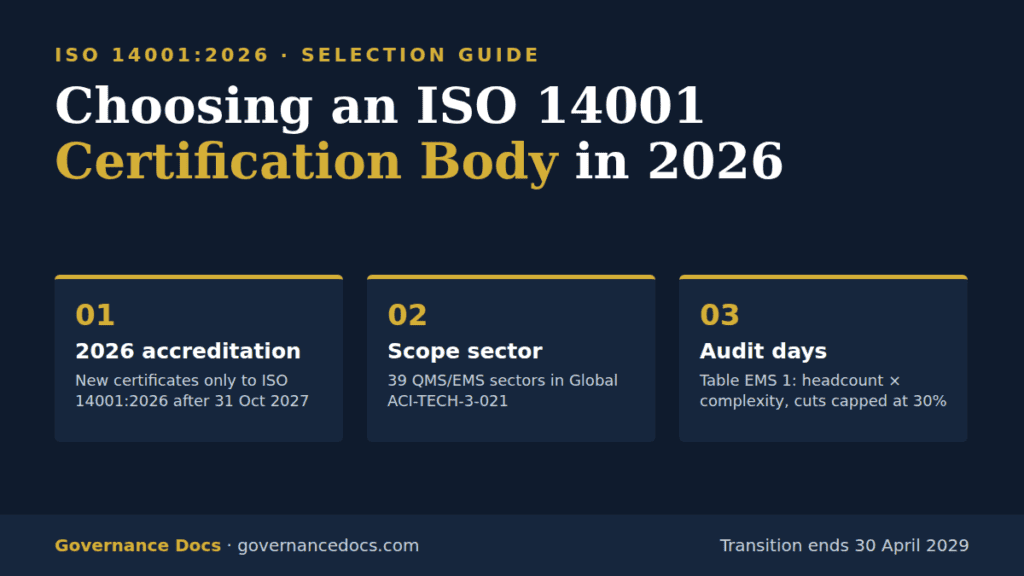
ISO published the fourth edition, ISO 14001:2026, in April 2026. Global ACI, which took over the International Accreditation Forum’s role on 1 January 2026, set the transition rules in Global ACI-TECH-3-TR 2029-04-30 (M), issued 4 September 2026. The dates matter when you choose a body:
| Milestone | Date | What it means for you |
|---|---|---|
| Accreditation bodies ready to assess the 2026 edition | 31 October 2026 | National accreditation bodies should already have announced their arrangements. |
| Certification bodies declare transition readiness | 31 January 2027 | A body that will not transition must tell its clients in writing by this date. |
| Accreditation body transition decisions complete | 30 April 2027 | From here, every accredited body still offering ISO 14001 should hold 2026 accreditation. |
| New certifications only to ISO 14001:2026 | 31 October 2027 | No new ISO 14001:2015 certificates can be issued after this date. |
| Transition ends | 30 April 2029 | ISO 14001:2015 certificates are no longer valid. |
Ask every candidate one direct question: has your accreditation body transitioned your ISO 14001 accreditation to the 2026 edition, and if not, when? A body certifying you to the 2015 edition in 2027 would leave you facing a transition audit almost straight away.
If you already hold a certificate, the transition audit can be combined with a surveillance or recertification audit, or run as a special audit. The body must review the changed requirements, including the new clause 6.3 on planning of changes, plus changes to your context. It must also decide whether extra audit time is needed. Our ISO 14001:2026 transition guide covers what changed in the standard itself.
Accreditation: the first filter for any ISO 14001 certification body
Anyone can print a certificate. An accredited ISO 14001 certification body has been assessed by a national accreditation body, such as ANAB in the US, UKAS in the UK or DAkkS in Germany. Accreditation bodies that sign the Global ACI Multilateral Recognition Arrangement recognize each other’s accredited certificates. That recognition is what makes a certificate travel across borders and supply chains.
Check three things before you request a quote:
- The body’s accreditation certificate lists ISO 14001, not just ISO 9001.
- The accreditation scope covers your scope sector (see the next section).
- The accreditation is current on the accreditation body’s own website, not only in a PDF from the sales team.
You can also search IAF CertSearch, the database of accredited certificates, to see whether a body’s certificates are actually listed.
Scope sectors: does the body cover your industry?
EMS accreditation is granted by sector. Global ACI-TECH-3-021 (I), formerly IAF ID 1, sets out 39 scope sectors for QMS and EMS accreditation, mapped to NACE economic activity codes. Examples run from agriculture and mining through chemicals, construction and waste to health and social work.
Your certificate scope must fall inside the body’s accredited sectors. A body accredited for engineering services but not for waste recycling cannot issue an accredited certificate for a recycling plant. Ask each ISO 14001 certification body which sectors it holds, and how many qualified auditors it has in yours. A body with one qualified auditor for your sector will struggle to schedule you.
How an ISO 14001 certification body sets audit time
Audit time is not a sales decision. Global ACI-TECH-3-004 (M), formerly IAF MD 5, sets the starting point. For an EMS it depends on two things: effective number of personnel and the environmental complexity category of your activities.
Table EMS 1 gives the initial audit time (stage 1 plus stage 2) in days. Here is an extract:
| Effective personnel | High | Medium | Low | Limited |
|---|---|---|---|---|
| 1-5 | 3 | 2.5 | 2.5 | 2.5 |
| 6-10 | 3.5 | 3 | 3 | 3 |
| 16-25 | 5.5 | 4.5 | 3.5 | 3 |
| 26-45 | 7 | 5.5 | 4 | 3 |
| 46-65 | 8 | 6 | 4.5 | 3.5 |
| 86-125 | 11 | 8 | 5.5 | 4 |
| 176-275 | 13 | 10 | 7 | 5 |
| 426-625 | 16 | 12 | 9 | 6 |
Table EMS 2 links sectors to categories. Mining, oil refining, chemicals, civil construction and hazardous waste processing are high. Food processing, transport, printing and healthcare are medium. Wholesale, retail, hotels and assembly work are low. Office-type activities such as HQ functions, telecoms and education are limited. Nuclear, local authorities and financial institutions are “special cases” that need separate planning.
The body then adjusts. Time can go up for a sensitive receiving environment, the views of interested parties, indirect aspects or complicated logistics. Time can come down for a mature system, a small site for its headcount or off-location staff. Total reductions may not exceed 30% of the table time. Every adjustment must be justified and recorded.
After certification, surveillance takes about one third of the initial audit time each year, and rarely less than one day. A recertification audit takes about two thirds of what a fresh initial audit would need at that point.
A worked example: a 60-person food processor is medium complexity, so the starting point is 6 days for stage 1 plus stage 2. Expect about 2 days of surveillance a year and about 4 days at recertification, before adjustments. Our ISO 14001 certification cost breakdown turns days like these into a budget.
How to compare ISO 14001 certification body quotes
Give every ISO 14001 certification body the same scope, sites, headcount and description of activities, then compare line by line. Watch for these red flags:
- Audit days well below Table EMS 1 for your complexity category, with no written justification. An underpriced quote often grows at stage 2.
- A complexity category that does not match your activities. A chemical blender quoted as “low” is a warning sign.
- Consultancy, gap assessments or “pre-audits” bundled by the same legal entity.
- No answer on 2026 accreditation status or the transition plan.
- Travel, report and certificate fees left out of the headline price.
Ask about lead times as well. A body that cannot schedule stage 2 before a tender deadline is the wrong choice at any price. If you also run ISO 9001 or ISO 45001, ask for an integrated audit under Global ACI-TECH-3-008 (formerly IAF MD 11), which can reduce total days.
Surveillance, validity and changing your ISO 14001 certification body
An accredited ISO 14001 certificate runs for a three-year cycle. Surveillance audits happen at least once a calendar year outside recertification years, and the first must take place within 12 months of the certification decision. Our ISO 14001 surveillance audit guide covers what the body samples each year, and our ISO 14001 certificate validity guide explains what happens if an audit slips.
You are not locked in. Accredited certification can usually be transferred under Global ACI-TECH-3-002 (formerly IAF MD 2), provided the certificate is valid and any open major nonconformities are dealt with. If your current body decides not to transition to ISO 14001:2026, it must tell you in writing by 31 January 2027, which is a natural point to move. See our guide to changing certification body for the steps.
Get your evidence ready before the auditor arrives
No ISO 14001 certification body will write your environmental management system for you. The cheapest audit is the one where the auditor finds complete, current records on day one. That means the aspects and impacts register, the compliance obligations register, evaluation of compliance, internal audit results and management review minutes.
Frequently asked questions
Is an ISO 14001 registrar the same as a certification body?
Yes. “Registrar” is the common US term; “certification body” is the term ISO/IEC 17021-1 uses. Both mean the organization that audits and certifies your environmental management system.
Can I still get certified to ISO 14001:2015?
Only until 31 October 2027. After that date, accredited bodies may issue new certificates only to ISO 14001:2026, and all 2015 certificates lapse on 30 April 2029. Most organizations starting now should go straight to the 2026 edition.
Does accreditation matter if my customer only asks for “ISO 14001 certified”?
Usually, yes. Many buyers, tenders and supplier questionnaires accept only accredited certificates, and an unaccredited certificate does not benefit from mutual recognition between accreditation bodies. Check the buyer’s wording before you choose a cheaper unaccredited body.
How many audit days will my ISO 14001 certification body quote?
It starts from Table EMS 1 in Global ACI-TECH-3-004. A 30-person office-type business starts at 3 days for stage 1 plus stage 2, while a 30-person high-complexity manufacturer starts at 7. Adjustments can move that, but reductions are capped at 30%.
Our ISO 14001 Toolkit provides 65+ editable templates aligned to ISO 14001:2026, including the EMS manual, the aspects and impacts register, legal compliance procedures, internal audit and management review formats your certification body will expect to see, for $99.
When a standard changes, know first
One email a month: edition changes, new deadlines, and what they mean for documentation you already have. No sales sequence.

Governance Docs
Governance Docs LLC
Recent Posts
November 28, 2026
November 27, 2026
November 27, 2026

November 26, 2026

November 26, 2026