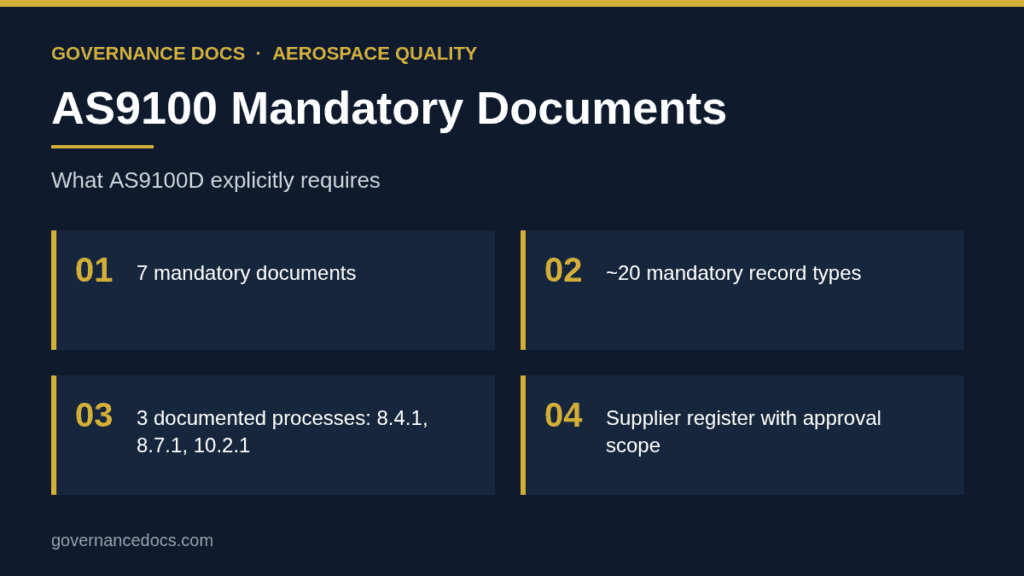
AS9100 mandatory documents are the short list of documented information that AS9100 Rev D explicitly requires, and the list is smaller than most aerospace suppliers expect. The standard names seven documents you must maintain and around twenty types of records you must retain. Everything else in a typical quality manual binder is there because the business needs it, a customer flowed it down, or a consultant added it out of habit.
This guide to AS9100 mandatory documents sets out exactly what AS9100D requires, clause by clause, where the aerospace additions sit on top of ISO 9001, and which “optional” documents auditors still expect to see in practice. As of October 2026, AS9100D (revised September 2016) remains the certifiable revision. The IAQG has signalled a successor, IA9100, but it has not been published yet, so this list is the one your certification body audits against today.
Free gap assessment
Are you ready for the 2026 edition of ISO 9001?
Score yourself against the new edition, free, including the risk and opportunity split and the clause 10 renumbering that breaks converted checklists.
AS9100D is built on the ISO 9001:2015 structure, which dropped the old requirement for six named procedures and a quality manual. Instead, the standard uses the phrase “documented information” and leaves it to you to decide how much documentation your processes need to work reliably. Clause 7.5.1 still requires you to hold whatever documented information is necessary for the effectiveness of the QMS, so “not mandatory” never means “not needed.”
The aerospace text adds back some explicit requirements. Where ISO 9001 says “maintain documented information,” AS9100D sometimes goes further and requires a documented process. Those additions are where most audit findings on documentation come from, because organizations migrating from an ISO 9001 system assume the lighter ISO approach still applies.
A useful way to read the list: a “document” (maintained documented information) tells people how things should be done, and a “record” (retained documented information) proves what was actually done. Auditors sample both.
The 7 Mandatory Documents in AS9100 Rev D
The table below lists the AS9100 mandatory documents you must maintain under AS9100D. Clause numbers refer to AS9100D.
#
Document
Clause
What auditors look for
1
Scope of the QMS
4.3
Products and services covered, sites, and justification for any requirement you claim does not apply
2
QMS description: relevant interested parties, scope, process descriptions and interactions, and assigned responsibilities and authorities
4.4.2
A process map or interaction matrix that matches how work really flows, plus named owners
3
Quality policy
5.2
Communicated, understood and consistent with your strategic direction
4
Quality objectives and plans to achieve them
6.2
Measurable targets with owners, dates and progress data
5
Documented process for controlling externally provided processes, products and services
8.4.1
Supplier approval, risk, monitoring and flow-down steps
6
Documented process for control of nonconforming outputs
8.7.1
Segregation, disposition authority, use-as-is and repair approvals, and customer notification
7
Documented process for nonconformity and corrective action management
10.2.1
Containment, root cause, human factors, effectiveness checks and flow-down to suppliers
Item 2 is the biggest practical difference from ISO 9001. Clause 4.4.2 in AS9100D requires a documented description of the QMS that pulls together interested parties, scope, process interactions and responsibilities. Many organizations still meet this with a short quality manual, which is a perfectly sound choice even though the manual itself is no longer a named requirement.
The Mandatory Records AS9100D Expects You to Keep
Records are where a stage 2 audit spends most of its time, and they make up most of the AS9100 mandatory documents list. AS9100D requires retained documented information in roughly twenty areas. Some apply only when the related clause applies to you (for example, design records if you hold design authority).
Evidence that processes run as planned (4.4.2)
Calibration and verification of monitoring and measuring equipment, including a register of that equipment (7.1.5)
Competence of people, including training and qualification evidence (7.2)
Review of customer requirements and any new requirements for products and services (8.2.3)
Design and development inputs, controls, outputs and changes, where design applies (8.3.3 to 8.3.6)
Production process verification, typically a first article inspection report (8.5.1.3)
Traceability, where required (8.5.2)
Customer property that is lost, damaged or found unsuitable (8.5.3)
Review of changes to production or service provision (8.5.6)
Release of products and services, including the identity of the person authorizing release (8.6)
Nonconforming outputs and the actions taken (8.7.2)
Monitoring and measurement results (9.1.1)
Internal audit program and audit results (9.2.2)
Management review outputs (9.3.3)
Nonconformities, corrective actions and their results (10.2.2)
Two records cause frequent findings. First, production process verification under 8.5.1.3: AS9100D expects verification of the first production run of a new or changed part, and most customers specify the AS9102 first article inspection format for it. Our first article inspection guide walks through the three AS9102 forms. Second, release records under 8.6: the auditor will check that the person who signed off was authorized to do so.
Aerospace Processes That Need Documented Control
Several AS9100D clauses require you to “plan, implement and control” a process without saying “maintain documented information.” In practice, very few organizations pass an audit on these without a written procedure, because the requirements are detailed and the auditor needs something to test against. Treat them as near-mandatory.
Operational risk management (8.1.1): responsibilities, risk criteria, identification, mitigation and acceptance of residual risk
Prevention of counterfeit parts (8.1.4): training, obsolescence monitoring, controls for sourcing from original or authorized manufacturers, and reporting
Work transfers (8.1): planning and control when work moves between sites or suppliers
Foreign object detection and prevention (8.5.1): often supported by a FOD program
Ask your certification body how it treats these. The consistent message from aerospace auditors is that if you cannot show a defined method, you will struggle to show the process is “controlled.”
Documents Auditors Still Expect Even Though They Are Optional
These are not among the AS9100 mandatory documents, yet most AS9100 audits will go more smoothly if they exist:
Quality manual: the simplest way to satisfy 4.4.2 and to explain your exclusions
Document and record control procedure: 7.5 has detailed requirements for protection, retention and disposal, and customers often specify retention periods
Internal audit procedure: helps demonstrate the program meets 9.2 and the auditor independence expectations
Approved supplier list: AS9100D 8.4.1 requires a register of external providers that includes approval status and scope of approval
Calibration register: a list of gauges with calibration status and recall methodology
Risk register: the output of both 6.1 and 8.1.1
The external provider register deserves a special mention. AS9100D 8.4.1 says the organization shall maintain a register of its external providers that includes approval status (for example approved, conditional or disapproved) and the scope of the approval. That is a mandatory record in all but name.
How Much AS9100 Mandatory Documents Coverage Is Enough?
Size and complexity drive how far you go beyond the AS9100 mandatory documents. A 15-person machine shop might run a lean system of a short manual, six or seven procedures and a handful of forms. A design-authority manufacturer with special processes and multiple sites may need several dozen procedures. The test auditors apply is simple: can your people perform the process consistently using what is written, and do the records prove they did?
Three practical rules help keep documentation proportionate:
Write procedures for processes that carry risk, not for every task. Risk to product conformity, safety and delivery is the filter AS9100D uses throughout.
Put the requirement and the record in the same place. A traveler or router that carries the inspection steps and captures sign-offs is both a work instruction and a record.
Keep customer flow-downs visible. Many primes add their own documentation requirements in purchase order clauses. Those carry the same weight as the standard during an audit of that customer’s work.
Common Documentation Findings in AS9100 Audits
The same handful of issues show up again and again in audit reports:
Scope statements that do not match the certificate request, or that claim a requirement does not apply without justification
Process maps that show the ideal, not the real flow, so interviews contradict the 4.4.2 description
Corrective action records with no root cause analysis, or with “operator error” as the cause and no human factors consideration
Supplier registers missing scope of approval, or listing suppliers who were never evaluated
First article inspections skipped after a design or process change
Uncontrolled copies of drawings or specifications on the shop floor, which also links to configuration management
Running an internal audit against the full list of AS9100 mandatory documents before stage 1 is the cheapest way to catch these. Our AS9100 internal audit checklist is organized clause by clause for that exact purpose.
Where This Fits in the AS9100 Family
The AS9100 mandatory documents list is also a strong starting point for the rest of the family: if you supply maintenance services rather than manufacture, AS9110 applies; if you distribute parts, AS9120 applies. The mandatory document logic is similar across all three, but the operational clauses differ. Our overview of aerospace quality management and the three AS9100-family standards explains which one fits your business.
If you would rather start from a structure than a blank page, the AS 9100 Toolkit includes 38 editable templates covering the quality manual, the aerospace-specific procedures and the registers listed above, aligned to AS9100D, AS9110C and AS9120B.
For the authoritative text, the current revision is published as AS9100D on SAE Mobilus.
A Practical AS9100 Mandatory Documents Checklist Before Stage 1
Use this short checklist to confirm your AS9100 mandatory documents are in place before you book the stage 1 audit:
Scope statement approved, with justification for any requirement that does not apply
QMS description covering interested parties, process interactions and responsibilities
Quality policy issued and communicated
Quality objectives with targets, owners and current results
Documented processes for external provider control, nonconforming outputs and corrective action
External provider register with approval status and scope
Calibration register and recall process
At least one full internal audit cycle and a management review on file
If any item is missing, close it before stage 1. Gaps in the AS9100 mandatory documents are easy for an auditor to spot and easy for you to fix in advance.
Frequently Asked Questions
Is a quality manual mandatory for AS9100D?
No. AS9100D does not name a quality manual as a required document. It does require a documented description of the QMS under clause 4.4.2, and most organizations meet that requirement with a short manual because it is the clearest format for auditors and customers.
How many procedures does AS9100 require?
Among the AS9100 mandatory documents, AS9100D explicitly requires documented processes for control of external providers (8.4.1), nonconforming outputs (8.7.1) and corrective action (10.2.1). In practice, most certified organizations also document risk management, configuration management, product safety, counterfeit parts prevention, document control and internal audit.
How long must AS9100 records be kept?
The standard does not set a single retention period. Clause 7.5.3.2 requires you to define retention and disposal, and customer contracts or regulations often specify the period. Retention of ten years or more is common for aerospace product records, but your contracts decide.
Will IA9100 change the mandatory documents list?
Possibly, but IA9100 has not been published as of October 2026, so there is no confirmed list yet. AS9100D remains the revision audited today, and existing certificates are expected to remain valid through a transition period once the new standard is released.