

COSO Generative AI Guidance: The Complete 2026 Audit-Ready Guide
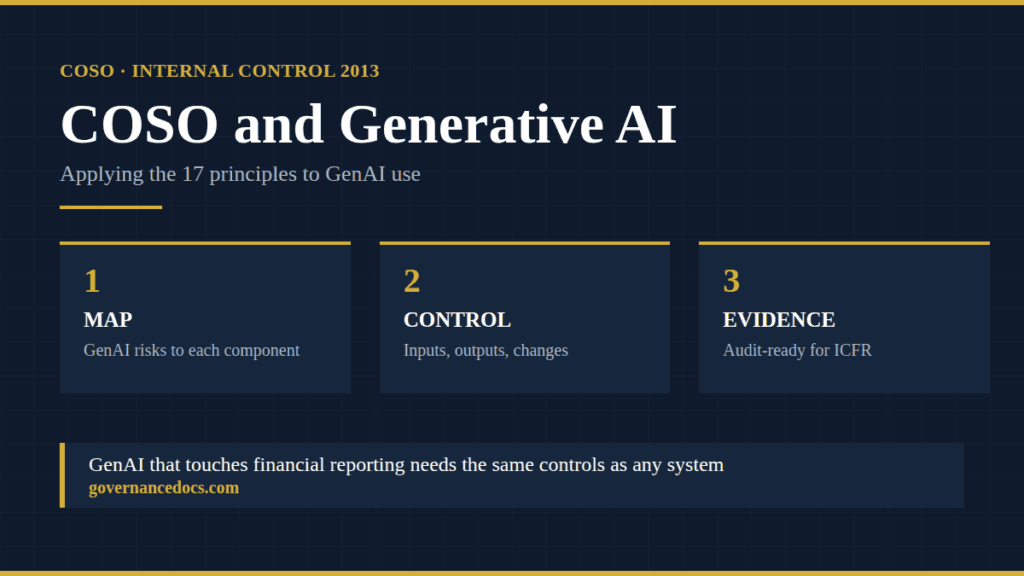
The COSO generative AI guidance is a 32-page COSO publication, released in February 2026, called Achieving Effective Internal Control Over Generative AI (GenAI). It does not create a new framework. It takes the 2013 Internal Control–Integrated Framework, with its five components and 17 principles, and shows how each applies when GenAI touches a business process.
This guide covers what the document says, what “audit ready” means once GenAI feeds financial reporting, and a table of risks, controls and evidence by component.
Free gap assessment
Is risk management actually changing decisions?
A maturity assessment against all eight principles, the framework and the process, free. Nobody can certify you to ISO 31000, so this scores distance from good practice instead.
Run the free ISO 31000 maturity assessment → or View premium report sample
What the COSO generative AI guidance is
COSO announced the paper on its generative AI publication page, where the PDF is available to download. COSO describes it as turning the Framework into practical, audit-ready guidance for governing GenAI, which is why many people search for the “COSO audit ready guidance generative AI” paper.
The authors are three academics and two practitioners, with input from the COSO Board. The COSO generative AI guidance builds on COSO’s earlier thought piece Realize the Full Potential of Artificial Intelligence and on its guidance for robotic process automation (RPA).
The COSO generative AI guidance names its intended readers: managers who use AI systems, compliance and risk teams, controllers and financial reporting groups, IT governance and security, board committees, internal audit and external auditors assessing GenAI-related controls.
What it deliberately leaves out
The scope is risks that GenAI creates or significantly amplifies. The paper does not repeat existing guidance on traditional IT general controls, such as network security, non-AI change management or segregation of duties in ERP systems. It states those controls are still needed.
In practice, your existing SOX ITGC domains remain the base layer. The COSO generative AI guidance sits on top of them.
The seven risk themes
The paper illustrates the GenAI risks it addresses under seven headings:
- Data quality, source and completeness
- Reliability and consistency, including hallucinations and drift after vendor updates
- Explainability and transparency
- Security and privacy, including prompt injection
- Bias and fairness
- Third-party and vendor risk
- Governance and accountability, where prompts, thresholds and retrieval connectors count as controlled configuration
The eight capability types
Instead of organizing controls by product or vendor, the COSO generative AI guidance groups GenAI uses by what the system does. The eight types follow a data-to-decision sequence:
| # | Capability type | Example from the paper (paraphrased) |
|---|---|---|
| 1 | Data extraction and ingestion | Pulling details out of incoming support emails |
| 2 | Data transformation and integration | Applying standard product categories before analytics run |
| 3 | Automated transaction processing and reconciliation | Matching supplier invoices to purchase orders |
| 4 | Workflow orchestration and autonomous task execution | An agent that pulls trial balance data, runs reconciliations and escalates exceptions |
| 5 | Judgment, forecasting and insight generation | Demand forecasts or a draft market summary |
| 6 | AI-powered monitoring and continuous review | Scanning sensor data for likely defects |
| 7 | Knowledge retrieval and summarization | Condensing new privacy regulation for a compliance officer |
| 8 | Human–AI collaboration | A developer reviewing code that GenAI wrote |
Classifying use cases this way shows where errors start and how far they travel. Appendix B of the paper maps controls to all five components for each type.
The paper also sets five foundational characteristics: GenAI is probabilistic, dynamic, easily scalable, has a low barrier to entry, and can itself help govern GenAI. Under the first, outputs are treated as claims that need validation, not facts.
How it maps the 17 principles to GenAI
The main body of the COSO generative AI guidance walks through each component and calls out the principles most affected. If you need a refresher on the principles themselves, our guide to the COSO 17 principles and five components covers them in full.
Control environment (Principles 1–5)
Principle 1 starts with a GenAI acceptable use policy covering prohibited data, bias expectations and off-limits use cases. Principle 2 puts GenAI risk in front of the board, for example through a cross-functional responsible AI committee.
Principle 3 asks for a named owner for every GenAI tool and a RACI for prompts, system prompts, retrieval datasets and transformation rules. Principles 4 and 5 cover role-based training and accountability for misuse.
Risk assessment (Principles 6–9)
Each use case needs defined objectives and success criteria. The paper also asks whether GenAI is the right tool at all, since deterministic automation may be more reliable.
Principle 8 adds GenAI fraud vectors such as deepfakes, synthetic records and prompt manipulation. Principle 9 treats changes to models, prompts, retrieval connectors and vendor updates as significant change that triggers re-assessment.
Control activities (Principles 10–12)
Principle 10 calls for human review proportionate to risk. Principle 11 extends general controls over technology to models, configurations, embeddings and retrieval indexes, with access control, change management and segregation of duties.
For high-impact processes, the paper describes an AI “bill of materials”: logs of prompts, outputs, system messages, model version, parameters and plugins used.
Information, communication and monitoring (Principles 13–17)
Principle 13 asks you to capture prompts, inputs, outputs, sources, model versions and confidence scores. Principles 16 and 17 combine continuous metrics with periodic deep reviews, and widen root-cause analysis to cover prompt design, retrieval issues and vendor changes.
Internal control over generative AI in ICFR: what “audit ready” means
The phrase “audit ready” matters most when GenAI touches internal control over financial reporting. The COSO generative AI guidance addresses this in a sidebar with a working definition of AI reliance.
Reliance exists when management depends on an AI output as part of the evidence that an ICFR control is designed or operating effectively. The paper’s contrast is simple:
- Reliance: AI matches journal entries to support, and management approves posting using only the AI output.
- Non-reliance: AI suggests matches, but the control owner re-performs all or a sample and documents the review.
Where reliance exists, the paper expects the same evidence standards as any ICFR control: a documented prompt, configuration and model version, a clear sampling rationale with exception resolution, and retained evidence of design and operation. For non-reliance cases, evidence expectations may be lower.
That definition gives your SOX team a clean scoping question for every GenAI use case in a key process. If the answer is reliance, the AI configuration belongs in your risk and control matrix like any other system.
Five ways to test AI control performance
The paper lists approaches that support both management’s assurance and auditor evidence needs:
- Human-in-the-loop review, from full re-performance to risk-based sampling
- Performance testing against test populations and edge cases
- Multi-model validation against independent models or deterministic benchmarks
- Data analytics monitoring for anomalies and drift
- Third-party validation, especially for vendor AI in high-risk areas
On deficiencies, Principle 17 notes that GenAI failures include hallucinations in regulated disclosures, biased outcomes and privacy leakage, not just missing controls. Evaluate their severity the same way you would any other gap, using your control deficiency evaluation method.
COSO AI controls table: component, risk, control and evidence
This table condenses the paper’s guidance into a working format. The control examples come from the publication; the evidence column is what an auditor would typically ask to see.
| COSO component | GenAI risk | Control examples | Evidence |
|---|---|---|---|
| Control environment | Shadow AI; unclear ownership | Acceptable use policy; named owner per tool; RACI for prompts and retrieval data; role-based training | Approved policy; use case inventory with owners; training records |
| Risk assessment | Hallucination, drift, prompt injection, vendor change | Objectives and success criteria per use case; living risk register; change triggers for model and prompt updates | Risk register version history; scenario analyses; re-assessment records |
| Control activities | Over-reliance; unauthorized configuration change | Confidence thresholds with human review; SoD between configuring and approving; documented approval for prompt and threshold changes | Change tickets; review sign-offs; post-change sample results |
| General controls over technology | Untracked model or index changes | Models, embeddings and retrieval indexes managed as configuration items; independent validation in deployment pipelines | Access lists; change logs; logs of prompts, outputs and model version |
| Information and communication | Untraceable outputs; misleading external use | Source capture; controlled prompt libraries and model cards; incident and change notification protocols | Output logs with sources; prompt library history; notification records |
| Monitoring activities | Gradual accuracy decline; failed detection logic | KPI and KRI dashboards; periodic model effectiveness reviews; retraining or rollback triggers; remediation log | Dashboard snapshots; review reports; remediation log with root cause |
The six-step implementation roadmap
The COSO generative AI guidance closes its main body with a cyclical roadmap. After step 6, you return to step 1.
- Establish an AI governance structure sized to the organization, typically a cross-functional committee.
- Inventory GenAI use cases, including scans for shadow AI, and classify each by capability type.
- Assess risks by COSO component, using “what if” scenarios.
- Design and map controls, each linked to a component, a capability type and a metric.
- Implement and communicate, including training and change histories.
- Monitor and adapt, including revalidation after vendor model updates.
Three short case studies follow, including one where a GenAI accrual process missed a supplier’s switch from monthly to quarterly billing. Month-end variance analysis caught it, which is a useful reminder that your existing detective controls still matter.
How COSO AI guidance fits with ISO 42001 and NIST AI RMF
The three serve different purposes, and most organizations will use more than one. Our overview of AI governance frameworks explains the usual order.
| Framework | What it is | Best used for |
|---|---|---|
| COSO GenAI guidance (2026) | Guidance applying the 2013 COSO Framework to GenAI | Controls that management and auditors test, especially ICFR |
| ISO/IEC 42001:2023 | Certifiable AI management system standard | A certifiable management system with AI risk and impact assessments |
| NIST AI RMF 1.0 | Voluntary framework with Govern, Map, Measure and Manage functions, plus a Generative AI Profile (NIST AI 600-1) | Structured risk identification and measurement |
The practical overlap is the use case inventory and the risk assessment. One generative AI risk assessment can feed the ISO 42001 risk process, the NIST Map and Measure functions and COSO Principle 7 at the same time.
Free AI risk assessment
Which of your AI systems could harm people, or you?
List your AI systems, models and data, pick from 54 AI risk scenarios, including the attacks on AI described in ISO 27090, rate them for the people affected and for you, and plan treatment with ISO 42001 Annex A controls. You get a heat map, a process score and the findings an auditor would raise, free.
Run the free AI risk assessment → or View premium report sample
COSO adds what the other two do not stress: control-level evidence that an auditor can test and rely on. If your GenAI use reaches the general ledger, that is the layer your external auditor will ask about first.
COSO generative AI guidance FAQ
Is the COSO generative AI guidance mandatory?
No. It is COSO guidance, not a regulation or a new framework. It applies the existing 2013 Framework to GenAI, so organizations that already use COSO for ICFR can extend their current control system rather than start a separate one.
Does it replace the 2013 Internal Control–Integrated Framework?
No. The paper states it adapts the five components and 17 principles of the 2013 Framework. Your control criteria stay the same; the guidance shows how they apply to GenAI.
What does “audit ready” mean in the COSO GenAI paper?
Each of the eight capability types comes with minimum control expectations across the five components and illustrative metrics for audit evidence. For ICFR, the paper adds a reliance test and evidence expectations such as documented prompts, configurations and model versions.
Where should a SOX team start?
Inventory every GenAI use case that touches a key process, then apply the reliance test to each. Use cases with reliance need full ICFR documentation and testing; the rest still need governance but lighter evidence. Our SOX Toolkit (45 templates, $99) covers the wider SOX program around those controls.
How does it relate to the COSO ERM framework?
The paper builds on COSO’s earlier AI thought piece, which used the ERM foundation, and translates it into internal control practice. For how the two COSO frameworks differ, see our overview of the COSO framework and its new generative AI guidance.
Our COSO ERM & Internal Control Toolkit provides 21 editable templates for documenting internal control and ERM against the COSO components and principles — including internal control and ICFR policies, control testing and deficiency evaluation, a risk appetite statement and an enterprise risk register — for $99.
When a standard changes, know first
One email a month: edition changes, new deadlines, and what they mean for documentation you already have. No sales sequence.

Governance Docs
Governance Docs LLC
Recent Posts

November 27, 2026

November 27, 2026

November 26, 2026

November 26, 2026

November 26, 2026