CART
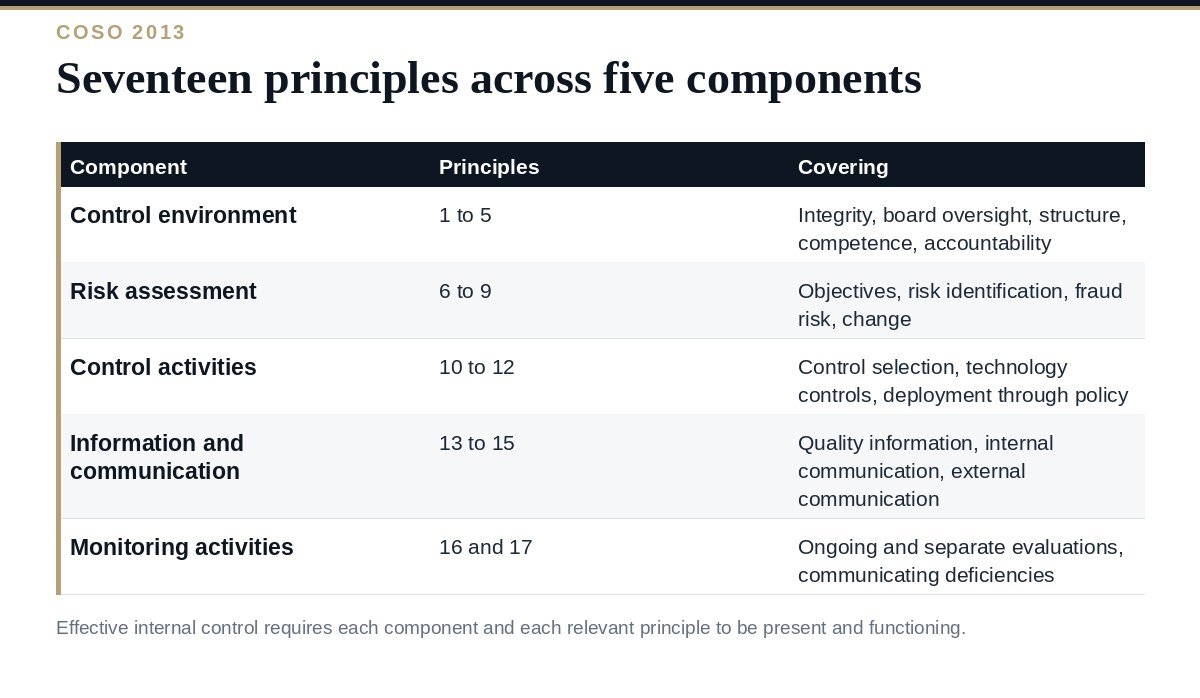
The COSO 17 principles are what turned the internal control framework from a concept into something you can assess. The 2013 revision codified them — five components, seventeen principles beneath them — and set a test: for internal control to be effective, each component and each relevant principle must be present and functioning, and the components must operate together.
This guide lists the seventeen as COSO frames them, explains the present-and-functioning test and what a major deficiency is, and covers where assessments go wrong.
Free gap assessment
Is risk management actually changing decisions?
A maturity assessment against all eight principles, the framework and the process, free. Nobody can certify you to ISO 31000, so this scores distance from good practice instead.
Run the free ISO 31000 maturity assessment → or View premium report sample
The 2013 framework’s test has two halves. Present means the component and its relevant principles exist in the design and implementation of the system of internal control. Functioning means they continue to exist in the conduct of the system. Both, for every relevant principle, plus the components operating together in an integrated manner.
That is what makes a principle-level assessment unavoidable. A major deficiency is a deficiency, or combination of deficiencies, that severely reduces the likelihood that the entity can achieve its objectives — and it exists when management determines that a component and one or more relevant principles are not present and functioning, or that the components are not operating together. In other words, a single principle you cannot evidence is not a rounding error; it puts the effectiveness conclusion at risk.
COSO supports the judgment with points of focus — example characteristics for each of the COSO 17 principles. They are aids, not a checklist: you are not required to evidence every point of focus, and management can conclude a principle is present and functioning by other means. Treating them as mandatory line items is what turns a COSO assessment into a paperwork exercise.
Four patterns account for most of the rework in a COSO 17 principles assessment.
Mapping controls to components instead of principles. The components are too coarse to test. A control matrix that maps to “Control Environment” tells you nothing about whether principle 5 — accountability for internal control responsibilities — is functioning.
Ignoring principle 8. Fraud risk became its own principle in 2013, and assessments carried over from the 1992 framework frequently have no fraud risk assessment at the assertion or transaction level to point at.
Free enterprise risk assessment
Which of your business risks sit above your appetite?
Set your criteria and appetite, pick from 36 strategic, financial, operational and compliance scenarios, rate them and decide how to treat each. Built to ISO 31000, and free.
Run the free enterprise risk assessment → or View premium report sample
Under-evidencing principle 11. General technology controls sit in their own principle, and in most organizations the evidence is held by IT rather than finance. If nobody has asked IT for access reviews, change management records and job monitoring, principle 11 is not evidenced.
Assuming every principle is relevant. COSO’s test is that each relevant principle is present and functioning. In rare circumstances a principle may not be relevant — but that determination has to be documented and supported, not assumed by omission.
The COSO 17 principles arrived with the 2013 refresh, and the framework is the reference point US issuers use when management assesses internal control over financial reporting. That is why the principles show up in SOX programmes: management’s assessment has to conclude on an effective system of internal control, and the framework defines what effective means. Our guide to SOX 404 covers who has to have that assessment attested by an auditor.
Outside the US the same structure gets used voluntarily as an internal control model, and it sits comfortably alongside management system standards — the risk assessment component in particular maps closely onto ISO 31000’s process. What COSO adds is the accountability layer: named principles a board can ask about, one at a time.
How many COSO principles are there?
Seventeen, codified in the 2013 revision of the Internal Control–Integrated Framework and distributed across the five components: five, four, three, three and two.
What are the five components?
Control environment, risk assessment, control activities, information and communication, and monitoring activities.
Do all 17 principles have to be met?
Every relevant principle must be present and functioning, and the components must operate together. A component or relevant principle that is not present and functioning is a major deficiency.
Are points of focus mandatory?
No. They are example characteristics to help management judge whether a principle is present and functioning.
Is COSO the same as COSO ERM?
No. Internal Control–Integrated Framework and Enterprise Risk Management are two different COSO frameworks with different purposes. Our guide to the two COSO frameworks explains where each applies.
Assess at the principle level, because that is where the framework’s test bites. Map controls to the seventeen rather than to the five, treat points of focus as prompts rather than requirements, document any principle you judge not relevant, and pay particular attention to fraud risk and general technology controls — the two that most assessments inherit as gaps. A principle you cannot evidence is a major deficiency waiting to be found by somebody else.
Control matrices, assessment templates and deficiency logs are in the COSO ERM & Internal Control Toolkit, or start with the free ISO templates.

October 14, 2026

October 13, 2026
October 12, 2026
October 12, 2026
October 12, 2026

