CART
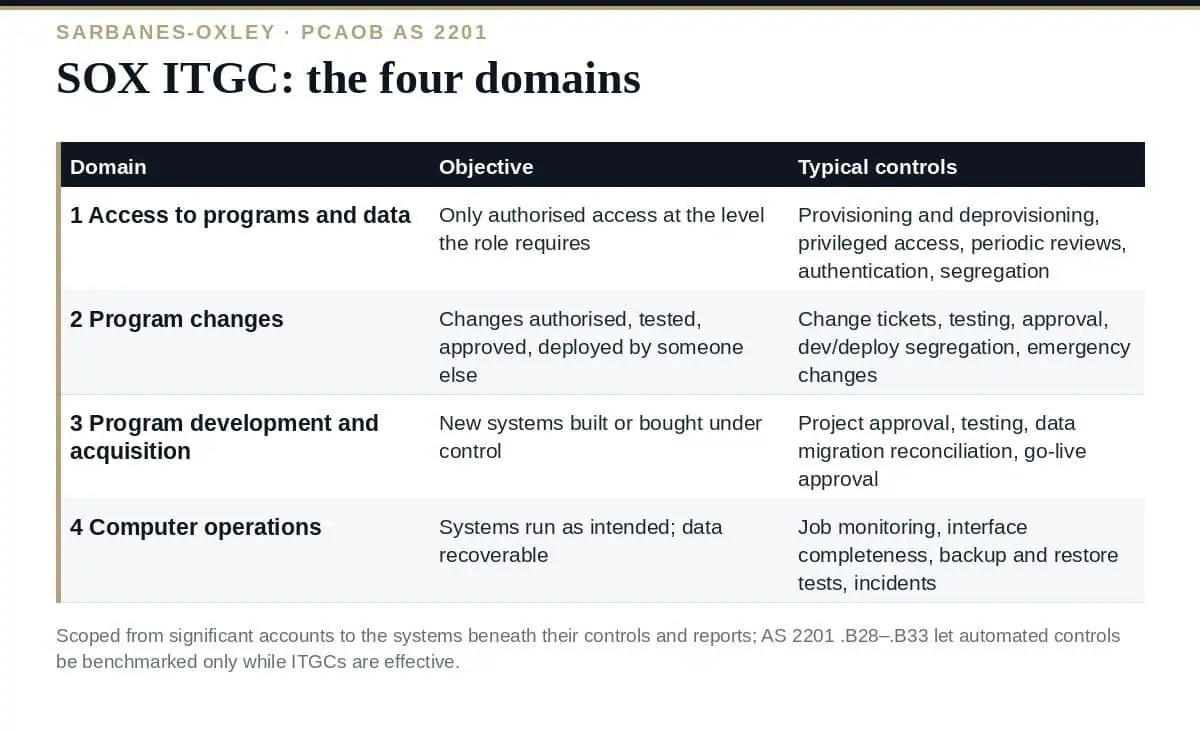
SOX ITGC — the IT general controls in a Sarbanes-Oxley programme — are the controls over the systems that process, store and report financial data, and they matter because every automated application control and every system-generated report an auditor relies on is only as good as the general controls beneath it. PCAOB Auditing Standard 2201 names the categories directly: in its benchmarking paragraphs it refers to general controls over program changes, access to programs, and computer operations, and to controls over application and system software acquisition and maintenance — the four domains that every SOX programme organises its IT testing around: access to programs and data, program changes, program development and acquisition, and computer operations.
AS 2201 also lists reliance on IT general controls as a factor in the risk associated with a control, which is why an ITGC failure can escalate into a deficiency in the application controls and reports that depend on it. This guide sets out the four SOX ITGC domains with the controls in each, explains how ITGCs relate to application controls and to information produced by the entity, describes scoping to in-scope systems, sets out how ITGCs are tested and how a deficiency is evaluated, and lists the failures auditors find most often.
Free gap assessment
Where do you actually stand against ISO 27001?
Score every management system clause and all 93 Annex A controls, free, and get a prioritised gap list back.
Run the free ISO 27001 gap assessment → or View premium report sample
Internal control over financial reporting relies on IT in three ways: automated application controls (a three-way match, a system-enforced approval limit), system-generated reports used in manual controls (the aged receivables report a reviewer signs off), and the integrity of the data in the financial systems themselves. None of those can be relied on unless the systems are controlled — unauthorised access could change a configuration, an untested change could break a calculation, a failed job could drop transactions.
AS 2201 treats reliance on IT general controls as a risk factor for the controls that depend on them and, in paragraphs .B28–.B33, allows an auditor to benchmark an automated application control — not re-test it every year — only if the general controls over program changes, access and computer operations are effective and continue to be tested. Effective ITGCs are therefore both a requirement and the thing that makes the rest of the programme cheaper. Our guide to SOX compliance covers the five-step ICFR cycle the ITGCs sit inside.
| Domain | Objective | Typical controls | Typical evidence |
|---|---|---|---|
| 1. Access to programs and data | Only authorised people and processes can access financial systems and data, at the level their role requires | User provisioning with approval; timely deprovisioning on leaving or transfer; privileged and administrative access restricted and monitored; periodic user access reviews; authentication settings (password, MFA); segregation of duties in role design; access to production data and direct database changes controlled | Access request tickets; leaver reports reconciled to HR; access review sign-offs with remediation; privileged account inventory; system configuration extracts |
| 2. Program changes | Changes to financial applications, databases and infrastructure are authorised, tested, approved and moved to production by someone other than the developer | Change request and approval; testing evidence; user acceptance where relevant; approval to deploy; segregation between development and deployment; emergency change process with retrospective approval; configuration changes to financially relevant settings controlled | Change tickets with approvals and test results; deployment logs reconciled to tickets; emergency change register |
| 3. Program development and acquisition | New systems and major upgrades are built or bought, tested, converted and implemented under control | Project approval; requirements and design sign-off; testing including data conversion; go-live approval; data migration reconciliation | Project governance records; test plans and results; migration reconciliations |
| 4. Computer operations | Systems run as intended and data is available and recoverable | Job scheduling and monitoring with failure follow-up; batch and interface completeness checks; backup and restore testing; incident and problem management for financially relevant systems | Job logs and exception follow-up; backup reports and restore tests; incident records |
| Layer | What it is | Depends on ITGC domain |
|---|---|---|
| Automated application controls | System-enforced controls: matching, tolerances, approval limits, calculations, interface validations | Program changes (the control’s logic), access (who can change its configuration), operations (that it ran) |
| Information produced by the entity (IPE) | System-generated reports and queries that manual controls rely on — ageing, reconciliations, exception reports | Program changes (report logic), access (parameters and data), operations (completeness of the run); plus the completeness and accuracy testing of the report itself |
| Manual controls using IT | Reviews and approvals performed in or from systems | Access (who could have performed or altered), operations |
| Data | The financial data itself | All four |
The consequence for scoping: an ITGC is in scope when a control or report the programme relies on depends on it. That is why ITGC scoping starts from the significant accounts, not from the IT inventory. Our guide to SOX scoping and materiality covers the top-down path from accounts to systems.
| Test | What is done | Notes |
|---|---|---|
| Design and implementation | Walkthrough of each control: who performs it, when, using what, with what evidence — AS 2201 .37 walkthroughs | Once per year; changes in systems or people reset it |
| Operating effectiveness | Sample the control’s occurrences across the period: access requests, leavers, changes, access reviews, job failures, backups | Sample sizes follow the frequency and risk; our guide to SOX control testing covers the conventions |
| Population completeness | Prove the sample came from the whole population — every change deployed, every leaver — usually by reconciling system logs to tickets | The step most often missing; a sample from an incomplete population tests nothing |
| Configuration inspection | Read the setting: password policy, segregation rules, scheduler parameters | Point-in-time; repeat at year end or rely on change controls |
| Roll-forward | Where interim testing is used, evidence for the remaining period — AS 2201 .55–.56 | Inquiry alone is insufficient for the roll-forward of key ITGCs |
An ITGC deficiency is evaluated like any other, but its consequence spreads. The evaluation asks: which application controls, reports and data depend on the failed general control; could the failure have allowed a misstatement in them; do compensating controls exist — a detailed manual review of the report, a reconciliation that would catch a wrong calculation, monitoring of privileged activity — and were they tested.
A deprovisioning failure with a compensating quarterly access review that operated is often a deficiency; a change-management failure on the revenue system with no compensating review can be a significant deficiency or a material weakness, because the automated controls beneath revenue can no longer be relied on and the auditor loses the benchmarking basis in .B29. Our guide to material weakness vs significant deficiency covers the severity test.
What are SOX ITGC?
The IT general controls over the systems that support internal control over financial reporting, organised in four domains: access to programs and data, program changes, program development and acquisition, and computer operations. PCAOB AS 2201 refers to them as general controls over program changes, access to programs and computer operations, and over software acquisition and maintenance.
Why do ITGCs matter if we test the financial controls?
Because automated application controls, system-generated reports and the financial data itself can only be relied on if the systems are controlled. AS 2201 treats reliance on IT general controls as a risk factor, and lets auditors benchmark automated controls only while the general controls are effective and tested.
Which systems are in scope for ITGC?
Those that support significant accounts and relevant assertions — the applications running the in-scope controls and reports, plus the databases, operating systems, middleware, identity and scheduling infrastructure beneath them, and service organisations whose services are part of the information system.
How are ITGCs tested?
Walkthroughs for design, sampled testing of occurrences for operating effectiveness with population completeness proven, configuration inspection for settings, and roll-forward where interim testing is used.
Is an ITGC failure a material weakness?
Not automatically. It is evaluated by which application controls, reports and data depend on it, whether a misstatement could have resulted, and whether tested compensating controls exist. A failed change control over a key financial system without compensating review can rise to a significant deficiency or material weakness.
Run SOX ITGC as the foundation they are: scope from significant accounts to the systems and service organisations beneath them, implement and evidence the four domains — access, change, development and operations — test with complete populations and real roll-forward, and evaluate any failure by what depends on it, because the application controls and reports the whole programme relies on are only as reliable as the general controls under them.
The ITGC control matrix for the four domains, the in-scope system inventory, the access review, change management and job monitoring procedures, the test plans with population and sampling steps and the deficiency evaluation template are in the SOX Compliance Toolkit, or start with the free templates.

October 11, 2026
October 11, 2026
October 11, 2026
October 11, 2026
October 11, 2026

