

EU AI Act and MDR: The Essential 2026 Guide for AI Devices
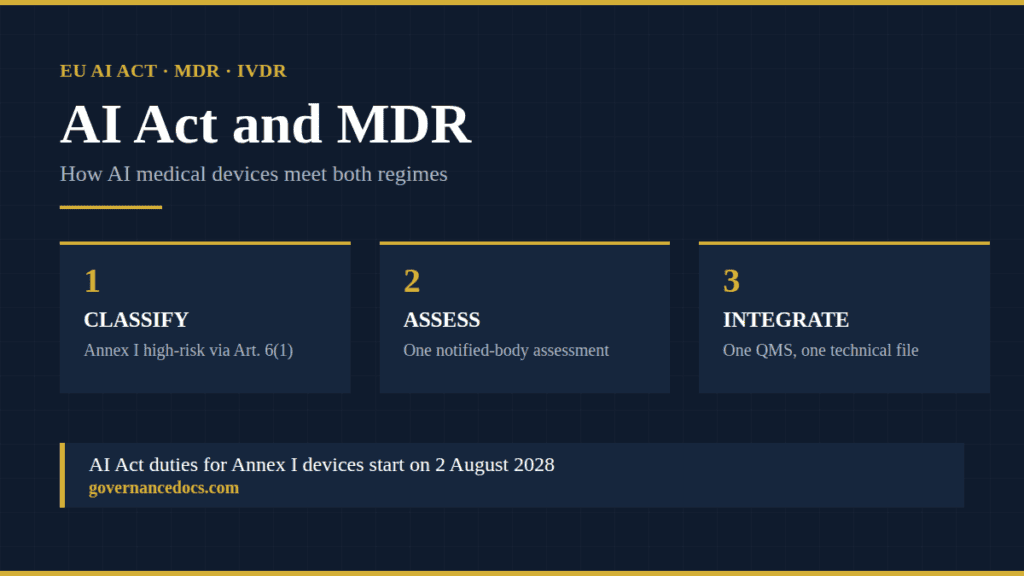
The EU AI Act and MDR now apply side by side to most AI-enabled medical devices, and manufacturers have to satisfy both through one quality system and one notified body review. The good news is that the two laws were designed to be combined. The bad news is that the AI Act adds requirements the MDR never asked for, especially on data, logging and human oversight.
This guide explains when an AI device becomes high-risk under the EU AI Act and MDR, when the obligations start, and how to merge the two sets of evidence. Positions are checked against the Regulation (EU) 2026/1744 amendments and the joint MDCG and AI Board guidance, as of late November 2026.
Free gap assessment
Which AI Act obligations do you actually owe?
Score what is already in force separately from the high-risk duties that now land in 2027, free.
Run the free EU AI Act gap assessment → or View premium report sample
When the EU AI Act and MDR both apply
Article 6(1) of the AI Act makes an AI system high-risk when two conditions are met. First, the AI system is a safety component of a product, or is itself a product, covered by the laws listed in Annex I. Second, that product must undergo third-party conformity assessment.
The MDR (Regulation (EU) 2017/745) and IVDR (Regulation (EU) 2017/746) are both in Annex I, Section A. So the question for AI medical devices in the EU becomes simple: does a notified body have to assess the device?
The joint guidance MDCG 2025-6 / AIB 2025-1, published in June 2025, sets this out in a table:
- High-risk under the AI Act: MDR Class IIa, IIb and III; Class I sterile, measuring or reusable surgical; Annex XVI products assessed by a notified body; IVDR Class B, C and D, and sterile Class A.
- Not high-risk via Article 6(1): MDR Class I self-certified devices, IVDR non-sterile Class A, and in-house devices under Article 5(5).
Two points catch people out. The AI Act does not change your MDR risk class. And the prohibited practices in Article 5 and the transparency duties in Article 50 apply regardless of device class.
MDR Rule 11 decides most cases
For medical device software, the AI Act outcome follows Annex VIII Rule 11 of the MDR. Software that provides information used for diagnostic or therapeutic decisions is Class IIa. It rises to IIb if a wrong decision could cause serious deterioration or surgery, and to III if it could cause death or irreversible deterioration.
Software that monitors physiological processes is Class IIa, or IIb where it monitors vital parameters and variations could put the patient in immediate danger. All other software is Class I. In practice, almost every clinical decision-support or diagnostic AI lands in Class IIa or above, so the medical device software AI Act link is the rule, not the exception.
EU AI Act and MDR timeline after the 2026 Omnibus
Regulation (EU) 2026/1744, the Digital Omnibus on AI, entered into force on 27 July 2026. It moved the high-risk dates. Here is the sequence that matters for device makers:
- 2 February 2025: the original Article 5 prohibitions applied.
- 2 August 2026: general application, including Article 50 transparency duties.
- 2 December 2026: four new prohibited categories added by the Omnibus apply.
- 2 December 2027: high-risk duties for Annex III systems (for example, emergency patient triage or eligibility for public healthcare benefits).
- 2 August 2028: high-risk duties for Article 6(1) and Annex I products, which includes AI medical devices and IVDs. This date was 2 August 2027 before the Omnibus.
The Commission had proposed, in COM(2025) 1023, moving the MDR and IVDR into Annex I Section B, which would have removed most AI Act duties for devices. The legislators kept them in Section A. That separate MDR/IVDR simplification proposal is still a proposal, so plan on full dual compliance.
Free AI risk assessment
Which of your AI systems could harm people, or you?
List your AI systems, models and data, pick from 54 AI risk scenarios, including the attacks on AI described in ISO 27090, rate them for the people affected and for you, and plan treatment with ISO 42001 Annex A controls. You get a heat map, a process score and the findings an auditor would raise, free.
Run the free AI risk assessment → or View premium report sample
EU AI Act and MDR obligations side by side
Use this table to map the EU AI Act and MDR duties into one compliance file instead of two. Article references are to the AI Act unless marked MDR.
| Obligation | MDR/IVDR | EU AI Act | How to combine |
|---|---|---|---|
| Quality management system | MDR Art. 10(9); ISO 13485 in practice | Art. 17 | Add AI elements to the existing QMS, as Art. 17(3) allows |
| Risk management | Annex I GSPR 3; ISO 14971 | Art. 9 | One risk file that adds AI hazards such as bias, drift and automation bias |
| Data governance | Clinical evaluation; software GSPR 17 | Art. 10 | A data management plan covering training, validation and test sets |
| Technical documentation | Annexes II and III | Art. 11 and Annex IV | A single set of documentation, per Art. 11(2) |
| Instructions and transparency | GSPR 23 labelling and IFU | Art. 13 | One IFU that states intended purpose, accuracy and limitations |
| Human oversight | Usability and safe use requirements | Art. 14 | Design oversight controls and document them in usability files |
| Logging and traceability | UDI and traceability | Art. 12 | Automatic event logs specified in the software architecture |
| Accuracy, robustness, cybersecurity | GSPR 17 | Art. 15 | One verification and validation plan with declared metrics |
| Conformity assessment | Notified body under Annex IX, X or XI | Art. 43(3) | One notified body assessment covering both |
| Post-market monitoring | MDR Arts. 83–86 | Art. 72 | Fold AI monitoring into the PMS plan, as Art. 72(4) allows |
| Incident reporting | MDR Art. 87 vigilance | Art. 73 | Report under the MDR; AI Act reporting is limited to fundamental-rights infringements (Art. 73(10)) |
| Changes | Significant change control | Art. 43(4) substantial modification | Pre-define learning changes in Annex IV point 2(f) so they are not new modifications |
For the MDR side of the file, our guide to MDR technical documentation under Annexes II and III lists each part. The AI Act content slots into those same sections.
One notified body, one conformity assessment
Article 43(3) tells providers of Annex I Section A products to follow the conformity assessment procedure of the sector law. For a device, that means the MDR or IVDR route you already use.
Within that procedure, the notified body checks the AI Act requirements in Articles 8 to 15, plus parts of Annex VII on QMS and technical documentation review. MDCG 2025-6 confirms that MDR sampling rules for technical documentation still apply.
Ask your notified body early whether it has been cleared to assess AI Act requirements. If it is not, you could face a delay just as the 2028 date approaches.
Integrating the QMS: ISO 13485 plus Article 17
The joint guidance treats the EU AI Act and MDR quality system duties as complementary. You do not need a second management system. You need targeted additions to the ISO 13485 system you already run.
- A data management procedure for collection, labeling, cleaning and dataset versioning.
- AI-specific risk analysis linked to the ISO 14971 file.
- Record-keeping rules for automatic logs.
- Human oversight design inputs and verification.
- Post-market monitoring that checks for drift and for interaction with other AI systems.
Software lifecycle evidence still comes from IEC 62304. Our comparison of IEC 62304 and ISO 13485 shows how the two standards connect. For the regulatory status of the QMS standard itself, see our note on ISO 13485 recognition.
If you are still building the MDR baseline, the EU MDR Toolkit covers the device-side procedures that the AI Act content attaches to.
Data governance and GDPR for health data
Article 10 requires training, validation and test data to be relevant, sufficiently representative and, as far as possible, free of errors and complete. It also requires an examination for possible biases. For a device, that means showing the data reflects the intended patient population.
Our guide to AI data governance covers the controls in detail. Health data is also special-category data under GDPR Article 9, so every dataset needs a lawful basis and a condition for processing. Read how GDPR applies to AI before you reuse clinical records for training.
Digital health regulation in the EU beyond devices
Not every health AI is a medical device. Digital health regulation EU lawmakers have built splits into three tracks, and the AI Act applies differently on each.
AI in medicines development
AI used to discover molecules, design trials or analyse safety data is not itself a device. The European Medicines Agency published a reflection paper on AI in the medicinal product lifecycle in September 2024. It expects a risk-based approach, documented models and early dialogue with regulators when AI affects evidence for a marketing authorization.
Wellness and administrative software
Fitness, wellbeing and scheduling tools usually fall outside the MDR. They escape the Annex I route, but Article 5 and Article 50 still apply, and some uses may fall under Annex III.
The European Health Data Space
The European Health Data Space Regulation (EU) 2025/327 entered into force on 26 March 2025. Key parts apply from March 2029, including the first cross-border patient data exchanges and most secondary-use rules. Permits for secondary use, which can cover training and testing algorithms, will run through it.
A readiness checklist for AI medical device makers
Work through these steps in order to prepare for the EU AI Act and MDR together. Most AI medical devices EU notified bodies review will need every one of them.
- Confirm the software is an AI system under the Commission’s definition guidelines.
- Record the MDR or IVDR class and whether a notified body is involved.
- Screen the product against Article 5 and Article 50 now, as they already apply.
- Run a gap assessment of the QMS against Article 17 and Articles 9 to 15.
- Write a data management plan and a bias examination for each model.
- Specify logging, human oversight and a predetermined change plan in the design file.
- Merge AI monitoring and incident triage into PMS and MDR serious incident reporting procedures.
- Confirm your notified body’s AI Act designation and agree a timeline before 2 August 2028.
For the wider device framework, start with our overview of the EU MDR, Regulation (EU) 2017/745.
EU AI Act and MDR FAQ
Is every AI medical device high-risk under the AI Act?
No. Only devices that need notified-body conformity assessment are high-risk through Article 6(1). Self-certified MDR Class I software and non-sterile IVDR Class A devices are not, although Articles 5 and 50 still apply to them.
When do the high-risk rules apply to AI medical devices?
From 2 August 2028. Regulation (EU) 2026/1744 moved the Annex I date from 2 August 2027. Use the extra time to integrate the QMS and line up your notified body.
Do we need two technical files and two certificates?
No. Under the EU AI Act and MDR together, Article 11(2) requires a single set of technical documentation, and Article 43(3) routes the AI Act checks through your MDR or IVDR conformity assessment. One notified body reviews both.
Does the AI Act change our MDR risk class?
No. MDCG 2025-6 states that high-risk status under the AI Act does not move a device into a higher MDR or IVDR class. The MDR class decides the AI Act outcome, not the other way round.
Our EU AI Act Toolkit provides 60 editable templates for high-risk AI compliance — including an AI system inventory and risk classification, data governance and human oversight procedures, and post-market monitoring and incident reporting templates — for $99.
When a standard changes, know first
One email a month: edition changes, new deadlines, and what they mean for documentation you already have. No sales sequence.

Governance Docs
Governance Docs LLC
Recent Posts

November 27, 2026

November 27, 2026

November 26, 2026

November 26, 2026

November 26, 2026