

AI Data Governance: The Practical 2026 Guide to Training Data
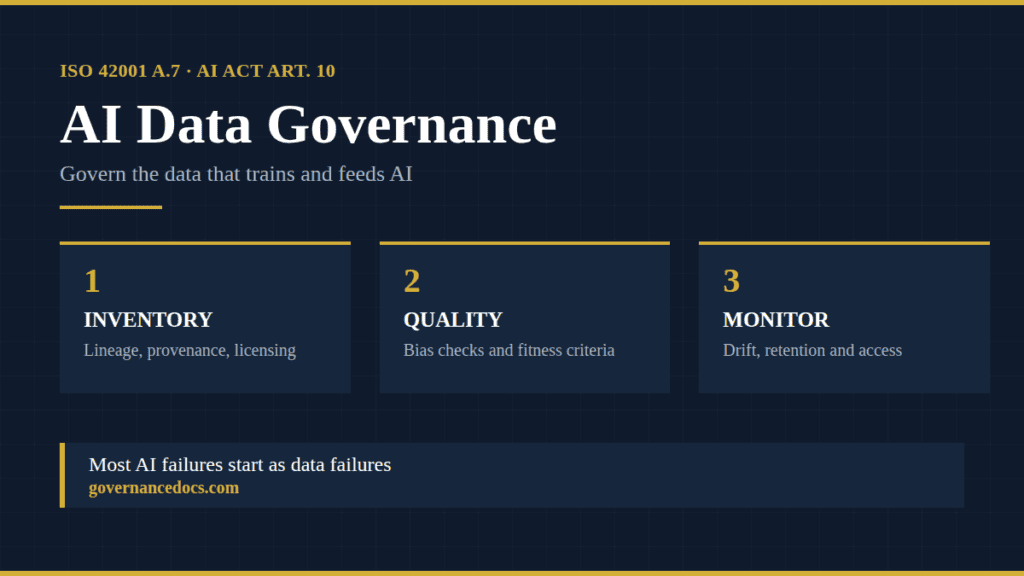
AI data governance is the set of rules, owners and records that control the data used to train, tune, test and feed an AI system. It answers five questions an auditor will ask: where the data came from, whether you were allowed to use it, whether it is fit for purpose, who can touch it, and how you know it has not changed.
Most organizations already run some form of data governance. The gap is that classic programs were built for reports and transactions, not for models that learn from data and keep consuming it after release. This guide shows what to add, maps each control to ISO/IEC 42001, the NIST AI RMF, the EU AI Act and DAMA-DMBOK, and ends with a 10-item checklist.
Free gap assessment
How much of ISO 42001 could you evidence today?
Score every clause and Annex A control of the AI management standard, free, and see where the programme really sits.
Run the free ISO 42001 gap assessment → or View premium report sample
What AI data governance adds to ordinary data governance
A sound data governance framework already gives you owners, stewards, a data catalog, quality rules and access control. Keep all of it. AI work adds three things the usual framework rarely covers.
- Data becomes part of the product. A training set shapes model behavior permanently, so a bad record is not fixed by correcting the source table later.
- Rights travel with the data. Licence terms, consent and the original collection purpose limit what a dataset may train, even when the data is technically available.
- The data keeps moving after go-live. Production inputs drift away from what the model learned, so governance has to continue into operations.
In practice, data governance for AI means extending your existing policies to cover datasets as controlled assets, each with an owner, a lineage record, a quality specification and a documented legal basis.
The frameworks that set AI data governance requirements
Four sources define what good looks like. Two are certifiable or legally binding, two are guidance. You do not need to adopt all four, but the controls overlap heavily, so one set of evidence can serve several.
ISO/IEC 42001 Annex A.7, data for AI systems
ISO/IEC 42001:2023 is the certifiable AI management system standard. Its Annex A.7 holds five data controls: A.7.2 data for development and enhancement of AI systems, A.7.3 acquisition of data, A.7.4 quality of data for AI systems, A.7.5 data provenance and A.7.6 data preparation.
Our guide to ISO 42001 Annex A.7 data controls walks through each one. If certification is the goal, the ISO 42001 Toolkit ($199) covers the full management system.
NIST AI RMF, MAP and MEASURE
The NIST AI Risk Management Framework (AI RMF 1.0, released 26 January 2023) is voluntary. Several subcategories speak directly to data. MAP 2.3 asks you to document data collection and selection, including availability, representativeness and suitability. MAP 4.1 covers legal risks from third-party data.
On the MEASURE side, MEASURE 2.10 requires privacy risk to be examined and documented, and MEASURE 2.11 requires fairness and bias to be evaluated with results documented. MEASURE 2.4 covers monitoring system behavior in production.
EU AI Act Article 10
Article 10 of the EU AI Act sets data and data governance requirements for high-risk AI systems. Training, validation and testing data sets must be subject to governance practices covering design choices, collection processes and data origin, preparation steps, assumptions, availability and suitability, bias examination and mitigation, and data gaps.
Data sets must also be relevant, sufficiently representative and, to the best extent possible, free of errors and complete. The Digital Omnibus on AI, Regulation (EU) 2026/1744, deleted Article 10(5) and moved the rule on processing special-category data for bias detection into a new Article 4a.
Timing matters. The Omnibus postponed high-risk obligations: Annex III systems now apply from 2 December 2027 and AI embedded in Annex I regulated products from 2 August 2028. That is time to build evidence, not a reason to wait.
DAMA-DMBOK knowledge areas
DAMA-DMBOK is not AI-specific, but it supplies the operating disciplines. Metadata Management carries lineage, Data Quality carries the acceptance criteria, Data Security carries access and masking, and Data Storage and Operations carries retention and disposal. Data Governance sits over all of them as the decision-rights layer.
Free AI risk assessment
Which of your AI systems could harm people, or you?
List your AI systems, models and data, pick from 54 AI risk scenarios, including the attacks on AI described in ISO 27090, rate them for the people affected and for you, and plan treatment with ISO 42001 Annex A controls. You get a heat map, a process score and the findings an auditor would raise, free.
Run the free AI risk assessment → or View premium report sample
Training data governance: the eight control areas
These eight areas cover what the frameworks above ask for. Each one needs an owner and an evidence record, or it will not survive an audit.
1. Data inventory and lineage
Inventory is where AI data governance starts. List every dataset used by every AI system: training, validation, test, fine-tuning, retrieval sources and production inputs. Link each to the systems it feeds in your AI model inventory.
Lineage records should show source, transformations, version and date, so you can rebuild any training set and say which model versions used it.
2. Provenance and licensing
Record where each dataset came from and under what terms. Scraped, purchased, open-licence and customer-supplied data all carry different rights. Public availability on the web does not by itself grant a right to train on the data.
Keep the licence or contract reference next to the dataset record, and note any restrictions on commercial use, redistribution or model training.
3. AI data quality criteria
Define AI data quality before training starts, not after results disappoint. Set measurable criteria for completeness, accuracy, consistency, timeliness and label quality, with thresholds tied to the intended use.
Test against those thresholds at intake and again after preparation. Log failures and decisions in an issue register so rejected or patched data is traceable.
4. Bias examination
Check whether the data represents the people and conditions the system will meet in use. Look for missing groups, skewed labels, proxy variables and historical decisions baked into the outcomes you train on.
Document what you tested, what you found and what you changed. Article 10 and MEASURE 2.11 both expect the result to be written down, not just performed.
5. Personal data and lawful basis
If personal data is in scope, you need a lawful basis under GDPR Article 6 for the training purpose, plus an Article 9 condition for special-category data. Reusing customer data collected for another purpose triggers the compatibility test in Article 6(4).
Our guide to GDPR and AI covers lawful basis, DPIAs and data subject rights in model training. Minimize, pseudonymize or synthesize wherever the use case allows.
6. Retention and disposal
Set retention periods for raw data, prepared training sets, model artefacts and logs. GDPR storage limitation applies to personal data in training sets just as it does elsewhere.
Decide in advance what happens to a model when its training data must be deleted: retrain, document an exception, or retire the model.
7. Access control
Training data is often the richest copy of sensitive data in the company, assembled in one place. Restrict access by role, separate development from production data, and log who extracted what. Treat this as an AI data governance control, not only an IT one.
8. Monitoring for drift
Production inputs change. Data drift means the input distribution shifts; concept drift means the relationship between inputs and outcomes shifts. Both degrade results without any code change.
Set drift metrics, thresholds and an owner who acts on alerts. Feed findings back into the quality and bias records so the next training cycle starts from evidence.
AI data governance control table
Use this table to assign owners and collect evidence. The framework column gives the main reference, not every possible mapping.
| Control area | What to do | Evidence | Framework reference |
|---|---|---|---|
| Inventory and lineage | Register every dataset per AI system; record source, transformations and versions | Dataset register, lineage diagrams, version history | ISO 42001 A.7.2, A.7.5; DMBOK Metadata Management |
| Provenance and licensing | Record origin and usage rights before acquisition | Licence or contract references, acquisition approvals | ISO 42001 A.7.3, A.7.5; AI RMF MAP 4.1; EU AI Act Art. 10(2)(b) |
| Quality criteria | Set and test measurable thresholds for each dataset | Quality specification, test results, issue log | ISO 42001 A.7.4; EU AI Act Art. 10(3); DMBOK Data Quality |
| Data preparation | Document labelling, cleaning and enrichment steps | Preparation procedure, labelling guidelines, change log | ISO 42001 A.7.6; EU AI Act Art. 10(2)(c) |
| Bias examination | Test representativeness and outcome skew; record mitigations | Bias assessment report, mitigation decisions | AI RMF MEASURE 2.11; EU AI Act Art. 10(2)(f)-(g) |
| Personal data | Confirm lawful basis, minimize, assess privacy risk | Records of processing, DPIA, lawful-basis note | GDPR Arts. 5, 6, 9; AI RMF MEASURE 2.10 |
| Retention | Set periods for raw, prepared and archived data | Retention schedule, disposal log | GDPR Art. 5(1)(e); DMBOK Data Storage and Operations |
| Access control | Role-based access, environment separation, logging | Access matrix, access reviews, extraction logs | DMBOK Data Security; ISO/IEC 27001 if certified |
| Drift monitoring | Track input and outcome drift with thresholds and owners | Monitoring dashboards, alert tickets, retraining records | AI RMF MEASURE 2.4; ISO 42001 A.7.4 |
Data governance for AI: a 10-item checklist
Run this checklist for each AI system before release, and again at each retraining.
- Every dataset the system uses is listed in the AI inventory with a named owner.
- Lineage is recorded well enough to rebuild the exact training set for each model version.
- Origin and licence terms are documented, and training use is confirmed as permitted.
- Written quality criteria exist, with thresholds, and the latest test results are on file.
- Labelling and cleaning steps are documented, including who labelled and how disagreements were resolved.
- A bias examination has been run against the intended user population, with results and mitigations recorded.
- Personal data has a documented lawful basis, and a DPIA exists where the processing is high risk.
- Retention periods are set for raw data, training sets and model artefacts, with a deletion procedure.
- Access to training data is role-based, reviewed and logged.
- Drift metrics, thresholds and an alert owner are defined for production.
If you score fewer than seven, treat that as a priority gap. Our AI governance maturity model helps place the result in a wider program view.
Common mistakes we see in audits
Most AI data governance failures we find are record-keeping failures, not technical ones.
- Governing the model, not the data. Model cards exist, but nobody can say which dataset version trained the current model.
- Quality checked once. Data is validated at first training and never again, even though production inputs keep changing.
- Bias tested without records. A data scientist ran the analysis, but the result lives in a notebook nobody else can find.
- Vendor data taken on trust. Third-party datasets and foundation models arrive without provenance or licence evidence.
AI data governance FAQ
Is AI data governance different from data governance?
It is an extension, not a separate program. You keep your existing owners, policies and catalog. AI adds dataset-level lineage, usage rights, bias examination and drift monitoring, because models depend on data far longer than a report does.
Does the EU AI Act require training data governance for every AI system?
Article 10 applies to high-risk AI systems. Annex III high-risk obligations apply from 2 December 2027, and those embedded in Annex I products from 2 August 2028. Lower-risk systems still face GDPR and other laws, so similar controls are good practice.
How do I measure AI data quality?
Define criteria per dataset, such as completeness, accuracy, label agreement and timeliness, and set a threshold for each. Test at intake and after preparation, record results, and log failures with the decision taken.
Who should own AI data governance?
Data owners in the business stay accountable for their datasets. The AI system owner is accountable for fitness for purpose. A data steward or AI governance lead usually runs the records, with privacy and security signing off their parts.
Our Data Governance Toolkit provides 91 editable templates organized by DAMA-DMBOK knowledge area — including a Data Lineage Documentation Template, a Data Quality Rules Register and a Data Retention Schedule Template — for $99.
When a standard changes, know first
One email a month: edition changes, new deadlines, and what they mean for documentation you already have. No sales sequence.

Governance Docs
Governance Docs LLC
Recent Posts

November 26, 2026

November 26, 2026

November 26, 2026

November 26, 2026

November 26, 2026