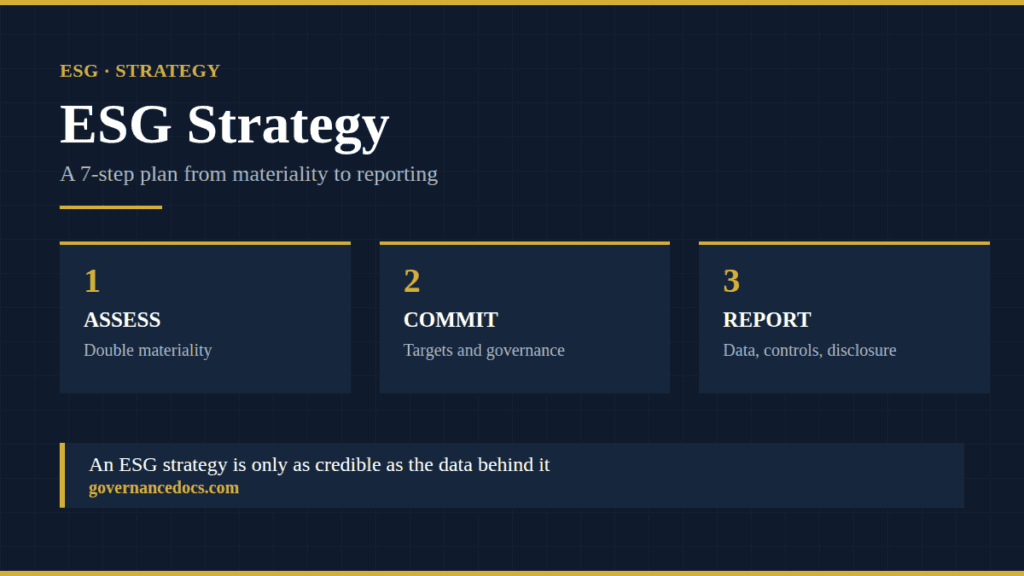
An ESG strategy is a company’s plan for managing its most important environmental, social and governance issues, with owners, targets and data behind each one. It is not a values statement or a sustainability report. It is the set of decisions those documents should come from.
This guide gives you a seven-step method, the governance and data you need, the main reporting frameworks, and a one-page template you can fill in with your leadership team.
Free gap assessment
Are you ready for the 2026 edition of ISO 14001?
Score every clause of the new edition, free, including the aspects, life cycle and compliance evaluation work that carries most of the findings.
The terms overlap, but they come from different directions. Sustainability is the broad goal of operating without harming the environment, society or future generations. ESG is the investor-facing lens: a structured way to measure and report how environmental, social and governance factors affect, and are affected by, a business.
In practice, ESG and sustainability teams work from the same issues. The difference is the audience and the evidence. A sustainability plan can be aspirational. An ESG strategy has to survive questions from investors, lenders, customers and, in some markets, auditors.
These steps follow the order an auditor would expect to see in your records. Skipping straight to targets, before the materiality work, is the most common reason ESG plans get rewritten a year later.
1. Confirm who you are reporting to and why
List who asks you for ESG information: regulators, investors, lenders, customers, employees. Each group drives different requirements, and the list decides how formal your strategy needs to be.
For EU companies, check the current CSRD scope first. Directive (EU) 2026/470, the Omnibus I amendment adopted on 24 February 2026, limits mandatory sustainability reporting to undertakings with net turnover above EUR 450 million and more than 1,000 employees on average. Member States must transpose these changes by 19 March 2027.
A materiality assessment decides which ESG topics matter enough to manage and report. There are two lenses:
Impact materiality: how your business affects people and the environment, across your operations and value chain.
Financial materiality: how sustainability matters could affect your cash flows, financial position, cost of capital or access to finance.
Using both is double materiality, the principle set out in ESRS 1 for companies reporting under the CSRD. A topic is material if it passes either test. Investor-focused IFRS S1 uses the financial lens. GRI focuses on impacts.
Keep the method simple and documented. A practical sequence:
Build a long list of topics from your sector, value chain and existing risk register.
Gather input from affected stakeholders and internal experts.
Score each impact on severity and likelihood, and each financial effect on size and likelihood.
Set a written threshold, apply it, and record why each topic is in or out.
Have management approve the result and repeat the assessment when the business changes.
3. Choose priorities and ambition
Your material topics will usually number more than you can lead on. Pick a few priority topics where you will set stretch goals. For the rest, aim to manage risk and comply.
Write one ambition statement per priority topic. “Cut absolute Scope 1 and 2 emissions against a 2025 baseline” is a strategy. “Be a responsible business” is not.
4. Set targets and KPIs
Every priority needs at least one KPI with a baseline, a target, a date and an owner. Choose metrics that you can measure consistently every year. Our guide to the 12 ESG KPIs boards ask for is a good starting set.
For climate targets, define the emissions boundary before you set the number. The Scope 1, 2 and 3 emissions guide explains what falls in each scope.
5. Put governance and board oversight in place
Investors and both IFRS S1 and ESRS expect disclosure of how the board oversees sustainability matters. Decide three things and write them down:
Board level: which board or committee oversees the ESG strategy, how often it reviews progress and what it approves.
Management level: the executive accountable for delivery, and the working group that runs it.
Policy level: the ESG policy that sets commitments and responsibilities.
ESG data often lives in spreadsheets owned by facilities, HR and procurement. Treat it like financial data: define each metric, name a data owner, document the calculation and add a review step before figures leave the building.
Report progress against each target at least once a year, including where you missed. Review the ESG strategy itself when the materiality assessment changes, after a major acquisition, or when a regulator or key customer changes its requirements.
Common mistakes to avoid
Targets before materiality. Goals set first often miss the topics that investors and customers actually ask about.
Too many priorities. Twenty “priority” topics means none of them gets budget or attention.
No baseline. A target without a measured starting point cannot be tracked or assured.
Owners without control. Assign each KPI to someone who can change the result, not only report it.
Strategy separate from the business plan. If ESG targets are not in budgets and performance reviews, they will slip.
ESG strategy framework: which reporting standard fits?
A reporting framework is not a strategy, but it shapes the evidence your ESG strategy framework must produce. Most companies pick one primary framework and map to the others.
Framework
Set by
Materiality lens
Use it when
ESRS
European Commission, on EFRAG’s technical advice
Double materiality
You are in CSRD scope, or EU customers ask for CSRD-style data
IFRS S1 and S2
ISSB (IFRS Foundation)
Financial: risks and opportunities affecting the entity’s prospects
Investors and lenders are your main audience, or your jurisdiction adopts ISSB standards
GRI Standards
Global Reporting Initiative
Impact on the economy, environment and people
You report to a broad stakeholder group or want an impact-based baseline
Two current facts worth knowing. IFRS S1 and IFRS S2 were issued in June 2023 and are effective for annual reporting periods beginning on or after 1 January 2024, where a jurisdiction requires them.
For ESRS, the Commission adopted revised standards on 3 July 2026, cutting mandatory datapoints by over 60%. Check the final version before you design your data collection.
One-page ESG strategy template
Copy this table into a document and fill in the third column with your leadership team. If a row is hard to complete, that is where your strategy has a gap.
Element
What to write
Your entry
Purpose
One sentence on why ESG matters to your business model
[ ]
Audiences
Regulators, investors, lenders and customers you report to
[ ]
Material topics
Topics that passed the impact or financial materiality threshold, with the date of assessment
[ ]
Priority topics
The few topics where you will lead, not just comply
[ ]
Ambition statements
One measurable statement per priority topic
[ ]
Targets and KPIs
Metric, baseline year and value, target value and date
[ ]
Owners
Executive owner and data owner for each KPI
[ ]
Board oversight
Committee, review frequency and decisions reserved to the board
[ ]
Policies
ESG policy and supporting policies, such as environmental, HR and anti-bribery
[ ]
Data and controls
Systems, calculation records, review and sign-off steps
[ ]
Reporting
Primary framework, report date and assurance level, if any
[ ]
Review trigger
When the strategy will be reviewed and what forces an early review
It depends on size and data maturity. The materiality assessment and data work take the most time. A first version for a mid-sized company is commonly a project of a few months, followed by yearly refinement.
Do small companies need an ESG strategy?
Often, yes, even when no law requires one. Large customers and lenders send ESG questionnaires down the supply chain. A short, documented strategy answers most of them consistently.
Is double materiality still required after the EU Omnibus?
For companies still in CSRD scope, yes. The CSRD continues to require information on both the company’s impacts and how sustainability matters affect it. Omnibus I narrowed who must report, not the principle.
Who should own the ESG strategy?
The board oversees it and an executive owns delivery. A sustainability lead usually coordinates the work, but each target needs an operational owner who controls the result.
Our ESG Toolkit provides 20+ editable templates for setting up and reporting your ESG framework — including an ESG Gap Analysis Tool, an Aspect Impact and Risk Opportunity Register and five sector ESG policy templates — for $69.
When a standard changes, know first
One email a month: edition changes, new deadlines, and what they mean for documentation you already have. No sales sequence.