CART

ESG vs CSR is a distinction that matters more every year, because one of the two now carries legal obligations and the other never did. Corporate social responsibility is what a company chooses to do for society and the environment, reported on its own terms; environmental, social and governance is how investors, regulators and increasingly customers measure the risks and impacts a company creates and carries, on terms set by standards — the European Sustainability Reporting Standards, the ISSB’s IFRS S1 and S2, GRI — and, in the EU, by law. The two overlap in subject matter and diverge in almost everything else: who they are for, what they measure, whether the numbers are assured, and what happens when they are wrong. This guide sets ESG vs CSR side by side on four differences, shows where a CSR program becomes an ESG obligation, and explains what a company moving from one to the other has to build.
Free gap assessment
Are you ready for the 2026 edition of ISO 14001?
Score every clause of the new edition, free, including the aspects, life cycle and compliance evaluation work that carries most of the findings.
Run the free ISO 14001 gap assessment → or View premium report sample
Corporate social responsibility is a management philosophy: the idea that a company has responsibilities to society beyond profit and the law, and acts on them through philanthropy, community programs, ethical sourcing commitments, employee volunteering and voluntary environmental initiatives. CSR reports are narrative, chosen by the company, and addressed to the public. There is no CSR standard that binds anyone.
ESG began as an investment lens — a way for asset managers to assess how environmental, social and governance factors affect a company’s value and risk — and became a reporting regime. Environmental covers emissions, energy, water, waste, biodiversity and climate risk; social covers workforce, human rights, supply chain labour, communities and consumers; governance covers board composition, executive pay, ethics, anti-corruption and risk oversight. ESG reporting is structured by standards with defined metrics, and in the EU it is mandatory for companies in scope of the Corporate Sustainability Reporting Directive, which requires reporting under the ESRS with limited assurance. Our guide to ESG reporting in 2026 covers what the EU’s simplification changed.
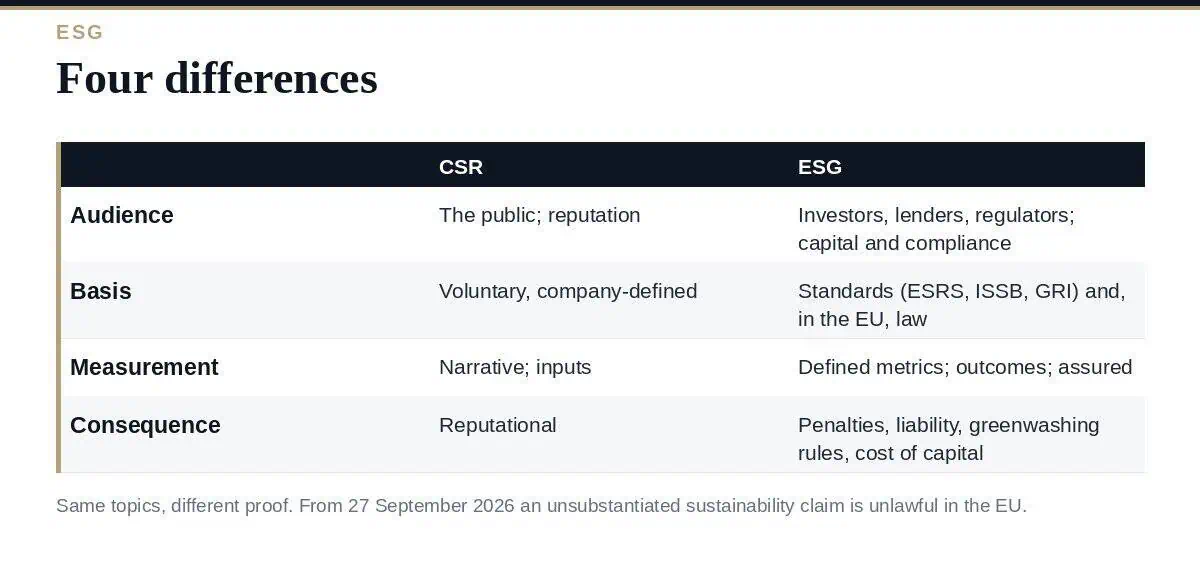
| Difference | CSR | ESG |
|---|---|---|
| 1. Audience | The public, employees, communities; reputation | Investors, lenders, regulators, large customers; capital and compliance |
| 2. Basis | Voluntary; company-defined commitments | Standards (ESRS, ISSB, GRI) and, in the EU, law (CSRD); materiality assessment decides what is reported |
| 3. Measurement | Narrative, selected metrics, inputs (money donated, hours volunteered) | Defined metrics and datapoints, outcomes (tonnes CO2e, injury rates, pay gaps), comparable across companies, assured |
| 4. Consequence | Reputational; no liability for the report itself | Regulatory penalties for non-compliance; liability for misstatement; greenwashing rules on claims; cost of capital |
A CSR report is written to be read by anyone and is judged on whether it makes the company look responsible. An ESG report is written for people who will put the numbers into a model: an asset manager screening a portfolio, a bank pricing a sustainability-linked loan, a procurement team scoring a supplier, a regulator checking a filing. The audience decides the form — narrative for CSR, structured data for ESG — and the tolerance for omission. A CSR report that leaves out a bad year is incomplete; an ESG report that does so is misleading.
CSR has no rulebook. ESG has several, and they are converging: the ISSB’s IFRS S1 (general sustainability disclosures) and S2 (climate) for the investor-focused baseline adopted by a growing list of jurisdictions; the ESRS for companies in CSRD scope, on the double-materiality basis that reports both the company’s impact on the world and the world’s impact on the company; GRI for impact reporting. Under all of them a materiality assessment, not the company’s preference, decides what is in the report. Our guide to the double materiality assessment covers the ESRS version.
CSR measures effort: donations made, trees planted, hours given. ESG measures outcomes and exposures in standardized units: Scope 1, 2 and 3 greenhouse gas emissions in tonnes of CO2 equivalent under the GHG Protocol; lost-time injury frequency; gender pay gap; board independence; the share of revenue from taxonomy-aligned activities. The units are what make companies comparable, and comparability is the point. Our guide to Scope 1, 2 and 3 emissions covers the metric every ESG framework starts with.
Nothing happens if a CSR report is thin. An ESG report in CSRD scope that is missing, late or unassured is a compliance failure with penalties set by national law; a sustainability claim that cannot be substantiated is, from 27 September 2026, an unfair commercial practice across the EU under Directive (EU) 2024/825; and an ESG rating or a lender’s covenant moves the cost of capital. The consequence is what turned ESG from a communications function into a governance one. Our guide to the EU greenwashing rules covers the claims side.
The ESG vs CSR subject matter overlaps almost entirely, which is why the terms are confused. The difference is what the company has to be able to prove. A CSR commitment to “reduce our environmental footprint” becomes, under ESG, a Scope 1–3 inventory, a transition plan with targets, and a disclosure of the climate risks to the business. A CSR supplier code of conduct becomes a human rights due diligence process with identified risks, actions and outcomes. A CSR ethics statement becomes anti-corruption policies, training coverage figures, whistleblowing case counts and governance structures. A company with a strong CSR program has most of the activity and almost none of the evidence.
What is the difference between ESG and CSR?
CSR is a voluntary, company-defined commitment to society, reported as narrative to the public. ESG is a measurement and reporting regime for investors, lenders and regulators, structured by standards such as the ESRS, ISSB and GRI, mandatory in the EU for companies in CSRD scope, and assured.
Is CSR the same as ESG reporting?
No. A CSR report describes what the company chose to do; an ESG report discloses defined metrics on the topics a materiality assessment found material, in comparable units, with consequences for omission or misstatement.
Does ESG replace CSR?
In reporting, largely yes. The activities a CSR program runs still matter, but they are now evidenced and disclosed under ESG standards rather than described in a company’s own terms.
Which companies must report ESG?
In the EU, companies in scope of the Corporate Sustainability Reporting Directive, under the ESRS with limited assurance; the 2026 simplification narrowed the scope and delayed some waves. Elsewhere, ISSB-based requirements are being adopted jurisdiction by jurisdiction, and listed companies face exchange rules.
What is the first thing to build?
A materiality assessment. It decides which topics, policies and KPIs the company is accountable for and turns a CSR agenda into an ESG scope.
Read ESG vs CSR as a shift from what a company chooses to say to what it must be able to prove: to investors and regulators rather than the public, against standards rather than preferences, in units rather than stories, with consequences rather than applause. Keep the CSR activity; build the materiality assessment, policies, metrics register, assurable data, governance and claims control that make it ESG.
ESG policy templates for five sectors, environmental, anti-bribery and corporate governance policies, the aspects, impacts and risk registers, and an ESG gap analysis tool are in the ESG Toolkit, or start with the free templates.

October 11, 2026
October 11, 2026

October 11, 2026

October 11, 2026

October 11, 2026

