

ISO 39001 Mandatory Documents: The Complete 2026 Clause-by-Clause List
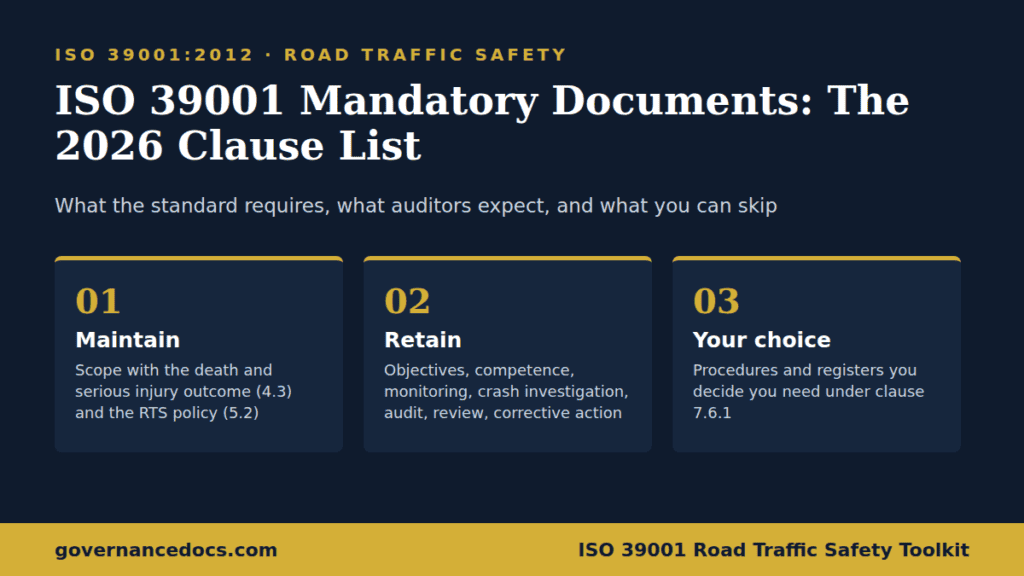
ISO 39001 mandatory documents are a shorter list than most fleet and safety managers expect. The road traffic safety (RTS) standard asks for a scope, a policy, objectives and targets, and then a run of records that prove the system works: competence, monitoring results, crash investigations, internal audits, management reviews and corrective actions. Everything else is your choice. This guide walks through the list clause by clause, separates what the standard requires from what auditors will simply expect to see, and shows where most first-time applicants over-document and under-record.
One status note before the list. ISO 39001:2012 is still the certifiable edition in 2026. Its official ISO record shows Edition 1, published October 2012, 37 pages, maintained by ISO/TC 241, with a free climate-action amendment (Amd 1:2024, priced at CHF 0). The same record lists the standard at stage 90.92, “to be revised”, with a successor, ISO/WD 39001.2, at working-draft stage. A working draft is years away from publication, so build to the 2012 text now.
Free gap assessment
Could you prove workers take part in safety decisions?
Score every clause of ISO 45001, free, including the consultation and participation evidence that fails more audits than any other requirement.
Run the free ISO 45001 gap assessment → or View premium report sample
What “documented information” means in ISO 39001
ISO 39001 was one of the first ISO management system standards written on the common high-level structure, so it uses “documented information” rather than the older “documents and records” split. Clause 7.6.1 says the RTS management system shall include two kinds: the documented information the standard itself requires, and whatever the organization decides is necessary for the system to be effective. That second category is where you have discretion, and where many organizations bury themselves in paperwork they do not need.
In practice the wording tells you what kind of item you are dealing with:
- Maintain (or “be available as”) documented information means a living document you keep current: the scope, the policy.
- Retain documented information means a record kept as evidence that something happened: audit results, review outputs, corrective actions.
- Clauses 7.6.2 and 7.6.3 then set the control rules for both kinds: identification, format, review and approval, availability, protection, distribution, storage, version control, retention and disposition.
Read every “shall” through that lens and the ISO 39001 mandatory documents fall into a short, predictable list.
ISO 39001 mandatory documents: the clause-by-clause list
The table below lists the ISO 39001 mandatory documents and records by clause, using the clause structure of ISO 39001:2012. The final column shows what a certification auditor will typically ask to see.
| Clause | Requirement | Type | What the auditor asks for |
|---|---|---|---|
| 4.3 | Scope of the RTS management system | Maintain | A scope statement naming the activities, sites and road use covered, and the intended outcome |
| 5.2 | RTS policy | Maintain | A signed, dated policy that is communicated internally and available to interested parties |
| 6.4 | RTS objectives and targets | Retain | Measurable objectives and targets with owners, dates and the action plans behind them |
| 7.3 | Competence | Retain | Evidence of competence: driver licence checks, training records, assessments |
| 7.6.1 | Documented information the organization deems necessary | Maintain or retain | Whatever your own processes rely on, such as procedures, registers and checklists |
| 8.1 | Operational planning and control | Maintain or retain, to the extent necessary | Enough documented information to show processes ran as planned: journey plans, vehicle inspections |
| 8.2 | Emergency preparedness and response | Retain | Emergency and post-crash plans and the results of tests or drills |
| 9.1 | Monitoring, measurement, analysis and evaluation | Retain | Results of monitoring RTS performance factors, and the periodic evaluation of legal compliance |
| 9.2 | Road traffic crash and incident investigation | Maintain | Investigation reports with root causes and actions, kept current |
| 9.3 | Internal audit | Retain | An audit programme and audit results |
| 9.4 | Management review | Retain | Minutes or a report showing inputs considered and decisions taken |
| 10.1 | Nonconformity and corrective action | Retain | The nature of each nonconformity, actions taken and the results of corrective action |
Notice what is missing. The standard does not demand a manual, a library of written procedures, or a separate document per clause. A small fleet operator can meet the ISO 39001 mandatory documents with a few controlled documents and a well-kept set of registers.
The four documents you maintain
1. Scope (clause 4.3)
Clause 4.3 says the scope “shall be available as documented information”. It also asks you to define the intended outcome of the system, and that outcome must include reducing, and ultimately eliminating, deaths and serious injuries in road traffic crashes the organization can influence. Put that sentence in the scope statement itself. Auditors look for it, and it is the clearest way to show you understood the Safe System basis of the standard.
A good scope names your role in the road traffic system (clause 4.1 asks you to identify it), the processes that affect road safety, the vehicle types and journeys covered, and any boundaries such as subcontracted transport. If grey-fleet driving (staff using their own cars for work) is in, say so. If commuting is out, say why.
2. RTS policy (clause 5.2)
ISO’s own start-up guide for the standard notes that the policy must be available as documented information and should be communicated inside the organization and made accessible to interested parties. Keep it to one page, have top management sign it, and make sure it commits to meeting legal and other requirements and to continual improvement.
3. Documented information you decide you need (clause 7.6.1)
This is not a single document. It is your judgement about which procedures, forms and registers your processes rely on. A company running 300 heavy goods vehicles will need written journey management and vehicle maintenance procedures. A professional services firm with grey-fleet drivers may need little more than a driver declaration and an annual licence check.
4. Operational control information (clause 8.1)
Clause 8.1 asks for operational planning and control of the processes linked to your RTS performance factors. Keep documented information to the extent needed to show those processes ran as planned. Typical examples are vehicle inspection checklists, journey plans for long or high-risk trips, and fatigue or hours-of-driving controls.
The records you retain
The retained records are where certification audits are actually won or lost. Auditors sample them, and gaps in records produce more findings than missing policies do.
- Objectives and targets (6.4). Retain the objectives, targets and plans. Set targets on intermediate factors you can influence, such as speed compliance or seat-belt use, not only on crash counts. Our guide to road traffic safety objectives shows how to word them.
- Competence (7.3). Licence validity checks, driver training, assessments and fitness-to-drive evidence.
- Emergency response (8.2). Your post-crash response plan and evidence that it has been tested.
- Monitoring and evaluation (9.1). Results for the performance factors you chose, plus the periodic evaluation of compliance with legal and other requirements.
- Crash and incident investigation (9.2). Investigation results, documented and kept current, including near misses where you choose to investigate them.
- Internal audit (9.3) and management review (9.4). The programme, the results and the decisions.
- Nonconformity and corrective action (10.1). What went wrong, what you did and whether it worked.
Where RTS performance factors fit
Clause 6.3 is the part of ISO 39001 with no equivalent in ISO 45001 or ISO 9001. It asks you to review your current road safety performance and choose the performance factors you will manage from three groups: exposure factors (distance and volume of travel, vehicle and road types), final safety outcome factors (deaths and serious injuries), and intermediate safety outcome factors such as safe speeds, driver fitness and fatigue, journey planning, vehicle safety, restraint use and post-crash response.
The clause does not name a single “performance factor register” as a required document. But the analysis behind your choice feeds clause 6.4 objectives and clause 9.1 monitoring, both of which need records, so in practice you need it written down. Auditors will ask how you chose your factors, and “we discussed it” is not evidence. Our guide to RTS performance factors covers the selection in detail.
ISO 39001 mandatory documents vs ISO 45001
Many organizations run ISO 39001 alongside an occupational health and safety system. The two standards share the high-level structure, so the ISO 39001 mandatory documents map well onto existing ISO 45001 records.
| Item | ISO 39001:2012 | ISO 45001:2018 | Can you combine them? |
|---|---|---|---|
| Scope | Clause 4.3, includes the deaths and serious injuries outcome | Clause 4.3 | Yes, one integrated scope with a road safety section |
| Policy | Clause 5.2 | Clause 5.2 | Yes, if the road safety commitments are explicit |
| Risk analysis | RTS performance factors, clause 6.3 | Hazard identification, clause 6.1.2 | Partly. Keep the 6.3 factor analysis visible |
| Incident investigation | Clause 9.2, road traffic crashes | Clause 10.2, incidents | Yes, one process with road crash fields |
| Internal audit and review | Clauses 9.3 and 9.4 | Clauses 9.2 and 9.3 | Yes, combined programme and agenda |
If you already hold ISO 45001, start from our list of ISO 45001 mandatory documents and add the road-specific items rather than building a second system.
How to build the ISO 39001 mandatory documents in four weeks
The timings below are a typical range for an organization with an existing safety function. Larger fleets and multi-site scopes take longer.
- Week 1: scope and policy. Map your role in the road traffic system, list the journeys and vehicles in scope, and write the scope and policy.
- Week 2: performance factors and objectives. Gather exposure data (distance, journeys, vehicle types), pick intermediate factors you can influence, and set objectives and targets.
- Week 3: operational records. Set up the registers for driver competence, vehicle checks, journey plans and emergency response. Decide which procedures you actually need under 7.6.1.
- Week 4: the check-and-act records. Create the investigation form, audit programme, management review agenda and corrective action log, then run one cycle of each before the stage 1 audit.
Common mistakes with ISO 39001 mandatory documents
- A scope without the outcome statement. Clause 4.3 asks for the intended outcome. Leaving out the deaths-and-serious-injuries reduction is an easy finding.
- Targets only on crash numbers. Crashes are rare and lagging. Targets on speed, fatigue or vehicle standards give you something to manage month to month.
- Ignoring grey fleet and contractors. If staff drive their own cars for work, or you rely on subcontracted haulage, the records need to show how those journeys are controlled.
- Investigations that stop at the driver. The Safe System approach assumes people make mistakes. An investigation that ends at “driver error” without looking at scheduling, vehicle or route will draw questions.
- Writing a manual and no records. A thick manual does not satisfy any retain requirement. Auditors sample records.
- Skipping the free amendment. Amendment 1:2024 adds climate change to the context and interested-party clauses. It costs nothing, and your context review should show you considered it.
A faster route to the full set
If you would rather adapt than draft from a blank page, the ISO 39001 Road Traffic Safety Toolkit ($99) gives you 10 editable templates: an RTS manual, the RTS policy, six operating procedures (driver, vehicle and journey management, incident and near-miss reporting, emergency response and post-crash, and supplier and contractor RTS requirements), an implementation roadmap, and a master workbook that holds the registers in one place. Tailor the scope and performance factor analysis to your fleet and the core records are ready to use.
For the wider picture of the standard, including the Safe System approach and how ISO 39001 relates to other management systems, start with our ISO 39001 guide. If you are budgeting for the audit itself, see ISO 39001 certification cost.
Frequently asked questions
How many mandatory documents does ISO 39001 require?
Counted clause by clause, ISO 39001:2012 asks for roughly a dozen items of documented information. Only a few are documents you maintain (the scope and policy, plus what your processes need). The rest are records you retain, such as objectives, competence evidence, monitoring results, investigation results, audits, management reviews and corrective actions.
Does ISO 39001 require a road safety manual?
No. The standard does not require a manual. Many organizations still write one because it is a convenient way to explain how the system meets each clause, but auditors will not raise a finding for its absence.
Do I need written procedures for ISO 39001?
Only where your organization decides they are needed for the system to work, under clause 7.6.1. Larger fleets usually document journey management, vehicle maintenance and crash investigation. Smaller organizations can often rely on clear registers and checklists.
Is ISO 39001 being revised?
Yes, but slowly. ISO lists ISO 39001:2012 at stage 90.92, “to be revised”, with ISO/WD 39001.2 at working draft. The 2012 edition plus the free Amendment 1:2024 remains the version certification bodies audit against in 2026.
Can ISO 39001 records be combined with ISO 45001 records?
Yes. Both standards share the high-level structure, so one policy, one audit programme, one management review and one incident process can serve both, provided the road-specific requirements, especially the clause 6.3 performance factors and the clause 9.2 crash investigations, stay visible.
Our ISO 39001 Road Traffic Safety Toolkit provides 10 editable templates covering every mandatory document listed above, including the RTS manual, the RTS policy, six operating procedures and a master register workbook, for $99.
When a standard changes, know first
One email a month: edition changes, new deadlines, and what they mean for documentation you already have. No sales sequence.

Governance Docs
Governance Docs LLC
Recent Posts

November 27, 2026

November 27, 2026

November 26, 2026

November 26, 2026

November 26, 2026