

ISO 9001 Toolkit: What a Complete One Contains (2026)
An ISO 9001 toolkit is only worth buying if it is written to the edition you will be audited against and covers every piece of documented information the standard asks for, with working records rather than empty headings. Since September 2026 that edition is ISO 9001:2026. A pack that still says “ISO 9001:2015” on every page, or one that changed the year on the cover and nothing else, will leave gaps exactly where transition auditors look first: the split between risks and opportunities, quality culture and ethical behavior, and the expanded change process.
This guide sets out what a complete toolkit for ISO 9001:2026 has to contain, clause by clause, the records thin packs leave out, the gaps that turn into audit findings, and a short test you can run on any pack before you pay for it.
Free gap assessment
Are you ready for the 2026 edition of ISO 9001?
Score yourself against the new edition, free, including the risk and opportunity split and the clause 10 renumbering that breaks converted checklists.
Run the free ISO 9001 gap assessment → or View premium report sample
What an ISO 9001 toolkit has to cover in 2026
ISO 9001:2026 is the sixth edition of the quality management system requirements standard. ISO published it in September 2026; it runs to 36 pages, is developed by ISO/TC 176/SC 2, and it withdrew both ISO 9001:2015 and the 2024 climate amendment. Certification bodies are now running transition audits. LRQA, for example, reports a three-year transition period running to 30 September 2029, after which ISO 9001:2015 certificates expire or are withdrawn.
The revision is evolutionary. The clause 4 to 10 structure, the process approach and the PDCA cycle all stay. What changed is specific enough to check in a template set:
- Risks and opportunities are separated. Clause 6.1 now splits into 6.1.1 (determining them), 6.1.2 (actions on risks) and 6.1.3 (actions on opportunities), and their effectiveness is evaluated separately in 9.1.3 and reviewed separately in management review.
- Quality culture and ethical behavior appear in leadership commitments (5.1.1), the environment for the operation of processes (7.1.4) and awareness (7.3).
- Planning of changes in 6.3 lists seven considerations instead of four, adding communication, monitoring the effectiveness of the change and reviewing its results.
- Climate change sits in the main text of 4.1, with a note at 4.2, instead of in a separate amendment.
- Clause 10 is renumbered: 10.1 is now continual improvement and 10.2 nonconformity and corrective action. There is no 10.3.
A complete ISO 9001 toolkit has to give you three things on top of that: the documented information you must maintain, the records you must retain, and the working tools (registers, forms, checklists) that produce those records as a side effect of running the system.
The documents inside a complete ISO 9001 toolkit
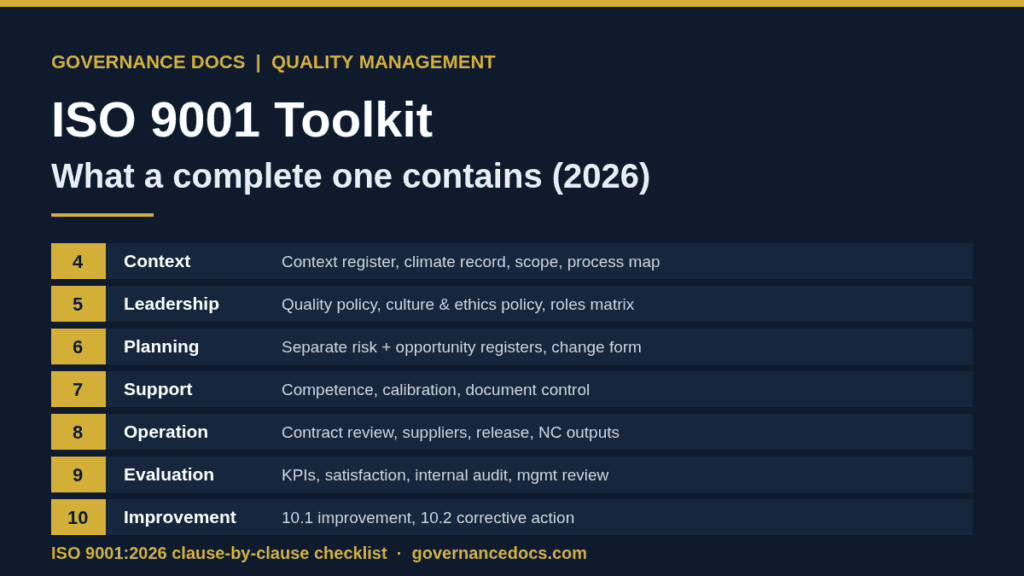
Documents describe how the quality management system works; records prove it ran. Our list of ISO 9001 mandatory documents covers each required item. The table below maps the clauses to what a complete pack should hand you for each.
| Clause | What the standard asks for | What a complete toolkit should include |
|---|---|---|
| 4 Context | Internal and external issues (now including climate change), interested parties, scope, processes | Context procedure, context and interested parties register, climate change determination record, scope statement, process map, process definition template |
| 5 Leadership | Leadership commitment, customer focus, quality policy, roles | Quality policy, leadership commitment procedure, quality culture and ethical behavior policy, roles and authorities matrix |
| 6 Planning | Risks, opportunities, quality objectives, planning of changes | Risk and opportunity procedure, a separate risk register and opportunity register, objectives register with action plans, change procedure, change request form, change register |
| 7 Support | Resources, infrastructure, work environment, monitoring and measuring resources, knowledge, competence, awareness, communication, documented information | Resource and infrastructure procedures, calibration register, knowledge register, competence matrix and training records, communication plan, document control procedure, master document and records register |
| 8 Operation | Operational planning, customer requirements, design, external providers, production and release, nonconforming outputs | Contract review form, design and development procedure and records, approved provider list and supplier scorecard, customer property log, release record, nonconforming output register |
| 9 Performance evaluation | Monitoring and measurement, customer satisfaction, internal audit, management review | KPI dashboard, customer satisfaction tracker, audit program, internal audit checklist, audit report, management review agenda and minutes |
| 10 Improvement | Continual improvement (10.1), nonconformity and corrective action (10.2) | Improvement register, corrective action procedure, corrective action register with root-cause and effectiveness fields |
The important column is the last one. A pack that gives you procedures for clauses 6, 9 and 10 but no registers leaves you designing your own risk register and corrective action log in the weeks before stage 2, which is the work an ISO 9001 toolkit is meant to save.
Why the 2026 edition breaks older template packs
Most ISO 9001 templates on the market were written for 2015 and many have not been touched since. Three of the 2026 changes cannot be fixed with find-and-replace:
One combined risk register no longer fits. In 2015 a single “risks and opportunities” register with a column for each was the norm. The 2026 text asks for actions on risks and actions on opportunities as separate requirements, with separate effectiveness evaluation and separate inputs to management review. Two registers, each with its own criteria and its own effectiveness check, give the auditor a clean trail. One register with an “opportunity” tick box usually does not.
Quality culture needs a home. A 2015 pack has no policy or awareness content on quality culture and ethical behavior, because the old text did not ask for it. Expect a transition auditor to ask how top management promotes it and how people are made aware of it.
The change procedure is short by three steps. A 2015 change procedure covers purpose and consequences, integrity of the QMS, resources and responsibilities. The 2026 list adds communication, monitoring effectiveness and reviewing results, so the change request form needs fields for each.
Our side-by-side of the ISO 9001:2026 changes walks through every revised requirement if you are moving an existing system across.
Six gaps that make an ISO 9001 toolkit fail an audit
- Wrong edition. Clause references to 10.3, a single 6.1 requirement or “ISO 9001:2015” in the document headers mean the pack predates the standard you are audited against.
- Procedures without records. No audit program, no corrective action register, no management review minutes template. Stage 2 is decided on records.
- No process map. Clause 4.4 asks you to determine your processes and their interaction. A pack that skips the process map and process definitions leaves the core of the system undescribed.
- An empty internal audit checklist. A checklist with clause numbers and blank rows is a table, not an audit tool. Look for a question and the expected evidence for each requirement.
- Generic operations content. Clause 8 is where products and services are actually made. Packs borrowed from another standard often have no contract review, release or customer property records.
- Relabeled content from another standard. A “quality” risk procedure that talks about hazards and “who may be harmed” was written for occupational health and safety. Auditors notice.
Toolkit, consultant or software platform
An ISO 9001 toolkit is one of three ways to get the documentation written. Each fits a different organization.
| Route | Typical cost | Best fit | Main risk |
|---|---|---|---|
| Template toolkit | A one-time purchase, typically under a few hundred dollars | Organizations with a quality lead who can spend time adapting documents | Templates adopted without tailoring |
| Consultant | Typically several thousand to tens of thousands of dollars, depending on size and scope | Organizations with no internal quality capacity or a tight deadline | Documents nobody inside owns or understands |
| QMS software | Recurring subscription, usually priced per user or per module | Larger or multi-site organizations that want workflows and dashboards | Paying for a platform before the processes are clear |
These routes combine well. Many organizations start from ISO 9001 templates, use a consultant for a pre-assessment, and move records into software once the system is running. For the full budget, including certification body fees, see our ISO 9001 certification cost breakdown.
How to check an ISO 9001 toolkit before you buy
Ask the seller for the full file list, then run five checks:
- Edition: does the product page say ISO 9001:2026, and does the sample show 6.1.2, 6.1.3 and the 10.1/10.2 order?
- Clause coverage: can you map each row of the table above to a named file?
- Registers: are the risk and opportunity registers separate, and do the Excel files have working drop-downs and example rows?
- Transition content: if you hold a 2015 certificate, is there a clause map from 2015 to 2026 and a gap assessment limited to what changed?
- Format and license: editable Word and Excel, not PDF, and a license that covers your organization (or your clients, if you are a consultant).
Our ISO 9001 Toolkit was rebuilt on the published ISO 9001:2026 text and holds 84 editable templates, 60 Word documents and 24 Excel workbooks, in nine sections that follow the clauses. Every one of the 65 numbered requirements in clauses 4 to 10 is assigned to a named document. It includes separate risk and opportunity registers, a quality culture and ethical behavior policy, a climate change determination record, a seven-consideration change procedure, a 2015-to-2026 transition guide with a seeded gap assessment, and an internal audit checklist pre-loaded with a question and expected evidence for each requirement. It is a one-time $89 download. Run it through the same five checks as any other pack.
Frequently asked questions
Is an ISO 9001 toolkit enough to get certified?
No toolkit gets you certified on its own. A certification body has to confirm that your quality management system is implemented and effective, which means records of real activity: objectives tracked, customer feedback analyzed, internal audits completed, a management review held and corrective actions closed. A toolkit removes the drafting so your time goes into running the system. The full sequence is in our guide on how to get ISO 9001 certified.
How many documents should an ISO 9001 toolkit contain?
There is no correct number. The standard names a limited set of documented information, and the rest depends on your processes. Judge a pack on clause coverage, the quality of the registers and whether it is written to the 2026 edition, not on the file count.
Can I keep using my ISO 9001:2015 templates?
Most of them, after review. Document control, internal audit, management review and many operations procedures carry over with clause references updated. The risk and opportunity content, the change procedure, quality culture and the clause 10 references need new or reworked documents before your transition audit.
Will an auditor reject template documents?
Not because they started as templates. Auditors reject documents that do not match how the organization works: unfilled placeholders, a process map that shows processes nobody runs, or objectives nobody tracks. Adapt every document and the origin does not matter.
Are free ISO 9001 templates good enough?
Free templates are a reasonable way to see the shape of the documents. Check the edition and clause references before relying on them, and expect to build the registers yourself. Our free ISO 9001 templates page is a starting point.
The short version
A complete ISO 9001 toolkit in 2026 is written to ISO 9001:2026, maps every clause 4 to 10 requirement to a document or record, separates risks from opportunities, gives quality culture and the seven-point change process a home, and ships working registers instead of blank tables. Check the file list against the clause table above, then spend your effort on the records auditors read most closely: objectives, internal audit, management review and corrective action. For the standard itself, see ISO 9001:2026 on iso.org, and for the wider picture read our complete ISO 9001 guide.

Governance Docs
Governance Docs LLC
Recent Posts
November 23, 2026

November 22, 2026
November 21, 2026
November 20, 2026
November 19, 2026