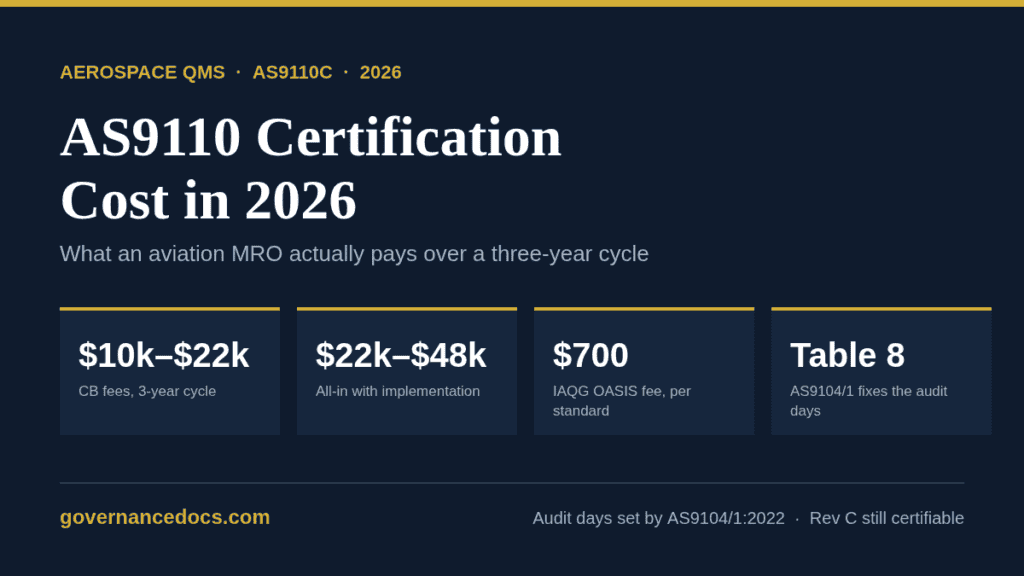
AS9110 certification cost for a single-site repair station lands between $10,000 and $22,000 in certification body fees across a full three-year cycle, and between $22,000 and $48,000 once you add the work of building a maintenance quality management system that will survive a Stage 2 audit. Those are wide bands because two things move them a long way: your effective headcount, which is fixed by a published table rather than negotiated, and whether your scope includes design of repairs and modifications.
This guide breaks the AS9110 certification cost down line by line for an aviation MRO, and flags the three places where the bill differs from an AS9100 one.
Free gap assessment
Are you ready for the 2026 edition of ISO 9001?
Score yourself against the new edition, free, including the risk and opportunity split and the clause 10 renumbering that breaks converted checklists.
The figures below are typical US ranges for 2026, not quotes. Every certification body prices its own day rate and travel, and the IAQG scheme fixes the number of days they can bill.
Cost element
Typical range (USD)
When you pay
Gap analysis against AS9110C
$1,500–$4,000
Once, before you start
QMS build (consultant-led)
$8,000–$20,000
Once, over 4–9 months
QMS build (in-house)
200–400+ internal hours
Once, over 4–9 months
Stage 1 + Stage 2 initial audit
$4,500–$9,500
Year 1
IAQG OASIS certification fee
$700 per certified standard
At initial certification and each recertification
OASIS digital/insight fee
around $250
Recurring; confirm with your CB
Annual surveillance audit
$2,000–$4,500
Years 2 and 3
Recertification audit
$3,000–$6,000
End of cycle
Auditor travel and expenses
$500–$2,500 per audit
Each audit
Internal auditor training
$500–$2,500 per person
Once, then refreshers
Why AS9110 certification cost is set by a table, not a quote
Aerospace certification does not work like ISO 9001, where a registrar can sharpen a pencil to win the job. Audit duration for the whole 9100 series is fixed by AS9104/1:2022, the IAQG scheme document published on 7 January 2022 and phased in over an 18-month transition. Table 8 of that document sets initial, surveillance and recertification days against your effective number of personnel, and it carries separate columns for 9100/9110, 9100/9110 less Design, and 9120.
Three mechanics in that table drive most of the variance in an AS9110 certification cost:
Effective personnel, not payroll. The count includes part-time, temporary and contract staff working inside the certification scope. Contract A&P mechanics count. A 40-person shop that runs 15 contractors through the hangar is priced as a 55-person shop.
The “less Design” column. Most repair stations do not design repairs or modifications — they work to approved data issued by someone else. Where clause 8.3 is genuinely out of scope, you are priced from the shorter column, which is the single largest legitimate saving available to an MRO. If you hold a DER or design approval and develop your own repair schemes, you are not.
Risk and uplift. A minimum 20% is added to the table figure for planning and reporting. Your certification body also classifies the site on performance data, and a site that fails to submit that data by the CB’s deadline is treated as high risk by default, which adds a further 10%.
As a sense of scale, a site in the 46–65 effective personnel band sits at around six audit days for initial certification on the 9100/9110 column, with surveillance and recertification at roughly 40% and 75% of that. Multiply by a US auditor day rate of $1,200–$2,000 and you have the backbone of the quote before travel.
AS9110 certification cost line by line
Certification body fees are the visible half of an AS9110 certification cost. The invisible half is the maintenance QMS itself, and for an MRO that already holds an FAA Part 145 or EASA Part-145 approval, the invisible half is usually cheaper than a first-time AS9100 manufacturer’s would be.
Gap analysis — $1,500–$4,000. A one- or two-day review mapping AS9110C against what your Part 145 manual system already does. Worth buying if you have never been audited against a 9100-series standard; skip it if you have a competent quality manager and a template set.
Documented system — $8,000–$20,000 consultant-led, or 200–400 internal hours. AS9110C contains ISO 9001:2015 in full and adds maintenance-specific requirements, so the paperwork is a QMS, not a maintenance manual. Most of the cost sits in procedures you may not have as formal documents: technical data control, human factors in corrective action, tooling and loaned-equipment control, counterfeit and suspected unapproved parts prevention, and competence records for staff who certify release to service.
Stage 1 and Stage 2 — $4,500–$9,500. Stage 1 is the readiness review, usually scheduled four to eight weeks after you sign. Stage 2 is the full audit. Both are billed from the same Table 8 allocation.
OASIS fees — $700, plus about $250. The IAQG charges $700 per certified standard at initial certification and at each recertification, and the same amount on a certificate transfer between certification bodies; adding a site mid-cycle is around $300. A separate OASIS digital/insight fee of roughly $250 has applied to aerospace clients since May 2025. There is no annual certification fee. Confirm the current schedule with your CB before you budget, because the fee table has been revised twice since 2024.
Surveillance and recertification — $2,000–$4,500 a year, then $3,000–$6,000. Surveillance audits fall in years two and three. Recertification closes the cycle. A lapsed certificate is the expensive failure mode: you pay for a full initial audit and a fresh OASIS fee, which is why letting a surveillance slip is worse than it looks.
What an MRO pays that an AS9100 shop does not
Three AS9110C requirements add to AS9110 certification cost in ways that an AS9100 manufacturer rarely carries, and they are the lines most first-time budgets miss.
Human factors training. AS9110C aligned the standard with safety management thinking, and it expects human factors to appear in planning, training, error analysis and root cause. Auditors look for evidence that a maintenance error investigation considered human factors rather than stopping at “mechanic did not follow procedure.” Budget $150–$600 per person for a credible course, and expect to repeat it.
Technical data control. The standard wants approved data, current revisions, and availability at the point of work. If your mechanics still work from printed instructions kept in a binder, closing this one properly usually means buying or configuring a document control system rather than writing a procedure.
Tooling, calibration and release authorisations. Loaned and customer-supplied tooling, FOD prevention, and the competence and authorisation records for staff who inspect and release work all get audited. Most Part 145 shops have the substance and not the records, so this is administrative cost rather than capital cost.
Working against those additions is the overlap with your regulator. AS9110 does not replace an FAA Part 145 or EASA Part-145 approval and it is not accepted in place of one — but a shop with a mature Part 145 manual system has already built most of clauses 7 and 8, which is why MROs frequently certify faster than greenfield manufacturers. If you are still deciding which of the three aerospace standards applies to you, our AS9110 vs AS9120 guide draws the scope line, and the aerospace quality management overview covers how the family fits together.
AS9110 certification cost by MRO size
AS9110 certification cost figures below are all-in, including implementation. Treat them as planning numbers for a US single-site repair station in 2026.
MRO profile
CB fees + OASIS, 3-year cycle
All-in with implementation
Up to 25 staff, no design, one location
$8,000–$15,000
$18,000–$34,000
26–65 staff, no design
$11,000–$23,000
$24,000–$48,000
66–125 staff, repair design in scope
$19,000–$36,000
$38,000–$78,000
Two or three line-maintenance stations
$27,000–$55,000
$52,000–$105,000
Multi-site arithmetic catches people out. Duration is calculated for each site, summed, and then uplifted — line stations are not free riders on the main base certificate unless they qualify under the scheme’s sampling rules, which your CB will assess, not you.
How to reduce AS9110 certification cost without cutting corners
Scope design out honestly. If you do not develop repair data, say so in the application and make sure clause 8.3 exclusion is defensible. This is the “less Design” column, and it is the biggest single lever.
Count your effective personnel before the CB does. If contractors sit just over a band boundary, understand that before you sign, not after the audit plan arrives.
Submit performance data on time. Missing your CB’s deadline defaults the site to high risk and adds 10% to every audit in the cycle.
Use remote auditing for the desk work. Up to half an audit can be conducted remotely. That saves travel and expenses, not audit days — the days are fixed.
Start from templates, not a blank page. The documented-information requirements are the same for everyone. Writing 38 procedures from scratch is the most expensive way to satisfy them.
Do not buy a mock audit from your certification body. Impartiality rules stop them consulting on the system they will certify, and what you get is a thin pre-assessment at audit rates.
The IA9110 question: what the 2026 revision does to your budget
AS9110C, dated 4 November 2016, is still the certifiable revision as of late October 2026. It is the fourth edition — AS9110 (2003), AS9110A (2009), AS9110B (2012), AS9110C (2016) — and SAE lists the earlier three as historical.
The IAQG has said it will rebase and rename the series once ISO 9001:2026 is out, with AS9100 becoming IA9100 and AS9110 becoming IA9110 as a single international document rather than parallel AS/EN/JIS Q versions. ISO 9001:2026 was published in September 2026, so the countdown has started, but as of this writing the IAQG has not published IA9110, a release date, or a transition deadline. Reported target windows range from Q4 2026 to Q1 2027 and they are not official.
What that means for an AS9110 certification cost decision today: certify to Rev C. Existing certificates stay valid through whatever transition period is set, and the cheapest place to absorb a transition is at a recertification audit you were paying for anyway, rather than as a standalone upgrade audit. If you want the detail on how the renaming works, see our IA9100 guide; the manufacturing-side numbers are in the AS9100 certification cost breakdown.
Frequently asked questions
Is AS9110 certification cost higher than AS9100? Usually slightly lower for the same headcount, because most MROs are priced on the “less Design” column of AS9104/1 Table 8. The implementation side can run the other way if your technical data control is informal.
Can I hold AS9100 and AS9110 on one certificate? You can be certified to more than one 9100-series standard, but the IAQG bills the OASIS fee per certified standard, so two standards means two fees.
Does my Part 145 approval reduce the audit days? No. Audit duration comes from the table, and regulatory approval is not one of its inputs. It reduces your implementation effort, not your audit bill.
How long does AS9110 certification take? Four to nine months of implementation for a small repair station, plus four to eight weeks between contract and Stage 1, and two to six weeks after Stage 2 closes before the certificate is issued.
Who is allowed to issue the certificate? Only a certification body operating under the IAQG ICOP scheme with auditors authenticated for AS9110 specifically. A certificate that does not appear in the OASIS database is not recognised by primes, whatever the paper says.
Where this leaves you
Budget $10,000–$22,000 in certification body fees over three years for a single-site repair station, and $22,000–$48,000 all in. Confirm your effective personnel count and whether design is in scope before you ask for quotes, because those two answers set the audit days and the audit days set most of the bill. Then get the documented system built early enough that Stage 1 is a formality.
Our AS 9100/9110/9120 Aerospace QMS Toolkit covers all three standards with 38 editable templates for $99 — the procedures, forms and records an auditor asks for, so the implementation half of your AS9110 certification cost is template editing rather than drafting.