
CART
No products in the cart.
ISO Compliance Insights & Best Practices
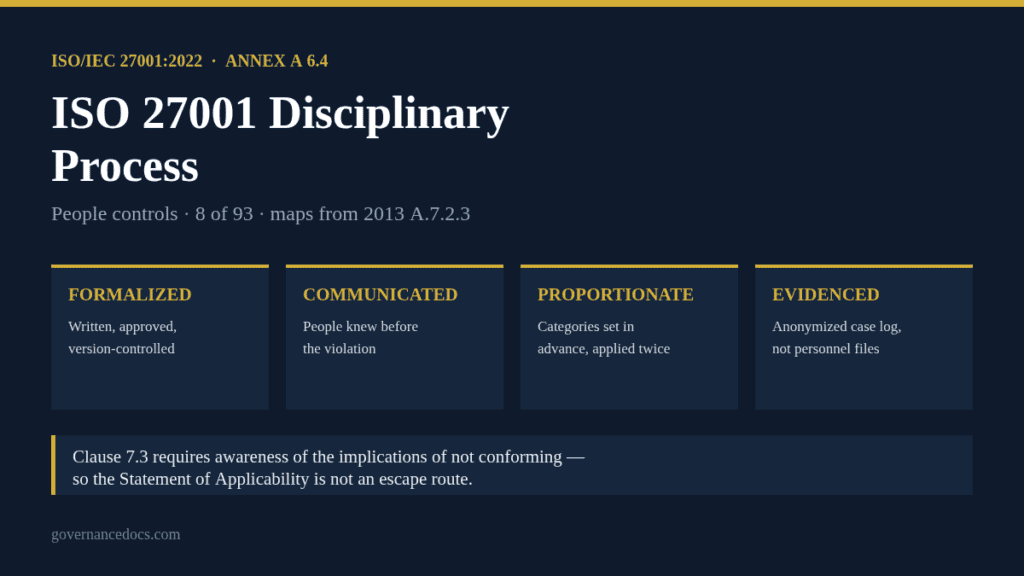
The ISO 27001 disciplinary process is the control most organizations think they already have, because HR owns a disciplinary policy and nobody has read it since induction. Annex A 6.4 asks for something narrower and more specific than that policy usually delivers, and clause 7.3 quietly makes it impossible to opt out of. This guide covers what the control actually says, why the Statement of Applicability is not an escape route, what the process has to contain, where it stops for contractors, and the records a certification auditor can realistically look at without reading anyone’s personnel file.
Free gap assessment
Where do you actually stand against ISO 27001?
Score every management system clause and all 93 Annex A controls, free, and get a prioritised gap list back.
Run the free ISO 27001 gap assessment → or View premium report sample
Control 6.4 in ISO/IEC 27001:2022 (Edition 3, published October 2022) asks for a disciplinary process that is formalized and communicated, so that action can be taken against personnel and other relevant interested parties who have committed an information security policy violation.
Two verbs carry the whole ISO 27001 disciplinary process requirement. Formalized means written down and approved — most organizations pass that on the strength of an HR document. Communicated means the people it applies to knew about it before the violation, not after. That second verb is where the ISO 27001 disciplinary process usually fails an audit, and it is the one that costs nothing to fix.
| Item | Detail |
|---|---|
| Control reference | Annex A 6.4, Disciplinary process |
| Theme | People controls — 8 of the 93 controls sit here |
| Control type | Preventive |
| 2013 predecessor | A.7.2.3, same title, then filed under Human Resource Security |
| Required verbs | Formalized, communicated |
| Mandatory document under clause 7.5? | No |
| Appears in the Statement of Applicability? | Yes — clause 6.1.3 requires every one of the 93 |
The 2022 renumbering moved this control rather than rewrote it. If your Information Security Management System transitioned from the 2013 edition, the document behind A.7.2.3 is still the right document — it just needs the new reference and, in most cases, a communication record it never had. The wider restructure put the 93 controls into four themes: 37 organizational, 8 people, 14 physical and 34 technological. Our guide to the ISO 27001:2022 Annex A controls covers how the four themes fit together.
Annex A is a list of candidate controls, and clause 6.1.3 lets you exclude any of them in the Statement of Applicability with a documented justification. That is the usual escape route for controls an organization does not need, and it is the reason teams assume the ISO 27001 disciplinary process is optional for a small, trusting company.
Free ISO 27001 risk assessment
Which of your risks sit above your appetite line?
Set your own risk criteria, pick from 61 information security risk scenarios, rate likelihood and impact, and decide how to treat each one. You get a heat map, a process score and the findings an auditor would raise, free.
Run the free risk assessment → or View premium report sample
It is not, and the reason sits in the main clauses rather than in Annex A. Clause 7.3 requires that persons doing work under the organization’s control are aware of the information security policy, their contribution to the effectiveness of the ISMS, and the implications of not conforming with the ISMS requirements. That third item is a main-clause requirement. It cannot be excluded, justified away or scoped out, because clauses 4 to 10 are not optional in the way Annex A is.
So if you exclude A.6.4, clause 7.3 still obliges you to tell people what happens when they do not conform — and then an auditor will ask what, in fact, does happen. An exclusion that leaves that question unanswered reads as a gap rather than a decision. In practice the honest options are to implement the ISO 27001 disciplinary process properly, or to implement it and be able to point at where it lives.
Note what is not required: a standalone document called “Disciplinary Procedure”. A.6.4 is not on the clause 7.5 documented-information list — our ISO 27001 mandatory documents checklist sets out what actually is. The mandatory artifact here is the Statement of Applicability line that says the control is applied and names where. An incident management procedure with a disciplinary referral step can satisfy the control perfectly well in a 25-person company.
A.6.4 is a response control. It assumes somebody has already established that a violation happened. The control that produces that finding is A.5.36, compliance with policies, rules and standards for information security — the one that asks you to review, periodically, whether people are actually following the policies you wrote.
Read together, the pair exposes the most common structural failure: organizations write both controls into the Statement of Applicability, implement neither as a loop, and then have a disciplinary process that has never been triggered because nothing ever detects a violation. Monitoring, logging and access reviews are what feed it. If your last access review found three accounts belonging to people who left, that is either a joiners-and-leavers process failure or an individual one, and the ISO 27001 disciplinary process is how you tell the difference on the record.
Seven elements make the difference between a document and an ISO 27001 disciplinary process an auditor can follow end to end.
The table below is an example structure, not a requirement of the standard — ISO 27001 sets no categories, no tariff and no review frequency for this control. Build your own and keep it consistent with whatever your employment contracts and local law already allow.
| Category | Example | Typical proportionate response |
|---|---|---|
| Low — error, no harm | Sent an internal file to a personal email to work at home | Documented conversation, refresher training, note on file |
| Medium — careless, recoverable | Shared a login with a colleague; left a classified document unattended | First written warning, mandatory retraining, control tightened |
| High — deliberate circumvention | Disabled endpoint protection; used an unapproved cloud service for client data | Final written warning, access restricted, incident raised |
| Severe — intentional harm or theft | Exfiltrated a customer database before resigning | Dismissal process, legal referral, regulator notification assessed |
| Repeat — same category twice | Second credential-sharing finding within the retention window | Escalate one level, treat as a management failure as well |
The control text reaches “personnel and other relevant interested parties”, which is broader than your payroll. The practical problem is that you cannot discipline somebody you do not employ. There is no warning to issue to a contractor and no final written warning for an agency worker’s umbrella company.
For non-employees the route is contractual, and it has to exist before it is needed. That means the obligation sits in the engagement terms, the confidentiality agreement and the supplier agreement, with a stated consequence: removal from the engagement, suspension of access, a breach notification duty, a right to terminate. An ISO 27001 disciplinary process that describes only the employee route leaves the larger population — in many organizations, the one with the most privileged access — covered by nothing at all.
| Population | Where the consequence is defined | What the record looks like |
|---|---|---|
| Employees | Employment contract and disciplinary procedure | HR case file, outcome letter |
| Fixed-term and probationary staff | Same procedure, shorter protections in some jurisdictions | HR case file |
| Agency and umbrella workers | Agency contract plus your site rules | Removal-from-assignment notice to the agency |
| Independent contractors | Engagement terms and the confidentiality agreement | Breach notice, access revocation record |
| Supplier and managed-service staff | Supplier agreement security clauses | Supplier incident record, corrective action request |
For UK organizations, ISO 27001 is not the binding constraint on how you run a disciplinary case — employment law is. The Acas Code of Practice on disciplinary and grievance procedures is a statutory code, and employment tribunals must take it into account. The current version was published on 11 March 2015 and remains the one in force.
Acas consulted during 2026 on a redrafted Code. Two proposals matter to anyone writing an ISO 27001 disciplinary process this year: the draft puts early, informal resolution ahead of formal action, and it extends its application from “employees” to “workers” more broadly. As of this writing the draft has not been approved or laid before Parliament, so treat it as direction of travel rather than a requirement — but if you are rewriting the document anyway, drafting it to the wider population costs nothing and matches ISO’s own “other relevant interested parties” scope better than the 2015 Code does.
Outside the UK, the principle transfers even where the statutory machinery does not. US employment is generally at will, which removes the procedural floor but not the evidentiary problem: an inconsistent response to two similar security violations is exactly what a discrimination or wrongful-termination claim is built on. Consistency is a legal defense before it is an audit answer.
The ISO 27001 disciplinary process has the most awkward evidence problem in Annex A. Proving it works means showing cases, and cases are among the most sensitive personal records an organization holds. You should not be handing personnel files to a certification auditor, and a competent auditor will not ask for them.
| Evidence | What it proves | Privacy handling |
|---|---|---|
| Approved procedure with a version and owner | Formalized | None needed |
| Induction and awareness records showing it was covered | Communicated | Names can be a count |
| Signed acknowledgments or policy-acceptance log | Communicated, per person | Show the log, not the content |
| Anonymized case log: date, category, outcome | The process runs | No names, no identifying detail |
| One redacted worked example | The steps were followed in order | Redact before the audit, not during |
| Awareness or control changes traced to a case | The feedback loop closes | Reference the case by log ID |
| Management review minutes referencing the pattern | Clause 9.3 input | Aggregate only |
Build that anonymized case log now rather than at audit time. Minimizing what you disclose is a data protection obligation in its own right, and reconstructing a redacted example under time pressure is how identifying details end up in an auditor’s notes.
One more thing worth saying plainly: zero cases is not a failure. Plenty of organizations genuinely have no disciplinary action in a certification cycle. What that changes is the test — without cases, the auditor has to assess the ISO 27001 disciplinary process through a walkthrough, the awareness records and the A.5.36 compliance reviews instead. Prepare for that interview rather than inventing a case.
If you also map to NIST CSF 2.0, the nearest subcategory is GV.RR-02: cybersecurity roles, responsibilities and authorities are established, communicated, understood and enforced. The last word is the one that lines up with A.6.4 — enforcement is treated as part of governance rather than as an HR afterthought. GV.RR-04, which puts cybersecurity into human resources practices, covers the neighboring ground. CSF 2.0 is not certifiable, so this is a mapping convenience rather than a second obligation.
No. Clause 7.5 lists the documented information the standard requires, and a disciplinary procedure is not on it. What is mandatory is the Statement of Applicability under clause 6.1.3, which has to record a decision on A.6.4 like every other control. In practice almost every organization applies it, and the document it points to can be an existing HR procedure or an incident management procedure with a referral step.
Often yes, with one condition: it has to cover information security violations explicitly, and people have to have been told. A policy that lists theft, lateness and insubordination but never mentions data, systems or confidentiality is not evidence for this control. Adding a security section and an acknowledgment record is usually a half-day of work.
You can write an exclusion, but it is hard to justify and it does not remove the underlying obligation. Clause 7.3 independently requires that people are aware of the implications of not conforming with the ISMS, and that clause cannot be excluded. An exclusion here usually creates more audit conversation than implementation would.
That is normal and it is not a nonconformity. The auditor tests the process differently — a walkthrough of what would happen, the communication and acknowledgment records, and the A.5.36 compliance reviews that would surface a violation in the first place. Do not manufacture a case to fill the gap.
The control reaches personnel and other relevant interested parties, so yes in scope — but not through the same mechanism. For non-employees the consequence has to live in the contract, the confidentiality agreement or the supplier agreement, and the record is a breach notice or removal from the engagement rather than a warning letter.
ISO 27001 sets no interval for this control. Annual review alongside the rest of the policy set is the convention, and it is what most certification bodies expect to see. Review it out of cycle after any case, after an employment-law change in a country you operate in, and whenever your background screening or joiners-and-leavers process changes, since the three share the same population.
Most of the work in an ISO 27001 disciplinary process is drafting and communication, not technology. If you would rather start from something structured than from a blank page, the ISO 27001 Toolkit ships 165 editable templates for the 2022 edition, including an Employee Disciplinary Process document, Employment Contracts Clauses for the security obligations that belong in the contract itself, and the Statement of Applicability workbook where the A.6.4 decision has to be recorded. It is $99 as a one-time purchase, and the people-controls documents are the fastest part of the pack to adapt.
The short version: write the categories, cover contractors in the contract, tell people the process exists, keep an anonymized case log, and feed what you learn back into awareness. The ISO 27001 disciplinary process is a cheap control to get right and an expensive one to be caught without.

October 29, 2026

October 28, 2026
October 28, 2026

October 27, 2026
October 27, 2026