
CART
No products in the cart.
ISO Compliance Insights & Best Practices
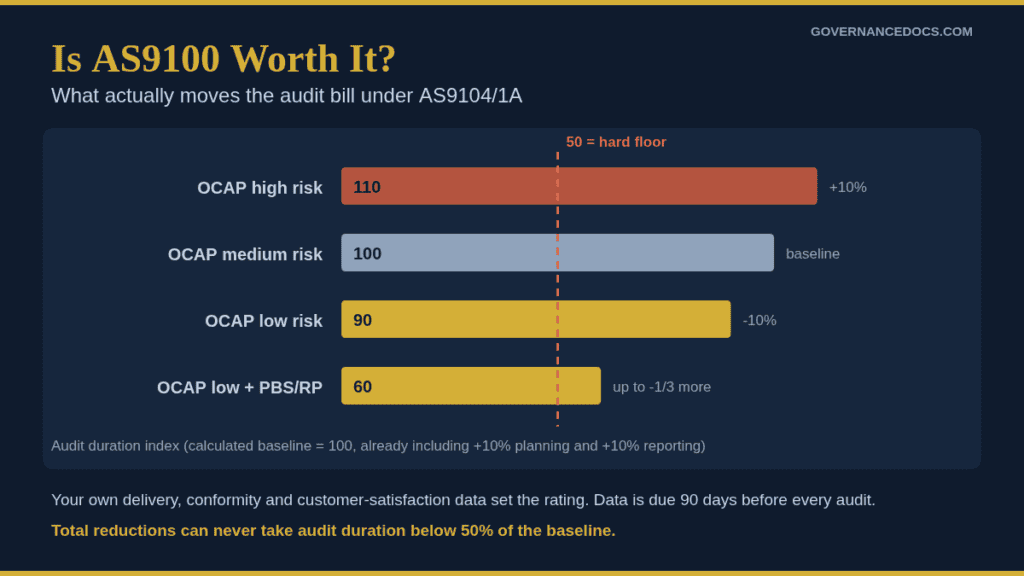
Is AS9100 worth it? For most aerospace suppliers the honest answer is that the certificate is not a marketing asset, it is an entry ticket — and the interesting part is what happens after you hold it. AS9100 is the only major quality scheme that prices your next audit off your own performance data. Run the system properly and the audit bill falls by up to half. Buy the certificate and coast, and you pay a 10% surcharge for the privilege. That mechanism, not the plaque on the wall, is what decides whether the investment returns anything.
This guide gives the decision in one table, summarises the three-year cost, then spends most of its length on the two levers that almost nobody explains to a first-time buyer: the Organization Certification Analysis Process and Performance Based Surveillance. It also covers who is not eligible, what the certificate does not buy you, and whether to certify now or wait for IA9100. Is AS9100 worth it in your case? The table below settles most of it in a minute.
AS9100 is a customer requirement, not a legal one. No civil aviation authority requires it, and it does not substitute for a regulatory approval. So the verdict depends almost entirely on who buys from you and who you want to buy from you.
| Your situation | Verdict | Why |
|---|---|---|
| A prime or tier-one customer has named AS9100 in a contract or supplier manual | Yes, without analysis | The cost of the audit is a rounding error against the revenue you lose by being removed from the approved supplier list |
| You machine, fabricate or assemble parts and want aerospace work you do not have yet | Yes | Roughly 31,300 sites already hold an AQMS certificate. It is table stakes for a request for quote, not a differentiator |
| You are an MRO or continuing-airworthiness organisation | Yes, but AS9110, not AS9100 | Certifying to the wrong standard in the series is a rejected certificate, not a cheaper one |
| You buy parts and resell them into aerospace without transforming them | AS9120 | Distribution has its own standard and its own audit scope |
| You hold ISO 9001, sell mostly outside aerospace, and no customer has asked | Not yet | Spend the money on the ISO 9001 system until an aerospace customer creates the demand |
| You are design-only, a test house or a pure service provider with no manufacturing | Check eligibility first | The standard you are eligible for follows your scope of certification, and some scopes fit none of the three |
The audit half of the bill is not negotiable in the way buyers expect. Audit duration for AS9100 comes from the IAQG scheme document AS9104/1A, which fixes the day count for each headcount band, adds a minimum 10% for audit planning and a further minimum 10% for report writing, and then permits only a short, closed list of reductions. Certification bodies set the day rate; they do not set the days.
For a single-site supplier with 10 to 50 people, budget roughly $10,000 to $20,000 in certification body fees across the first three-year cycle, and $20,000 to $45,000 all-in once implementation support is included. Those are typical ranges, not quotes. The IAQG certificate fee is a separate $700 per certified standard, charged at initial certification and again at each recertification. Our AS9100 certification cost breakdown does the day-count arithmetic band by band, so this article does not repeat it.
Is AS9100 worth it at that price? Hold the shape of the number in mind rather than the number itself: the certification body is usually the smaller half of the total, and the system you build is the larger half. That matters for the question of whether AS9100 is worth it, because the larger half is the part that generates the return.
Here is the part that changes the answer to is AS9100 worth it more than any other single fact. Every other certification scheme charges you the same for a well-run system and a barely-compliant one. The aerospace scheme does not. AS9104/1A caps total audit-time reductions at 50% of the calculated baseline, and it names the only three ways to get there: a process applicability review for processes you genuinely do not perform, the risk analysis described below, and Performance Based Surveillance. Nothing else counts.
| Lever | Effect on audit duration | What it requires from you |
|---|---|---|
| Planning and report writing | Minimum +10% and +10%, always added | Nothing. It is built into the calculation |
| OCAP risk rating — high | +10% | Poor delivery, conformity or customer-satisfaction results, or late data |
| OCAP risk rating — medium | No change | The IAQG expects around 85% of certified organisations to land here |
| OCAP risk rating — low | -10% | Metrics that meet or exceed your own goals, and a credible internal audit programme |
| Process applicability review | Reduction for processes not performed | An accurate, evidenced scope of certification |
| Performance Based Surveillance / Recertification | Substantial up-front reduction, reported at up to a third | One completed three-year cycle plus the eligibility list below |
| Floor on all reductions combined | Cannot fall below 50% of baseline | The scheme’s hard limit |
The Organization Certification Analysis Process is a performance-based risk assessment that runs before every initial, surveillance and recertification audit. Under AS9104/1A clause 9.1.10 the data must reach your certification body at least 90 days before the audit starts. The package is specific: your interaction of processes, your internal audit programme and the latest internal audit reports and findings, your latest management review information, on-time delivery goals and actuals, conformity of delivered product goals and actuals, customer satisfaction goals and actuals, customer complaints and feedback, any product safety issues, site and employee counts, your scope of certification, and a list of any additional aerospace standards you work to such as AS9102 for first article inspection or AS9146 for foreign object debris prevention.
The IAQG’s own OASIS knowledgebase describes how the OCAP tool calculates audit duration from those inputs, rating complexity, internal audit, delivery, conformity, customer satisfaction and the effectiveness of your processes at the previous audit as exceeding, meeting or falling below goal. The outcome is one of three things: 10% added, no change, or 10% taken off.
Two consequences bear directly on whether AS9100 is worth it, and both are worth stating plainly. Missing the 90-day window does not delay the audit, it changes its price. And if the information you submit turns out to be inaccurate, the auditor raises a nonconformance — so there is no upside in flattering your own metrics. A supplier who already measures on-time delivery and conformity honestly gets a discount for work they were doing anyway. A supplier who does not measure them at all pays a surcharge and then has to build the measurement system to escape it.
PBS/RP is the larger prize and the reason the three-year view understates the return. Entry is not available at initial certification. You qualify only after completing a full AQMS cycle, and then you must show:
Read that list as a specification rather than a hurdle. It is a description of a quality function that would be worth having with no certificate attached, and the scheme pays you to build it. Asked over a six-to-nine-year horizon rather than a three-year one, is AS9100 worth it becomes a far easier question: years one to three are the expensive ones, and a supplier who runs the system properly buys down the cost of years four onwards. A supplier who treats the certificate as paperwork pays full price forever, plus the occasional 10%.
Three things, and only one of them is the document itself. Anyone answering is AS9100 worth it by listing generic quality benefits has missed all three.
A listing that primes actually check. Every accredited AS9100, AS9110 and AS9120 certificate is entered in OASIS, the IAQG database administered by the Performance Review Institute. It is not optional: PRI states that if a certified supplier refuses to be part of the OASIS database, certification bodies are required by the IAQG to revoke the certificate. Buyers search that directory. A certificate that is not in it does not exist commercially.
Audit data you can choose to show. OASIS holds audit assessment data, not just certificate status, and access to it is controlled by your own OASIS administrator rather than being open to the world. That makes it an asset you can spend: granting a prospective customer read access to a clean audit history is a far stronger answer to a supplier questionnaire than any brochure. Most suppliers never think to use it.
A defined scheme instead of a certificate market. Aerospace certification runs under the Industry Controlled Other Party scheme, with auditor competence governed by the AS9104 series and audit days fixed by the scheme rather than by whoever quotes cheapest. The practical effect is that your customers treat an AS9100 certificate as evidence in a way they do not always treat a generic ISO 9001 certificate. If you want the clause-by-clause difference, see our comparison of AS9100 vs ISO 9001.
Do the arithmetic on exclusion rather than on benefit, because that is where the money is. Take a 25-person shop budgeting toward the middle of the range: about $15,000 in certification body fees over the first cycle and about $18,000 in implementation, internal audit training and staff time. Call it $33,000 over three years, or roughly $11,000 a year.
Now price the alternative. A single aerospace programme worth $250,000 a year at a 12% margin contributes $30,000 a year. One contract you would otherwise be ineligible to quote covers the whole three-year investment in about 13 months. That is why the question of whether AS9100 is worth it is rarely answered by comparing the certificate against its own cost — it is answered by comparing it against the quotes you are not invited to submit.
The honest caveat: the certificate gets you invited, not selected. With roughly 31,300 certified sites in the directory, AS9100 removes a disqualifier and nothing more. Price, capability, capacity and delivery performance still decide the award.
Usually not yet, and the eligibility question comes before the cost question. Under AS9104/1A the standard you certify to follows your scope of certification, and the three are not interchangeable:
| Standard | Intended for | Typical mistake |
|---|---|---|
| AS9100 | Organisations that design, develop or provide aviation, space and defence products and services, including post-delivery activities such as maintenance, spare parts or materials for their own products | Treating it as the default for any aerospace-adjacent business |
| AS9110 | Organisations whose primary business is maintenance or continuing airworthiness management for civil or military aviation articles, and OEM maintenance, repair and overhaul operations run autonomously or substantially differently from production | An MRO certifying to AS9100 and being told to add or change standards |
| AS9120 | Organisations that procure parts, materials and assemblies and resell them to aviation, space and defence customers | A stockist assuming AS9100 covers distribution |
Two further limits. The certificate is not a regulatory approval: AS9110 complements an FAA Part 145 repair station certificate, it does not replace it, and an AS9100 certificate grants no production or design approval of its own. And the site structure options were reduced to single site and multi-site, so the campus and complex structures some older guidance still describes are gone — if your quote assumes one, it is out of date. Our breakdown of AS9110 vs AS9120 covers the scope boundaries in more detail.
Certify now. Asked today, is AS9100 worth it does not depend on the revision cycle. AS9100 Rev D, published in 2016, is still the certifiable standard, and the revision that renames the series to IA9100 has not been published. The most recent certification-body guidance points to a release in 2027, following the publication of ISO 9001:2026, and the IAQG has not announced a transition period at all. Treat every date you read as a target rather than a commitment.
Waiting has a specific cost and no benefit. A revision of this kind keeps clauses 4 to 10 and expands existing requirements — product safety, counterfeit parts, sub-tier control — rather than rebuilding the management system, so a Rev D system built now transitions rather than restarts. Meanwhile every month you wait is a month you cannot quote. There is also a signal in the IAQG’s stated intention to move to more frequent, smaller updates: if that holds, the long comfortable transition windows the ISO world is used to will not be the aerospace norm, which is an argument for having a mature system before the first of them lands. Our guide to IA9100 and the 2026 revision tracks what is confirmed and what is not.
Four decisions, taken at the start, change the total materially — and they are what turns is AS9100 worth it from a marginal yes into an obvious one.
Plan on six to twelve months from a serious start to a Stage 2 audit for a small single site, driven mainly by how long it takes to accumulate records — internal audits, a management review, and the delivery and conformity data OCAP needs. The audit itself is days, not months.
You can claim conformity, and some customers accept it for low-risk supply. What you cannot do is appear in OASIS, and that is where buyers look. If the customer requirement names certification, self-declaration does not satisfy it.
Yes, in practice. AS9100 contains the full text of the underlying ISO 9001 standard plus the aerospace additions, so an AS9100 certificate covers ISO 9001 in full. Holding both separately is usually wasted money unless a non-aerospace customer specifically demands an ISO 9001 certificate.
It can. Nonconformities feed the OCAP rating that prices your next audit, and a major finding in the wrong area blocks PBS/RP eligibility for twelve months. Audit assessment data sits in OASIS, and while access is controlled by your own administrator, customers who already have permission will see it.
Yes, if aerospace is a market you intend to serve. The existing system is most of the work, so the incremental cost is the aerospace additions and the audit, not a second management system. Certifying to both separately is the wasteful option.
It can be, because audit duration scales with headcount, so the smallest band is the cheapest audit in the scheme. The constraint is not the fee, it is whether ten people can sustain an internal audit programme, management review and configuration control. If they can, the return is the same as for a larger shop. If they cannot, you will buy a certificate and then fail to keep it.
If your answer to is AS9100 worth it came out as yes, the work in front of you is documentation: a quality manual mapped to Rev D, the aerospace-specific procedures for configuration management, product safety, counterfeit-part prevention, first article inspection and special process control, and the internal audit and management review records that OCAP will ask for. Our AS 9100/9110/9120 Aerospace QMS Toolkit provides 38 editable templates covering all three standards in the series for $99, which is a sensible way to skip the blank-page stage and spend your budget on the parts of the system that only you can build.


September 28, 2026
September 28, 2026
September 28, 2026
September 28, 2026
September 28, 2026
