CART

A third-party risk assessment example shows what a finished vendor assessment looks like, which most frameworks describe only in principle. ISO/IEC 27001, NIST CSF 2.0 and DORA all say vendors must be assessed before you rely on them, but none gives you a completed one. This guide walks through a full third-party risk assessment example for a fictional payments firm about to put its customer wallets on a cloud platform, from tiering to the decision.
It follows the order our guide to the third-party risk assessment sets out: inherent risk first, then due diligence, then the risks that remain and the controls that manage them. The references are to ISO/IEC 27001:2022 controls A.5.19 to A.5.23, the NIST CSF 2.0 supply chain category GV.SC, and DORA Articles 28 to 30.
Free gap assessment
Where do you actually stand against ISO 27001?
Score every management system clause and all 93 Annex A controls, free, and get a prioritised gap list back.
Run the free ISO 27001 gap assessment → or View premium report sample
Meridian Payments (a fictional company) runs e-wallets and card top-ups for about 240,000 customers. It plans to move wallet balances, transfers and daily settlement onto Cobalt Ledger Systems (also fictional), a multi-tenant cloud platform, on a five-year contract worth about 1.2 million a year. Cobalt hosts with a public cloud provider, keeps its disaster recovery site in Europe and uses an offshore subcontractor for second-line support.
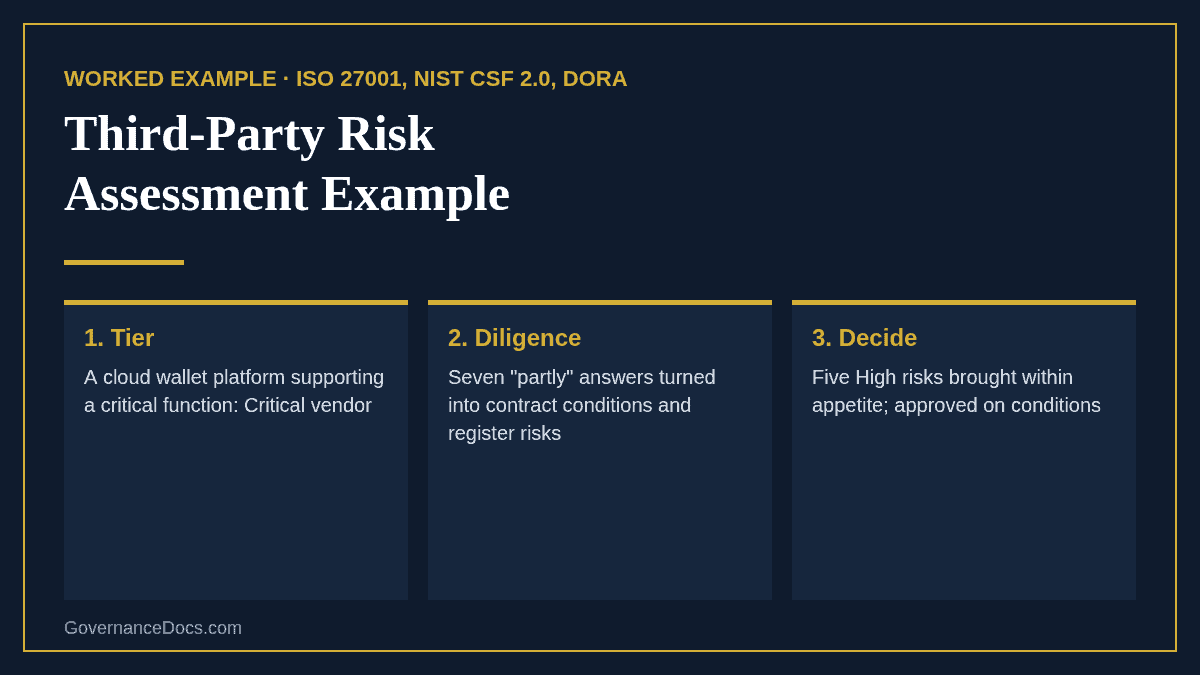
In any third-party risk assessment example, tiering comes first, because it decides how deep the rest of the assessment goes. Meridian’s answers:
| Question | Answer |
|---|---|
| Red flags from sanctions, adverse media or ownership checks? | No |
| Supports a critical or important function, or material outsourcing? | Yes |
| Holds or sees personal or confidential data? | Yes |
| Connects to our systems or holds privileged access? | Yes |
| Hard to replace quickly? | Yes (9 to 12 months to migrate) |
| Relies on subcontractors for key parts? | Yes |
| Data held or accessed outside the region? | Yes (recovery site) |
| Significant contract value or length? | Yes |
The second answer alone makes Cobalt a Critical vendor. Under DORA, a service supporting a critical or important function brings extra contract requirements (Article 30(3)) and a documented exit strategy (Article 28(8)); under the CBB and SAMA rules, material outsourcing needs the regulator’s prior approval or no-objection.
| Element | What Meridian recorded |
|---|---|
| Service | Cloud platform for wallets, top-ups and settlement, with 24/7 support |
| Function supported | All wallet balances and settlement; if it stops, customers cannot pay |
| Data and access | Customer identity and transaction history; vendor support has remote admin access |
| Locations and fourth parties | Regional cloud hosting, recovery site in Europe, offshore support subcontractor |
| Assurance | ISO 27001 certificate covering the platform; SOC 2 Type II with two closed exceptions |
| Exit route | Two alternative platforms; 9 to 12 months to move; no in-house fallback |
| Check | Answer | Note |
|---|---|---|
| Independent assurance current and in scope | Yes | Certificate scope checked against the service |
| Questionnaire checked against evidence | Partly | Only a summary of the penetration test shared |
| Vendor access least-privilege, MFA, logged | Partly | Support uses one shared admin account |
| Incident notification within an agreed time | Partly | Standard terms say “without undue delay” |
| Continuity plans tested and meet our needs | Partly | 8-hour recovery time against our 4-hour tolerance |
| Subcontractors disclosed and bound | Partly | Support subcontractor not in the contract |
| Right to audit | Partly | Pooled audits and SOC 2 reports; no individual on-site audit |
| Exit plan | Partly | Exit clause, but no written or tested plan |
| Data processing agreement; regulator approval | Yes | Both in place |
Seven “partly” answers is normal for a first pass on a critical vendor. Each one became either a contract condition or a risk in the register.
Risks are rated for Meridian and its customers on 1 to 5 scales, with Medium (9 and below) as the appetite line:
| Risk | Before | Controls | After |
|---|---|---|---|
| Long outage of the platform | 15 High | 4-hour recovery time with service credits; join the recovery test (A.5.30; DORA Art 30(3)) | 8 Medium |
| Lock-in: no orderly way out | 15 High | Written and tested exit plan; standard export format (DORA Art 28(8); GV.SC-10) | 8 Medium |
| Attack through vendor support access | 12 High | Named, time-bound accounts with session recording (A.5.15, A.8.5, A.8.15) | 4 Low |
| Slow incident notification | 12 High | Notice within four hours and investigation support (A.5.20; GV.SC-08) | 6 Medium |
| Breach at the vendor | 10 High | Full penetration test report reviewed; SOC 2 exceptions tracked (A.5.22) | 5 Medium |
Four more risks sat within appetite: limited audit rights, concentration on the same cloud host that runs Meridian’s CRM, data in the European recovery site, and undisclosed subcontracting. They stay in the register and are watched at reassessment.
The outsourcing committee advised approval on conditions: four-hour incident notice, the support subcontractor named in the contract, on-site audit rights, and a tested exit plan within six months. Cobalt accepted everything except individual on-site audits, offering pooled audits instead, and the committee accepted that with the regulator’s inspection right preserved.
The decision of this third-party risk assessment example: approve on conditions, signed by the Chief Executive, with the next reassessment in twelve months as the policy sets for a Critical vendor.
Use its structure. The tier, the checks and the risks will differ for every vendor and service.
No. A low-tier vendor with no data or access needs a light review. The tiering in step 1 is what keeps the effort proportionate.
The assessment supports the entries for the arrangement; the register of information records every ICT arrangement in the format supervisors ask for.
Record it, as Meridian did with on-site audits, and decide whether a compensating control is enough or the risk must be accepted by someone with the authority to do so.
To run your own in the same order, use our free third-party risk assessment template. For the questionnaire, contract clauses, exit plan template and registers behind it, see the TPRM Toolkit, and for what to collect, the vendor due diligence checklist.

October 19, 2026
October 19, 2026
October 18, 2026
October 18, 2026
October 15, 2026

