CART
ISO 41001 mandatory documents are the documented information ISO 41001:2018 requires a facility management (FM) system to maintain and the records it requires it to retain — and the list has a shelf life, because ISO/DIS 41001, the second edition, is at enquiry stage and will renumber some of what follows. The standard follows the harmonized structure’s rule: a small named set, and everything else left to the organisation under clause 7.5. There is no FM manual in it. What it names divides into the documents that describe the system — scope, FM policy, FM objectives, the operational planning of services — and the records that prove it operates: competence, monitoring and measurement results, internal audits, management review, nonconformity and corrective action. Two clauses are ISO 41001’s own — 7.6 organizational knowledge and 8.3 integration of services — and 10.3 preventive actions survives here after the other harmonized standards dropped it. This guide lists the ISO 41001 mandatory documents clause by clause, explains what each must contain to survive an audit, separates the FM-specific documents from the shared core, names the second tier no clause requires and every auditor asks for, and shows how to build a register that survives the edition change.
ISO 41001:2018 uses the harmonized term documented information for documents and records alike; maintain means a living controlled document, retain means a record kept as evidence. Clause 7.5 requires the documented information the standard specifies plus whatever the organisation determines is necessary for the effectiveness of the FM system — and for FM that second half is where the service specifications, SLAs, schedules and supplier records live, because clause 8 controls are only auditable through them. Terminology follows ISO 41011:2024, which replaced the 2017 vocabulary: the demand organisation, the FM organisation, the service provider, facility services and the FM policy are defined terms. Our guide to ISO 41001 covers the edition position.
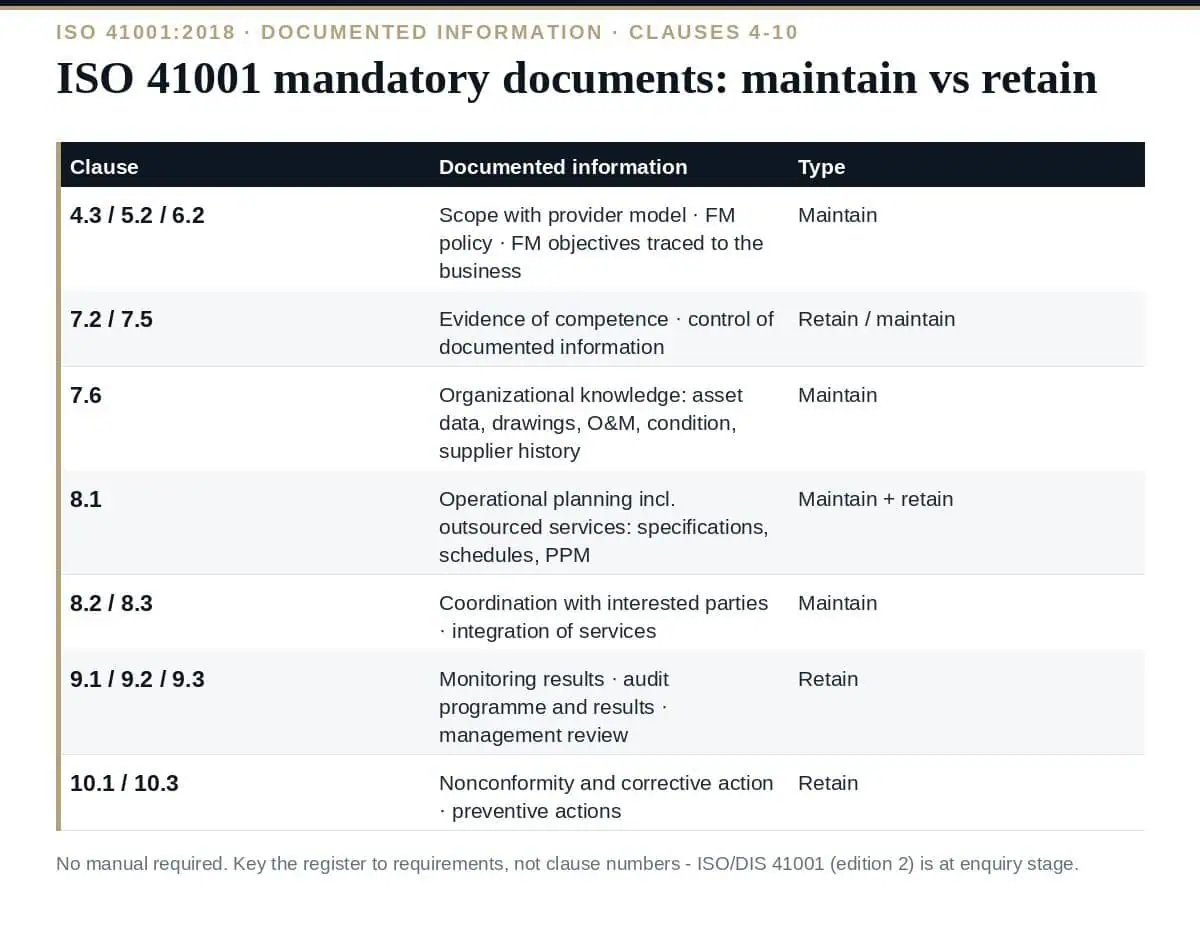
| Clause (ISO 41001:2018) | Documented information | Maintain or retain | What the auditor tests |
|---|---|---|---|
| 4.3 Scope | The scope of the FM system: sites, services, the demand organisation and the provider model — in-house, outsourced or mixed | Maintain | Scope matches the services delivered; exclusions justified |
| 5.2 Policy | The FM policy | Maintain | Commitments; framework for objectives; communicated; available to interested parties — ISO 41011 gives examples such as net zero carbon operations, workplace well-being, zero incidents, minimal whole-life cost |
| 6.2 FM objectives | The objectives and the plans to achieve them, traceable to organisational objectives | Maintain | Measurable, owned, monitored; the trace to the core business exists |
| 7.2 Competence | Evidence of competence | Retain | FM staff and, where the organisation controls them, contracted personnel; licences for statutory work |
| 7.5 Documented information | Control of documented information | Maintain | Current versions in use; obsolete specifications withdrawn |
| 7.6 Organizational knowledge | The knowledge necessary for the FM system, maintained and made available | Maintain | Asset data, drawings, O&M manuals, condition data, supplier knowledge — held by the organisation, not only by the outgoing provider |
| 8.1 Operational planning and control | Documented information to the extent necessary for confidence that processes are carried out as planned, including outsourced processes | Maintain and retain | Service specifications, schedules, PPM programmes, permits, supplier controls |
| 8.2 Coordination with interested parties | Arrangements for coordinating with the demand organisation, users and providers | Maintain | Meeting structures, change and shutdown coordination, communication plans |
| 8.3 Integration of services | How services are integrated — helpdesk, reporting, interfaces, boundary ownership | Maintain | One view of the estate across hard and soft services |
| 9.1 Monitoring, measurement, analysis and evaluation | Evidence of the results | Retain | SLA and KPI data, satisfaction, statutory compliance, condition, energy |
| 9.2 Internal audit | The audit programme and results | Retain | Programme by risk; independent auditor; findings closed |
| 9.3 Management review | Evidence of the results | Retain | Inputs including performance and strategy; decisions recorded |
| 10.1 Nonconformity and corrective action | The nonconformity, actions taken and results | Retain | Root cause; effectiveness verified |
| 10.3 Preventive actions | Actions taken to prevent potential nonconformities | Retain | ISO 41001 keeps this clause; evidence of proactive action from condition and trend data |
The clause headings are the 2018 edition’s, as listed on ISO’s Online Browsing Platform; the documented-information requirements within each are the harmonized text applied to facility management. Confirm wording against your copy, and expect the numbering to change when edition 2 publishes. Our guide to ISO 55001 covers the asset management sibling whose register overlaps this one.
| Not named by a clause | Why it is asked for | Where it lives |
|---|---|---|
| Interested-party and demand analysis | 4.2: the needs of the demand organisation and users; the input to objectives | Context file; strategy |
| Service specifications and SLAs | The 8.1 confidence evidence; ISO 41011 defines the SLA as the document agreed between demand organisation and provider on performance, measurement and conditions | Contracts |
| Asset register and condition data | 7.6 knowledge; 10.3 preventive action; the basis of maintenance planning | CAFM |
| Statutory compliance register and certificates | Legal obligations under 4.2 and 6.1; the highest-consequence records on the estate | Compliance system |
| Supplier performance reviews | 8.1 control of outsourced processes | Contract management |
| Helpdesk and incident records | 9.1 data; 8.3 integration evidence | Helpdesk system |
| FM manual | Not required; useful only as an index | Optional |
How many ISO 41001 mandatory documents are there?
Fourteen clause-level requirements in the table above: the maintained documents (scope, policy, objectives, document control, organizational knowledge, operational planning, coordination, integration) and the retained records (competence, monitoring, audit, review, nonconformity and corrective action, preventive action).
Does ISO 41001 require an FM manual?
No. Clause 7.5 requires the documented information the standard specifies plus whatever the organisation determines is necessary. A manual is optional.
Which documents are unique to ISO 41001?
Organizational knowledge (7.6), coordination with interested parties (8.2), integration of services (8.3) and preventive actions (10.3) — plus the scope’s provider model and the FM objectives’ trace to the core business.
Will the list change with edition 2?
Probably in numbering and possibly in content. ISO/DIS 41001 is at enquiry stage; key the register to requirements rather than clause numbers so the transition is a re-map, not a rebuild.
Do outsourced providers’ documents count?
Yes, where the FM organisation controls them under 8.1 and holds the knowledge under 7.6. Specifications, SLAs, performance data and asset knowledge must be the organisation’s, not only the provider’s.
Build the register from the fourteen clause requirements, mark each maintained or retained, and put the effort into the six FM-specific documents — the provider model in the scope, the traced objectives, organizational knowledge, coordination, integration and preventive action — because that is where the ISO 41001 mandatory documents differ from every other management system and where the auditor will look. Then key it to requirements, not numbers, and edition 2 becomes a column edit.
Every document in the register — FM policy and strategy, scope, objectives, demand analysis, service specifications and SLAs, the knowledge and asset register, coordination and integration procedures, the compliance register and the audit and review templates — is drafted in the ISO 41001 Facility Management Toolkit (17 templates), or start with the free templates.

September 20, 2026
September 19, 2026

September 19, 2026

September 19, 2026

September 19, 2026

