CART

Driver fatigue is the road traffic safety performance factor that ISO 39001 names among the intermediate outcomes an organisation can influence — driver fitness, alongside speed, vehicle safety, restraint use and journey planning — and it is the one that scheduling decisions create and telematics cannot see. A fatigued driver is not speeding, not distracted by a phone and not over a limit; they are asleep for two seconds at 90 km/h. ISO 39001:2012 asks the organisation, under clause 6.3, to identify the factors it can influence and, under 6.4, to set objectives and plans against them; fatigue is where the plan has to reach into rostering, delivery windows, overtime and the commercial pressure behind them. The legal floor exists — EU Regulation 561/2006 and the U.S. hours-of-service rules in 49 CFR 395 set driving-time and rest limits for heavy vehicles — but the floor is not a fatigue management system, and it does not cover the van, the sales representative or the grey-fleet commute at all. This guide sets out what the law requires, what ISO 39001 expects beyond it, the causes of driver fatigue an organisation controls, the seven elements of a fatigue management plan, how to measure it, and the findings auditors raise.
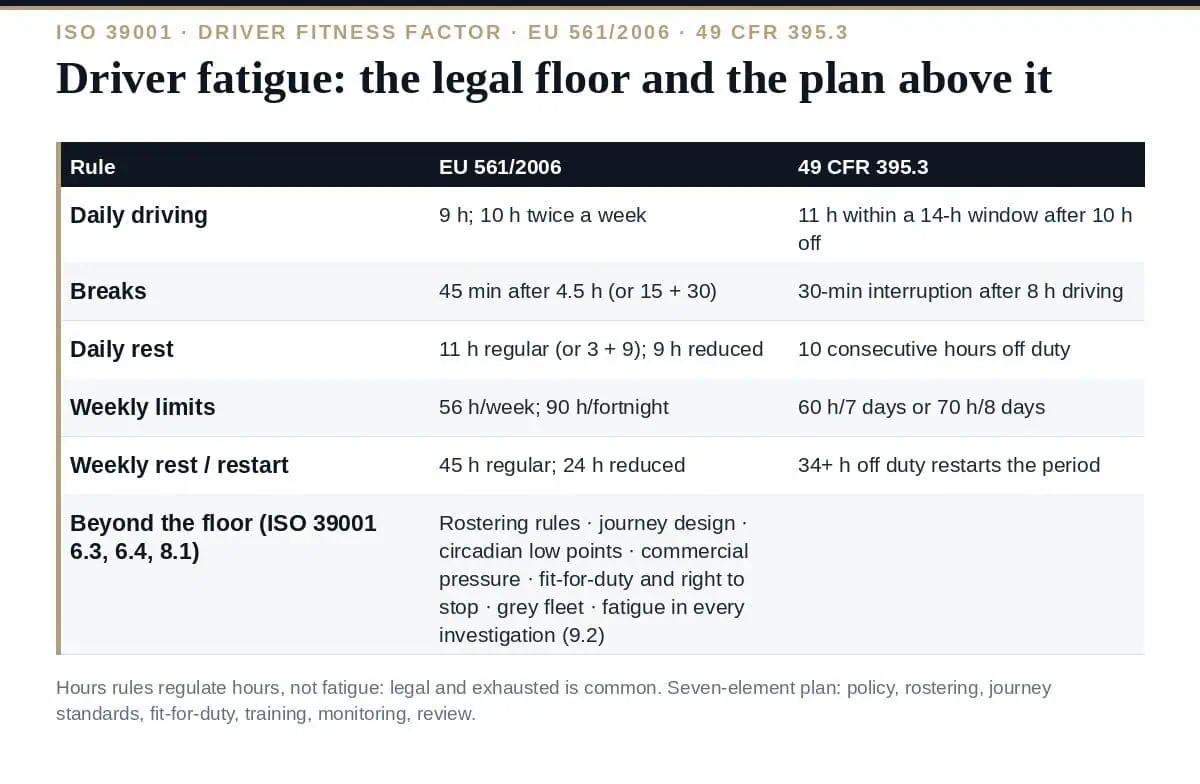
| Rule | EU Regulation (EC) No 561/2006 (consolidated 22 May 2024) | U.S. 49 CFR 395.3 (property-carrying CMV drivers) |
|---|---|---|
| Daily driving | 9 hours; extendable to 10 hours not more than twice a week (Art. 6(1)) | 11 hours of driving within a 14-hour window after 10 consecutive hours off duty (a)(1)–(3) |
| Breaks | 45 minutes after 4.5 hours of driving, or 15 + 30 minutes (Art. 7) | No driving after 8 cumulative hours without a 30-minute interruption (a)(3)(ii) |
| Daily rest | Regular 11 hours (or 3 + 9); reduced 9 hours (Art. 4) | 10 consecutive hours off duty before driving |
| Weekly limits | 56 hours driving per week; 90 hours in two consecutive weeks (Art. 6(2)–(3)) | 60 hours on duty in 7 days, or 70 in 8 days for carriers operating every day (b) |
| Weekly rest | Regular 45 hours; reduced 24 hours (Art. 4) | 34 or more consecutive hours off duty restarts the 7/8-day period (c) |
| Who it covers | Goods vehicles over 3.5 t and passenger vehicles for more than nine persons, with exemptions | Commercial motor vehicles as defined; short-haul exceptions in §395.1 |
Both regimes regulate hours, not fatigue. A driver can be legal and exhausted — a night shift after a day of childcare, a legal 10-hour drive into a 4 a.m. delivery, a van driver outside the regulations entirely. ISO 39001 starts where the tachograph stops. Our guide to ISO 39001 covers the standard’s Safe System basis.
| Clause | Requirement | Applied to driver fatigue |
|---|---|---|
| 4.1, 4.2 | Context; interested parties and requirements | Legal hours regimes; customer delivery windows; union agreements; insurer expectations |
| 6.3 RTS performance factors | Identify the exposure, intermediate and final outcome factors the organisation can influence | Driver fitness including fatigue as an intermediate factor; exposure by time of day and shift pattern |
| 6.4 RTS objectives and planning | Objectives and plans against the factors, with measures | Objectives on night driving hours, shift length, rest compliance, fatigue reports |
| 7.3 Competence; 7.4 Awareness | Competence and awareness for RTS roles | Drivers and schedulers trained to recognise and act on fatigue |
| 8.1 Operational planning and control | Controls for the identified factors | Rostering rules, journey design, rest facilities, fit-for-duty checks |
| 8.2 Emergency preparedness and response | Response to incidents | Procedure for a driver reporting fatigue mid-journey |
| 9.1 Monitoring; 9.2 Crash and incident investigation | Measure the factors; investigate crashes and incidents | Fatigue as a standing line of enquiry in every investigation |
| Cause | Where it comes from | Control |
|---|---|---|
| Time of day | Circadian low points 02:00–06:00 and mid-afternoon; night deliveries and early starts | Limit night driving; no long drives in the early-morning window; schedule breaks at low points |
| Shift length and pattern | Long days, rotating shifts, short turnarounds between duties | Maximum shift length below the legal ceiling; minimum rest between duties; forward-rotating patterns |
| Journey design | Long uninterrupted legs; unrealistic schedules; no break facilities | Journey planning with breaks built in; realistic transit times; rest stops identified |
| Commercial pressure | Delivery windows, penalties, pay by the drop or the mile | Contract terms that allow rest; pay structures that do not reward skipping breaks |
| Total workload | Loading, waiting, admin and second jobs on top of driving | Count all on-duty time; policy on secondary employment for professional drivers |
| Health and lifestyle | Sleep disorders, medication, alcohol, poor sleep environment | Fit-for-duty checks; medical screening for sleep apnoea in high-risk roles; support, not sanction, for disclosure |
| Grey fleet and non-professional drivers | Sales staff, engineers and managers driving long days after work | Journey limits and overnight rules for business travel; no driving after a full shift beyond a set hour |
Our guide to the fleet safety policy covers where the fatigue rules sit in the policy set; our guide to the journey risk assessment covers the journey-design element.
| Measure | Source | What it shows |
|---|---|---|
| Hours and rest compliance, and near-limit rates | Tachograph or ELD data; scheduling system | Whether the legal floor and the internal rules hold |
| Night and early-morning driving hours as a share of exposure | Telematics; rosters | Exposure at circadian low points |
| Fatigue reports and stops per 100 drivers | Reporting route | Whether people speak up — zero is a finding |
| Harsh events and lane departures by hour of day | Telematics; ADAS | Where fatigue shows before crashes |
| Incidents with fatigue as a contributing factor | 9.2 investigations | The final-outcome signal, normalised by exposure |
| Shift-length distribution and turnaround minimums | Rostering data | Whether the rules are actually applied |
Does ISO 39001 require a fatigue management plan?
Not by name. It requires the organisation to identify the RTS performance factors it can influence (6.3) — driver fitness including fatigue is one the standard names — and to set objectives and plans against them (6.4) with operational controls (8.1). A fatigue plan is how a fleet evidences that for this factor.
Are the EU and U.S. hours rules enough?
They are the legal floor for heavy vehicles: EU 561/2006 sets 9-hour daily driving (10 twice a week), 45-minute breaks after 4.5 hours, 11-hour daily and 45-hour weekly rest; 49 CFR 395.3 sets 11 hours driving in a 14-hour window, a 30-minute break after 8 hours, and 60/70-hour weekly limits. They do not manage time of day, shift patterns, commercial pressure or drivers outside their scope.
What about drivers of vans and cars?
Mostly outside the hours regulations, and in scope of ISO 39001 wherever the organisation influences their road use. Rostering, journey limits and overnight rules for business travel are the controls.
How do we get drivers to report fatigue?
A no-blame rule, protection of pay when a driver stops, a defined response procedure, and visible action on the causes they report. Reports rising in a new system is success, not a problem.
Should we screen for sleep disorders?
For high-exposure professional roles, medical screening for obstructive sleep apnoea and a supportive disclosure route are common controls; the plan should say who is screened, how, and what support follows.
Treat driver fatigue as a factor the organisation creates through its schedules and can therefore manage: keep the legal floor, write rostering and journey rules beneath it, give drivers a protected way to stop, measure exposure at the hours that matter, ask about fatigue in every investigation, and take the data to the people who set the delivery windows and the pay — because that is where the fatigue comes from, and where ISO 39001 expects the objective to land.
The Driver Fatigue Management Procedure, the journey management and rostering rules, the fit-for-duty declaration, the incident investigation form with the fatigue line of enquiry and the RTS objectives register are in the ISO 39001 Road Traffic Safety Toolkit, or start with the free templates.


September 20, 2026
September 19, 2026

September 19, 2026

September 19, 2026

September 19, 2026

