CART
An asset management policy is the shortest document in an ISO 55001 system and the one everything else is supposed to be consistent with. Clause 5.2 of ISO 55001:2024 makes it top management’s document: appropriate to the organisation’s purpose, consistent with the organisational plan and with other relevant policies, a framework for setting asset management objectives, a commitment to meet applicable requirements and to continual improvement, available as documented information, communicated within the organisation and available to stakeholders.
It sits between the organisational plan and the strategic asset management plan in the line of sight the standard is built around, and most policies fail not because they say the wrong thing but because they say nothing an auditor can trace — a page of values with no framework for objectives and no reference to the plan it is meant to serve. This guide sets out what clause 5.2 requires, the six sections a policy needs to satisfy it, how the policy connects to the SAMP and the objectives, what the 2024 edition’s leadership emphasis adds, and the five ways policies fail audit.
ISO 55001 places the policy under clause 5, Leadership, and the 2024 edition’s foreword names “a stronger emphasis on leadership and its role in supporting the enablement and success of the asset management system” among its changes. The policy is where that emphasis becomes a document.
The requirements follow the Harmonized Structure that every ISO management system standard now shares — appropriate to the purpose of the organisation, providing a framework for objectives, committing to applicable requirements and continual improvement, documented, communicated and available — with the asset-specific additions that give the clause its character: consistency with the organisational plan, consistency with the organisation’s other relevant policies, and appropriateness to the nature and scale of the assets and operations. ISO 55000:2024 supplies the principles the policy usually states — value, alignment, leadership and assurance. Our guide to ISO 55001:2024 covers the standard’s structure.
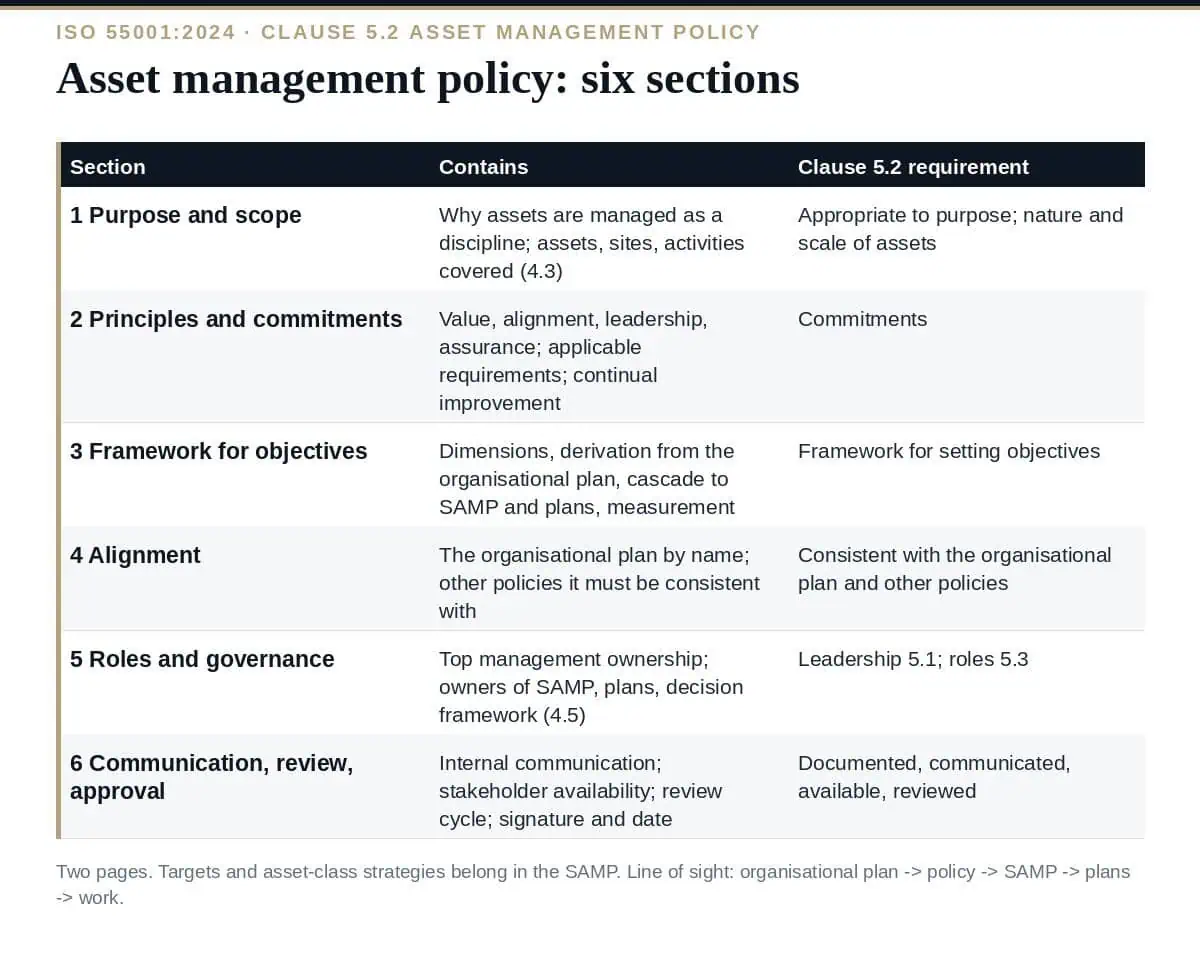
| Section | What it contains | Clause 5.2 requirement it evidences |
|---|---|---|
| 1. Purpose and scope | Why the organisation manages assets as a discipline; which assets, sites and activities the policy and the asset management system cover, consistent with the scope determined under clause 4.3 | Appropriate to the purpose of the organisation; appropriate to the nature and scale of the assets |
| 2. Principles and commitments | The principles the organisation adopts — typically value realisation, alignment, leadership and assurance from ISO 55000 — and the commitments to satisfy applicable legal, regulatory and stakeholder requirements and to continually improve the system | Commitment to applicable requirements and continual improvement |
| 3. Framework for asset management objectives | How objectives are set: the dimensions they cover (performance, cost, risk, sustainability, service), how they are derived from the organisational plan, how they cascade into the SAMP and the asset management plans, and how they are measured | Provides a framework for setting asset management objectives |
| 4. Alignment | The organisational plan the policy serves, by name and version; the other policies it must be consistent with — financial, risk, health and safety, environmental, information security — and how conflicts are resolved | Consistent with the organisational plan and with other relevant policies |
| 5. Roles and governance | Top management’s ownership; the roles accountable for the SAMP, the plans and the decision-making framework under clause 4.5; how the policy is enforced | Leadership and commitment under 5.1; roles under 5.3 |
| 6. Communication, review and approval | How and to whom the policy is communicated internally; which stakeholders receive it; the review cycle and trigger events; the approval signature and date | Documented, communicated, available to stakeholders, and reviewed |
The six sections fit on two pages. A policy longer than that is usually carrying content that belongs in the SAMP — targets, asset-class strategies, investment priorities — and a policy that changes every time the strategy changes has confused the two documents.
| Level | Document | Question it answers | Changes |
|---|---|---|---|
| Organisation | Organisational plan | What is the business trying to achieve? | With the business cycle |
| Policy | Asset management policy | What principles and commitments govern how we manage assets, and how are objectives set? | Rarely — on a change of purpose, structure or principles |
| Strategy | Strategic asset management plan | How do organisational objectives become asset management objectives, and by what approach? | With the strategy cycle, typically annually |
| Delivery | Asset management plans | What will be done to which assets, when, and at what cost? | Continuously |
The audit test is traceability in both directions: from a work order to an asset management plan, to an objective in the SAMP, to the framework in the policy, to the organisational plan — and back down. Our guide to the strategic asset management plan covers the document immediately below the policy.
Three of the 2024 changes reach the policy. The new subclause on asset management decision-making (4.5) means the policy should say that decisions are made under a documented framework with defined criteria, even if the criteria themselves live in the SAMP. The explicit distinction between risk and opportunity means a policy commitment to “manage risk” now reads as half a commitment. And the stronger leadership emphasis means the policy is expected to be visibly top management’s — approved, dated, and referred to in management review — rather than a quality manager’s draft with a chief executive’s name typed at the bottom.
What is an asset management policy under ISO 55001?
Top management’s statement of the principles and commitments governing how the organisation manages its assets, required by clause 5.2 of ISO 55001:2024: appropriate to the organisation’s purpose and the nature and scale of its assets, consistent with the organisational plan and other policies, providing a framework for asset management objectives, committing to applicable requirements and continual improvement, documented, communicated and available to stakeholders.
How long should it be?
One to two pages. Content that changes with strategy — targets, asset-class priorities, investment plans — belongs in the strategic asset management plan.
How does it differ from the SAMP?
The policy states principles, commitments and the framework for objectives; the SAMP converts organisational objectives into asset management objectives and sets the approach for the plans. The policy changes rarely; the SAMP is reviewed on the strategy cycle.
Who approves it?
Top management. The 2024 edition’s leadership emphasis expects the policy to be visibly owned by the people who own the organisational plan.
Does it need to cover risk and opportunities separately?
The 2024 edition distinguishes how the organisation addresses risk from how it addresses opportunities; a policy commitment that names only risk is incomplete.
Write the asset management policy as two pages in six sections: purpose and scope, principles and commitments, the framework for objectives, alignment with the organisational plan and other policies, roles and governance, and communication and review. Then prove the line of sight through it — from the organisational plan to an objective to a work order — because that trace, not the wording, is what the auditor samples.
The Asset Management Policy, the Asset Management Manual, the Strategic Asset Management Plan template, the RACI and Competence Matrix and the Management Review Procedure are in the ISO 55001 Asset Management Toolkit, or start with the free templates.

September 20, 2026
September 19, 2026

September 19, 2026

September 19, 2026

September 19, 2026

