CART
Inherent vs residual risk is the distinction every risk register draws and few define carefully: inherent risk is the level of risk before any controls are considered, residual risk is the level that remains after the controls in place are taken into account, and the difference between them is what the controls are worth. The terms come from the audit and COSO tradition — COSO ERM 2017 uses inherent, residual and target risk in its performance principles — rather than from ISO 31000:2018, which uses neither word: ISO 31000 assesses risk “with existing controls” and then treats it, and ISO Guide 73 defines residual risk as the risk remaining after risk treatment.
The two vocabularies describe the same movement from left to right across a heat map, but they disagree about the starting point, and that disagreement is the source of most register errors: scoring a risk with no controls at all produces a number nobody believes, and scoring the current state and calling it inherent hides what the controls do. This guide defines the terms as each framework uses them, shows how inherent, current and residual risk relate on a register, explains what each score is for — control valuation, appetite comparison, prioritisation — and sets out the errors that make inherent-versus-residual scoring meaningless.
| Term | COSO ERM 2017 / internal audit usage | ISO 31000:2018 and ISO Guide 73 | What a register records |
|---|---|---|---|
| Inherent risk | The risk to an entity in the absence of any direct or focused actions by management to alter its severity | Not used. ISO 31000 6.4.3 analyses risk considering the effectiveness of existing controls | The gross exposure: likelihood and consequence as if no control existed |
| Current risk | Not a COSO term; used in practice for the level with controls as they actually operate | The level ISO 31000 assesses — risk with existing controls, before further treatment | Likelihood and consequence given controls that are in place and working as they do |
| Residual risk | The risk remaining after management’s actions to alter its severity | Guide 73 3.8.1.6: risk remaining after risk treatment; ISO 31000 6.5.2 requires the residual risk to be documented and subjected to monitoring, review and, where appropriate, further treatment | Likelihood and consequence after planned treatment is implemented |
| Target risk | The level of residual risk the entity intends to achieve, within appetite | Implicit in risk criteria (6.3) and treatment plans (6.5) | The residual score the treatment plan is designed to reach, by a date |
The practical reconciliation: a register with four columns — inherent, current, residual and target — satisfies both vocabularies, and most organisations that use only two are collapsing current and residual into one without saying so. Our guide to ISO 31000 covers the process the columns sit in; the COSO ERM principles covers principle 11, where COSO’s severity assessment uses inherent and residual.
| Use | Which scores | What it tells you |
|---|---|---|
| Control valuation | Inherent → current | How much the existing controls are worth; which controls are key, and what happens if one fails |
| Prioritisation of treatment | Current vs criteria | Which risks are outside criteria now and need treatment |
| Appetite comparison | Residual and target vs appetite | Whether the planned treatment brings the risk within appetite, and when |
| Control testing focus | Risks with the largest inherent-to-current gap | Where a control failure would matter most; the internal audit plan |
| Assurance reporting | All four | What the organisation is exposed to, what it relies on, what it plans, and where it will be |
Without an inherent score there is no way to show what the controls do, and a register full of green residual scores tells a board nothing about how much of that green depends on a single control. Without a residual score there is no way to show that the treatment plan reaches appetite. The two-column register loses one of these; the four-column register keeps both.
The objection to inherent risk is real: “the risk of a data breach with no controls at all” is not a number anyone can estimate. The answer is to define what “no controls” means for the register.
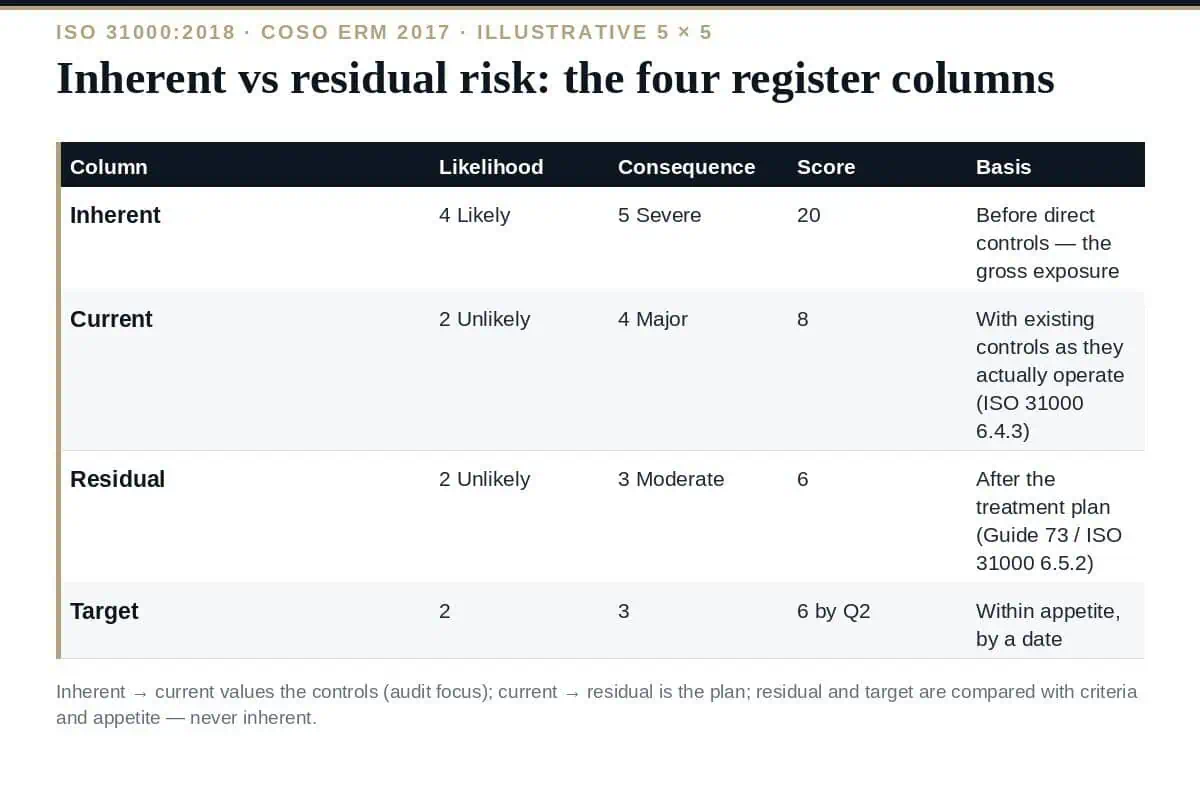
| Column | Likelihood | Consequence | Score (5 × 5) | Basis |
|---|---|---|---|---|
| Inherent | 4 Likely | 5 Severe | 20 | Customer database, 2 million records, internet-facing application, no access control, encryption, monitoring or training assumed |
| Current | 2 Unlikely | 4 Major | 8 | MFA, encryption at rest, monitoring and annual training in place and tested; consequence reduced by encryption and breach response |
| Residual (planned) | 2 Unlikely | 3 Moderate | 6 | Tokenisation of card data and data minimisation reduce the records exposed in a breach |
| Target | 2 | 3 | 6 by Q2 next year | Within the appetite threshold of 6 for data protection risks |
The inherent-to-current gap (20 to 8) values the existing controls and tells internal audit where to test; the current-to-residual gap (8 to 6) is the treatment plan; the target date is the commitment the board tracks.
What is the difference between inherent and residual risk?
Inherent risk is the level of risk before any direct controls are considered — COSO’s ‘absence of any direct or focused actions by management’; residual risk is the level remaining after treatment — ISO Guide 73’s ‘risk remaining after risk treatment’. The difference is the value of the controls.
Does ISO 31000 use the term inherent risk?
No. ISO 31000:2018 analyses risk considering the effectiveness of existing controls (6.4.3) and requires residual risk after treatment to be documented and monitored (6.5.2); ‘inherent’ and ‘gross’ are COSO and audit vocabulary. Registers reconcile the two with inherent, current, residual and target columns.
How do you estimate inherent risk realistically?
Define what ‘no controls’ means — exclude the direct controls for the risk, not the organisation’s existence — score likelihood on the activity’s exposure and consequence on the realistic uncontrolled outcome, use the same scales as the other columns, and use the result comparatively.
What is target risk?
The residual level the organisation intends to reach through its treatment plan, within appetite, by a date; COSO ERM names it, ISO 31000 implies it through risk criteria and treatment plans.
Should risk appetite be compared with inherent or residual risk?
Residual (and current). Appetite is the risk the organisation is willing to carry after controls; comparing it with inherent risk makes every risk look out of appetite.
Run inherent vs residual risk as four columns, not two: inherent as the gross exposure under a stated convention, current as the risk with controls as they actually operate, residual as the level the treatment plan reaches, and target as that level with a date — because the first gap values the controls, the second is the plan, and a register that shows only one of them is hiding the other from the board.
The four-column risk register, the risk criteria with the inherent-scoring convention, the control effectiveness assessment and the treatment plan template are in the ISO 31000 Risk Management Toolkit, or start with the free templates.


September 21, 2026

September 20, 2026

September 20, 2026
September 19, 2026

September 19, 2026

